Daily Gleanings: Q (21 November 2019)
Daily Gleanings about Occam’s Razor and how it does and doesn’t play into arguments about Q and the Synoptic Problem.
Daily Gleanings about Occam’s Razor and how it does and doesn’t play into arguments about Q and the Synoptic Problem.
Daily Gleanings from Michael Kruger about evidence for the importance of written gospel texts to the Apostolic Fathers.
Daily Gleanings about Craig Keener’s “Christobiography” and Antti Laato’s “Spiritual Meaning of Jerusalem in Three Abrahamic Religions.”
Daily Gleanings from Richard Middleton on Christian worldview and ethics and from Larry Hurtado on scribal and readerly changes.
Daily Gleanings about the publication of the proceedings from the 16th IOSCS congress and Matthew Crawford’s treatment of Eusebian canon tables.
Gleanings on perfectionism and recent articles in the Journal of Greco-Roman Christianity and Judaism.
The Center for the Study of New Testament Manuscripts has digitized 10 new gospel manuscripts, with dates ranging from the 10th to the 14th centuries. For additional details, see CSNTM’s announcement or view the manuscripts in their online library.
As I mentioned earlier, the current issue of the Journal of the Evangelical Theological Society (60.2) contains Henry Kelly’s essay on “Love of Neighbor as Great Commandment in the Time of Jesus: Grasping at Straws in the Hebrew Scriptures” (265–81). According to the abstract,
...One’s “neighbor,” generously interpreted to include everyone else in the world, even personal and impersonal enemies, looms large in the NT, especially in the form of the second great commandment, and in various expressions of the Golden Rule. The NT also contains expansive claims that neighbors have a similar importance in the OT. The main basis that commentators cite for these claims is a half-verse in the middle of Leviticus (“You shall love your neighbor as yourself,” 19:18b), as fully justifying these claims, supported by other isolated verses, notably, Exod 23:45, on rescuing the ass of one’s enemy. Relying on these verses has the appearance of grasping at straws in order to justify the words of Jesus, but it seems clear that in the time of Jesus they had indeed been searched out and elevated to new significance. John Meier has recently argued that it was Jesus himself who gave the Levitical neighbor his high standing, but because the Gospels present the notion as already known, this article suggests that it had achieved a consensus status by this time.
The most recent issue of the Journal of Biblical Literature carries Matthew Goldstone’s essay “Rebuke, Lending, and Love: An Early Exegetical Tradition on Leviticus 19:17–18” (307–21). According to the abstract,
...In this article I posit the presence of an early Jewish exegesis of Lev 19:17–18 preserved in the Tannaitic midrash known as Sifra, which is inverted and amplified in Did. 1:3–5, Q 6:27–35, Luke 6:27–35, and Matt 5:38–44. Identifying shared terminology and a sequence of themes in these passages, I argue that these commonalities testify to the existence of a shared exegetical tradition. By analyzing the later rabbinic material I delineate the contours of this Second Temple period interpretation and augment our understanding of the construction of these early Christian pericopae. In commenting on Lev 19:17, Sifra articulates three permissible modes of rebuke: cursing, hitting, and slapping. In its gloss on the subsequent verse, Sifra exemplifies the biblical injunction against vengeance and bearing a grudge through the case of lending and borrowing from one’s neighbor. The Didache, Matthew, and Luke invert the first interpretation by presenting Jesus as recommending a passive response to being cursed or slapped, and they amplify the second interpretation by commanding one to give and lend freely to all who ask. The similar juxtaposition of these two ideas and the shared terminology between Sifra and these New Testament period texts suggest a common source. By reading these early Christian sources in light of this later rabbinic work I advance our understanding of the formation of these well-known passages and illustrate the advantages of cautiously employing rabbinic material for reading earlier Christian works.
Stemming from the release of the second edition of Jesus and the Eyewitnesses: The Gospels as Eyewitness Testimony (Eerdmans, 2017), the EerdCast has a new 48-minute interview with Richard Bauckham.
HT: Rick Brannan. For other discussion of Jesus and the Eyewitnesses, see “Bauckham, ‘Jesus and the Eyewitnesses’ (2nd ed.),” “Bauckham on the Gospels as Historical Sources,” and “Gospel and Testimony.”
...Available from Eerdmans is the second edition of Richard Bauckham’s “Jesus and the Eyewitnesses: The Gospels as Eyewitness Testimony.”
For April, Logos Bible Software’s “free book of the month” and discounted companion focus on Scripture in its cultural contexts.
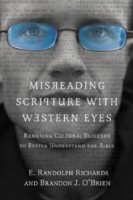 The free text is Randolph Richards and Brandon O’Brien’s Misreading Scripture with Western Eyes: Removing Cultural Blinders to Better Understand the Bible (IVP, 2012). According to the book’s blub:
 This month, Logos Bible Software’s free book is N. T. Wright’s Following Jesus: Biblical Reflections on Christian Discipleship (SPCK, 1994). The book falls into two parts:
...Part one outlines the essential messages of six major New Testament books—Hebrews, Colossians, Matthew, John, Mark, and Revelation. Part two examines six key New Testament themes—resurrection, rebirth, temptation, hell, heaven, and new life—and considers their significance for the lives of present-day disciples.
The newest volume of TC has been released, containing eight book reviews and the following articles:
HT: New Articles and Reviews in the TC Journal — Evangelical Textual Criticism
...Chris Stevens has the latest article in the Journal of Greco-Roman Christianity and Judaism, “John 9.38-39a: A Scribal Interjection for Literary Reinforcement.”
The latest reviews from the Review of Biblical Literature include:
For May, Logos Bible Software’s free volume is N. T. Wright’s The Lord and His Prayer(SPCK, 1996). The paired discount volume is Wright’s Paul: Fresh Perspectives (SPCK, 2005).
...The latest reviews from the Review of Biblical Literature include:
Select Works of Simon Kistemaker
Now garnering interest in Logos Bible Software’s prepublication program are 6 volumes of select works from Simon Kistemaker. The collection mostly contains items related to the Gospels but also includes an edited volume of hermeneutics essays and a survey of Calvinist history and thought.
...[caption id=“attachment_2129” align=“alignright” width=“87”]  Richard Bauckham[/caption]
In his 2006 Jesus and the Eyewitnesses, Richard Bauckham suggests:
...that we need to recover the sense in which the Gospels are testimony. This does not mean that they are testimony rather than history. It means that the kind of historiography they are is testimony. An irreducible feature of testimony as a form of human utterance is that it asks to be trusted. This does not mean that it asks to be trusted uncritically, but it does mean that testimony should not be treated as credible only to the extent that it can be independently verified. There can be good reasons for trusting or distrusting a witness, but these are precisely reasons for trusting or distrusting. Trusting testimony is not an irrational act of faith that leaves critical rationality aside; it is, on the contrary, the rationally appropriate way of responding to authentic testimony. . . . It is true that a powerful trend in the modern development of critical historical philosophy and method finds trusting testimony a stumbling-block in the way of the historian’s autonomous access to truth that she or he can verify independently. But it is also a rather neglected fact that all history, like all knowledge, relies on testimony. ( 5; italics original)
To commemorate the 400th anniversary of the King James Version in 2011, Crossway released an edition of the English Standard Version’s Gospels illuminated by Makoto Fujimura ( cloth, leather). A short introduction to the project is available below (HT: Bryant Owens):
...New Testament Studies (Photo credit: Wikipedia)
The latest issue of New Testament Studies includes:
New Testament Studies (Photo credit: Wikipedia)
In addition to John Barclay’s tribute to Friedrich Avemarie, the latest issue of New Testament Studies includes:
Joseph Ratzinger (Pope Benedict XVI)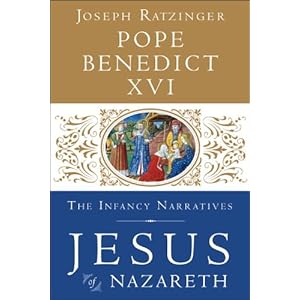
Today, the Pope’s new book on the Gospels’ infancy narratives goes on sale. The volume is the third of a three-part series. The two earlier volumes have respectively discussed the narratives from Jesus’ baptism to his transfiguration (2007) and the final entrance into Jerusalem to the resurrection (2011). The present volume:
...On the web:
Image via Wikipedia
The next issue of the Biblical Theology Bulletin includes:
In the latest contribution to the Journal of Greco-Roman Christianity and Judaism, Richard Carrier discusses “Thallus and the Darkness at Christ’s Death”:
...It is commonly claimed that a chronologer named Thallus, writing shortly after 52 CE, mentioned the crucifixion of Jesus and the noontime darkness surrounding it (which reportedly eclipsed the whole world for three hours), and attempted to explain it as an ordinary solar eclipse. But this is not a credible interpretation of the evidence. A stronger case can be made that we actually have a direct quotation of what Thallus said, and it does not mention Jesus. (185)
New Testament Studies
The latest issue of New Testament Studies includes:

In this clip, Richard Bauckham briefly abstracts his own argument from Jesus and the Eyewitnesses:
[youtube=http://www.youtube.com/watch?v=292NTf1cCNw&hl=en_US&fs=1]

Klyne Snodgrass discusses a “hermeneutics of identity.” Snodgrass repeatedly observes the New Testament’s concern with issues related to identity.