UC Classics podcast
The University of Cincinnati’s Department of Classics has a podcast with several noteworthy episodes, including an interview with Jodi Magness and a whole series on Qumran and Judean Desert texts. ...
At theLAB, Rick Brannan has an interesting post about the most frequently cited verses in a selection of systematic theologies. Especially by comparison with the size of the two testaments, New Testament references vastly outnumber Old Testament references (90% to 10% in the top 100 most frequently cited texts). As a supplement to the analysis, it might also be interesting to see a bibliography of the exact systematic theologies involved in the accounting would be interesting, as well as whether there would be some way of calculating whether the sample size is large enough to be statistically significant (e.g., within the publication date ranges represented). ...
The MLA has started a new initiative, named the Humanities Commons. According to the Commons’s introductory webinar registration page, Imagine a humanities network with the sharing power of Academia.edu, the archival quality of an institutional repository, and a commitment to using and contributing to open source software. Now imagine that this network is not-for-profit. It doesn’t want to sell your data or generate profit from your intellectual property. That’s Humanities Commons. Run by a nonprofit consortium of scholarly societies, Humanities Commons wants to help you curate your online presence, expand the reach of your scholarship—whatever form it may take—and connect with other scholars who share your interests. ...
EpiDig has a substantial Zotero collection of digital epigraphy resources. HT: AWOL
The Dropbox blog has a short essay on the downsides of trying to multitask. Rather than multitasking, deep and singular focus is just what the doctor ordered, but in our hyper-connected world, it isn’t always easy…. You could chuck all your gadgets and move to the woods, but luckily you don’t need to get that drastic. Experts say you can begin to retrain your brain and take advantage of deep focus by concentrating on one thing at a time, managing your use of technology, and reframing the “instant-response” expectations of your colleagues—and yourself. ...
Michael Hyatt has a good, short discussion of the value of reading old books. Much of Michael’s post is framed around C. S. Lewis’s discussion of the same topic in his introduction to Athanasius’s On the Incarnation, an online version of which Michael has spotted on this page. ...
Stemming from the release of the second edition of Jesus and the Eyewitnesses: The Gospels as Eyewitness Testimony (Eerdmans, 2017), the EerdCast has a new 48-minute interview with Richard Bauckham. HT: Rick Brannan. For other discussion of Jesus and the Eyewitnesses, see “Bauckham, ‘Jesus and the Eyewitnesses’ (2nd ed.),” “Bauckham on the Gospels as Historical Sources,” and “Gospel and Testimony.” ...
Under the heading of “keeping your Greek and Hebrew skills sharp,” Mark Ward has some helpful advice about creating a serial biblical text in Logos Bible Software. For instance, if you create a series between BHS and NA28 and you have BHS open, you can type a New Testament passage in the go box and run straight there. Logos will treat the two resources as combined. ...
The Baker Illustrated Bible Dictionary is a helpful resource with some useful enhancements in the Logos Bible Software version.
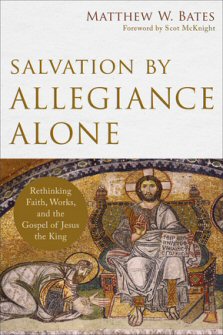
Over at the Logos Academic Blog, Tavis Bohlinger now has up the second part of his interview with Matthew Bates about his Salvation by Allegiance Alone: Rethinking Faith, Works, and the Gospel of Jesus the King (Baker, 2017). This interview portion focuses much more on Bates’s particular proposal in the volume. ...
On Academia.edu, Matthew Larsen has posted his recent Journal for the Study of the New Testament essay on “Accidental Publication, Unfinished Texts and the Traditional Goals of New Testament Textual Criticism.” Peter Head has started a related discussion on the Evangelical Textual Criticism Blog. ...
I’ve previously mentioned Michael Graves’s Biblical Interpretation in the Early Church (Fortress, 2017). The text is part of a projected 8-volume series. Logos Bible Software now has the first four volumes available for order via their pre-publication program. This includes ...
Stimulated by Craig Hill’s Servant of All: Status, Ambition, and the Way of Jesus (Eerdmans, 2016), Nijay Gupta provides some interesting excerpts and reflections. He comments, in part, I have learned that I cannot control what other people think of me. I need to be driven by what I think is right, keep my pride in check, have friends and colleagues who can graciously call me out if I err, and pass on generosity to those who are struggling just as others have lifted me up. I think we will be held back from doing all that we are called to do if we are overly occupied with how our work “looks” to others. I try to believe that if we commit ourselves to quality (and not just quantity), we should not be embarrassed with our work and productivity. ...
Mike Aubrey has provided an excerpt from an essay of his in Linguistics & Biblical Exegesis (Lexham, 2016). The excerpt strives carefully to work out a middle ground that is neither wholly on the side of theological lexica nor on that of James Barr’s critique of them. ...
I’ve recently had a discussion over at the Zotero forums that brought to light a couple interesting points that I hadn’t been aware of: There’s currently in beta a major update to Zotero 5.0, which includes several important feature changes. The beta isn’t quite ready for prime time yet but should be “very soon.” Included in this update is the new Citation Style Language (CSL) processor that should remedy the comma and period placement issue in the forum thread. Frank Bennett has provided an updated CSL processor that can be installed in a current Zotero 4 version via the Propachi Vanilla plugin. For additional discussion of Zotero here, see this tag. ...
It’s certainly not new, but I recently came across the GTD Times blog run by the David Allen Company. The most recent entry is the first part of a keynote in which Allen overviews his approach to “getting things done,” as covered more fully in his book by the same title ( affiliate disclosure). If academia should ever manifest itself as an environment with an overabundance of demands, Allen’s advice may be a helpful starting point in adequately coming to grips with that situation. ...
Theses and dissertations in Classics from the University of Iowa are available openly on the web. HT: AWOL
In commenting about theLAB’s interview with Matthew Bates, I overlooked having saved a couple other recent interactions with his Salvation by Allegiance Alone: Rethinking Faith, Works, and the Gospel of Jesus the King(Baker, 2017): Nijay Gupta provides a friendly, largely affirmative, and probing set of thoughts. Thomas Schreiner expresses his appreciation for some of the volume’s core impulses but suggests that the proposals gains fail to outweigh the corresponding deficiencies that it creates. For additional, related discussion, see Bates interview at theLAB and Bates, “Salvation by allegiance alone” and some theological forebears. ...
At the Logos Academic Blog, Tavis Bohlinger has the first part of an interview series with Matthew Bates. This first entry takes its main impetus from Bates’s Salvation by Allegiance Alone: Rethinking Faith, Works, and the Gospel of Jesus the King (Baker, 2017) but also ranges into other areas of personal background, research productivity, and spiritual formation. ...
In its first 2017 issue (currently behind the society membership paywall), the Journal of the Evangelical Theological Society has a version of Daniel Wallace’s presidential address from the 2016 annual Evangelical Theological Society meeting: “Medieval Manuscripts and Modern Evangelicals: Lessons from the Past, Guidance for the Future” (5–34). Per the abstract, the essay focuses on ...
In the last 2016 issue of the Bulletin for Biblical Research, Aaron Chalmers has an interesting essay on “the influence of cognitive biases on biblical interpretation” (467–80). Chalmers approaches the question from the perspective of cognitive psychology and focuses on “five key cognitive biases”—namely, “confirmation bias, false consensus effect, in-group bias, functional fixedness, and the illusory truth effect” (467). ...
Available in Fortress’s Ad fontes series is Biblical Interpretation in the Early Church, edited by Michael Graves.
Available from Eerdmans is the second edition of Richard Bauckham’s “Jesus and the Eyewitnesses: The Gospels as Eyewitness Testimony.”
Late last year, Books and Culture interviewed Richard Hays about some of his story and common themes in his work. Stemming from Hays’s similarly titled book, one of the questions addressed is “How is reading backward in a figural sense different from reading prophecy forward?” In response, Hays comments, in part, ...
Two latest posts on the Tyndale New Testament blog contain some interesting further comments about the edition and its preparation.
I’ve recently had the opportunity of working through Andrew Babyak’s article, “A Teaching Strategy for a Christian Virtual Environment” ( Journal of Research in Christian Education 24, no. 1 [2015]: 63–77). A number of Babyak’s reflections are quite insightful and helpful. According to the abstract, The current landscape in education is changing rapidly as online learning programs are experiencing great growth. As online learning grows, many professors and students are entering into new learning environments for the first time. While online learning has proven to be successful in many cases, it is not a journey upon which Christian professors or students should begin without some preparation. This article articulates a basic Christian teaching strategy by providing recommendations for those who are entering the online environment for the first time or desire to improve their online teaching effectiveness. These principles and recommendations are presented so that Christian professors can create Christian virtual environments in which they can have a significant impact on their students’ spiritual development in an online environment. It is critical that professors design their courses with the needs of online students in mind, ensuring that students of all learning styles are able to excel. Furthermore, professors should understand that online teaching often takes more time than traditional methods of teaching, increasing the importance of clear instructions and communication with students. ...
SBL Press continues to be quite responsive on its blog to questions submitted by users of the SBL Handbook of Style. One of the latest examples is the Press’s clarification of how to format citations from J.-P. Migne’s Patrologia Graeca. The 161-volume series is available online in the public domain from various sources, including Patristica.net and Document Catholica Omnia. ...
Noteworthy freebies from Faithlife this month include: Bush, Beckham, and Due, Live in Liberty: The Spiritual Message of Galatians (Lexham, 2015) Chrysostom, Homilies on the Acts of the Apostles (Parker, 1851) à Kempis, De la imitación de Cristo [ The Imitation of Christ, Spanish translation] (Subirana, 1908)
Discoveries in the Judaean Desert, vol. 32 has two codices that provide photographs, transcriptions, an introduction, notes, and catalog of variants for 1QIsaa.
Michael Hyatt has a helpful interview with Cal Newport, author of Deep Work: Rules for Focused Success in a Distracted World (Grand Central, 2016). According to Newport, Focus is now the lifeblood of this economy. Why? Because focus is rare and distraction abundant. As Hyatt comments, ...