J. David Stark
  • Start Honing Your Craft 
  • About
  • Blog
  • Resources
  • Store
  • Vita 
  • 🔍

Blog

Hyatt’s Interview with Newport

Cal Newport, “Deep Work” cover Michael Hyatt has a helpful interview with Cal Newport, author of Deep Work: Rules for Focused Success in a Distracted World (Grand Central, 2016). According to Newport,

Focus is now the lifeblood of this economy.

Why? Because focus is rare and distraction abundant. As Hyatt comments,

Even when we think we are focusing, we usually aren’t. When we work intensely on one problem but do quick “check backs” on email, social media, and the like during breaks, we run into the problem of “attention residue.” Those things come back with us when we return to our core work and make it harder to focus on our most important tasks.

...

May 1, 2017 Â· 1 min Â· J. David Stark

Biblical (Digital) Humanities

Biblicalhumanities.org is

a community of computer scientists, Bible scholars, and digital humanists collaborating to create open digital resources for biblical studies. Our emphasis is on open resources for biblical languages, such as morphologically tagged texts, treebanks, and lexicons. We hope that these resources will be used widely for teaching, research, and resources used to read and study the Bible.

The initiative sponsors the B-Greek and B-Hebrew forums, but I had missed the memo that these were connected to the larger Biblicalhumanities.org entity. The website provides a selective but helpful dashboard of current resources.

...

April 28, 2017 Â· 1 min Â· J. David Stark

Tyndale House GNT

Tyndale House Greek New Testament cover The Tyndale House Greek New Testament is set to be released with Crossway on 15 November 2017, just in time for SBL. The text is already available for pre-order on Amazon.

According to the volume’s blurb, the principal editors, Dirk Jongkind and Peter Williams, have

taken a rigorously philological approach to reevaluating the standard text—reexamining spelling and paragraph decisions as well as allowing more recent discoveries related to scribal habits to inform editorial decisions.

...

April 27, 2017 Â· 1 min Â· J. David Stark

Oxyrhynchus Papyri Transcriptions from the Paulines

Geoffrey Smith has made available offprints of new transcriptions for 5258 (132), containing fragments of Eph 3:21–4:2, and 5259 (133), containing fragments of 1 Tim 3:13–4:8. Dated to the third century, 5259 (133) is the earliest published witness to 1 Timothy.

HT: Andreas Köstenberger, Brice Jones, Rick Brannan

April 25, 2017 Â· 1 min Â· J. David Stark

Keener on Isaac and Ishmael

Craig Keener has an interesting post on the interaction between Isaac and Ishmael in Gen 21:10. The post mainly outlines the major options for what the text might be suggesting and promises two followups that will discuss “Isaac’s line being Abraham’s heir [as well as] the propriety of Abraham sending Hagar and Ishmael away.”

April 19, 2017 Â· 1 min Â· J. David Stark

Better attention than a goldfish

Goldfish image A recent study commissioned by Microsoft Canada found, disturbingly, that the human participants’ average attention spans had fallen to 8 seconds, a shorter time frame than measured for goldfish ( Evernote, New York Times). One of the major suspected drivers of these results is the propensity of the participants to use a mobile device while “paying attention” to something else.

Even comparatively minor distractions apparently have a compound effect on concentration and productivity ( Computers in Human Behavior, Evernote). What is required to avoid this effect will be different in different contexts ( Knowledge@Wharton). But, being as “present” as possible in or to whatever situation we’re engaged in should be helpful in at least raising for ourselves the question of whether the amount of time and life invested into something—e.g., a ding, chirp, buzz, beep, or blink—is actually worth the return that might be expected from that thing.

...

April 18, 2017 Â· 1 min Â· J. David Stark

Organizing Logos

Logos Bible Software logo On the Logos Talk blog, Mark Ward has a helpful post about techniques for having a “spring cleaning” in your Logos Bible Software library.

The “collections” tool is especially helpful for associating different resources that logically go together for a given purpose (e.g., multiple sets of Patristic texts, multiple grammars).

The “hide resources” feature can also be quite useful if a base package or collection upgrade was more cost effective but included some resources that weren’t useful. For instance, my library has several different BHS texts, but I’ve hidden some of the older or unmaintained versions so that the main one is always and only the one that appears when I go to open that text in my library.

...

April 14, 2017 Â· 1 min Â· J. David Stark

Searching Highlights in Logos

Mark Ward helpfully describes the syntax of searching for particular highlighting styles in Logos Bible Software.

April 13, 2017 Â· 1 min Â· J. David Stark

INTERSECT searches in Logos

Logos Bible Software logo Recently, my Logos Bible Software homepage popped up this helpful video that explains searching with the “INTERSECT[S]” operator. I have largely missed the memo on this operator until now, but it is apparently a one-stop shop that will cover operations otherwise performed by “WITHIN”, “ANDEQUALS”, and “WITHIN 0 WORDS/CHARS”.

April 11, 2017 Â· 1 min Â· J. David Stark

Remedying overcommitment

Michael Hyatt headshotMichael Hyatt has a new post where he provides seven strategies for remedying or avoiding overcommitment. All seven suggestions are good and worth considering. But, the capstone suggestion, number seven seems particularly key:

I couldn’t go on at my previous pace, and I didn’t have to. I began building new boundaries around my margin. And I started enforcing them to keep myself out of trouble. This is where the rubber meets the road for us all. We must deliberately build margin into our lives, or our busy seasons will become permanent. No one else is going to do this for us.

...

April 10, 2017 Â· 1 min Â· J. David Stark

Journal of Greco-Roman Christianity and Judaism (2016)

During 2016, the “Journal of Greco-Roman Christianity and Judaism” published several noteworthy articles.

April 6, 2017 Â· 1 min Â· J. David Stark

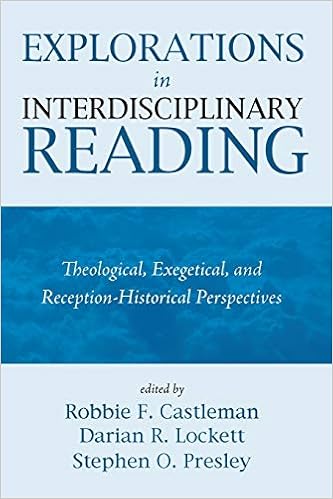
Castleman, Lockett, and Presley, eds., “Explorations in interdisciplinary reading”

Explorations in Interdisciplinary Reading: Theological, Exegetical, and Reception-historical Perspectives, edited by Robbie Castleman, Darian Lockett, and Stephen Presley, appeared under Wipf and Stock’s Pickwick in 2017.
The volume includes essays assembled through the Institute for Biblical Research’s recently concluded study group on Biblical Theology, Hermeneutics, and Theological Disciplines.

A key among the essays in the volume is the interplay between Scripture as situated in its own historical contexts and its continuing reception as a canonical whole.

...

April 5, 2017 Â· 2 min Â· J. David Stark

OpenOffice Turabian (7th ed.) Template

Writers who use OpenOffice.org and need to comply with Turabian’s Manual for Writers(7th ed.) may find this template helpful in cutting out some of the grunt work involved in setting up a Turabian-style paper in OpenOffice.org. Suggestions for improving this template are, of course, very welcome.

April 5, 2017 Â· 1 min Â· J. David Stark

Free Richards, O’Brien with discount on Bailey @Logos

For April, Logos Bible Software’s “free book of the month” and discounted companion focus on Scripture in its cultural contexts.

Richards and O’Brien, The free text is Randolph Richards and Brandon O’Brien’s Misreading Scripture with Western Eyes: Removing Cultural Blinders to Better Understand the Bible (IVP, 2012). According to the book’s blub:

Brandon O’Brien and E. Randolph Richards shed light on the ways Western readers often misunderstand the cultural dynamics of the Bible. They identify nine key areas where modern Westerners have significantly different assumptions about what is going on in a text than what the context actually suggests. Drawing on their own cross-cultural experience in global missions, the authors show how greater understanding of cultural differences in language, time, and social mores allow us to see the Bible in fresh and unexpected ways.

...

April 4, 2017 Â· 2 min Â· J. David Stark

Evernote on minimalism

Although I’ve moved away from using Evernote, their blog still often features interesting content. Recently they’ve had a three-part series on minimalism that heavily leans on Joshua Becker ( part 1, part 2, part 3). Among Joshua’s reflections that the series provides are a two-part suggestion for “saying ‘no’ effectively:

1. Figure out and write down what your priorities and values are, even if you’re in a hectic environment. Ask yourself some tough questions like “Who is the person I want to become? Would my 40-year-old self approve of this?” 2. Realize and understand this: “If you say yes to something, you’re saying no to everything else. If you want to say no to something, realize that allows you to say yes to something else.” This is the true power of saying no: freeing up time so you can say yes to the things that matter most to you.

...

April 3, 2017 Â· 1 min Â· J. David Stark

Free to focus—on sleep?

Free to Focus logo

Free to Focus logo

As part of Michael Hyatt’s Free to Focus resource set, he’s made available three treat the significance for productivity of adequate, quality sleep:

  • Interview with Shawn Stevenson (video)
  • Unleash Nature’s Secret Weapon eBook (PDF)
  • 13 Essential Keys to a Good Night’s Sleep (PDF)

Shawn Stevenson’s core business certainly falls in an area where probably few biblical scholars will care to follow. But some of the implications of the expertise that he has for broader productivity applications may indeed prove informative and helpful.

...

March 31, 2017 Â· 1 min Â· J. David Stark

Tips for better focus

Michael Hyatt headshotMichael Hyatt has a helpful discussion of 10 tips for enabling better focus.  For me, suggestions 5 (“Take email 
 software offline.”) and 6 (“Put on music that helps facilitates concentration.”) have tended to prove particularly helpful.

For Michael’s discussion of these tips and the other 8 he provides, see his original post.

March 30, 2017 Â· 1 min Â· J. David Stark

Faith, demonstration, and friendship

Fathers of the Church book cover In his On the Advantage of Believing, Augustine reflects on the necessity of belief but also on the danger of being overly credulous. He comments, in part,

But now consider, you will say, whether in religion we ought to believe. For even if we concede that it is one thing to believe, another to be credulous, it does not follow that there is no fault in believing in religious matters. What if it be a fault to believe and to be credulous, as it is to be drunk and to be a drunkard? One who holds this view as certain, it seems to me, could have no friend. For, if it is base to believe anything, either he acts basely who believes a friend, or, in not believing a friend at all, I do not see how he can call either him or himself a friend
. For there is also no friendship at all unless something is believed which cannot be demonstrated by positive reasoning. ( Util. cred. 10.23–24)

...

March 29, 2017 Â· 1 min Â· J. David Stark

Gaventa, “Romans 13”

SBL Press logo The newest issue of the Journal of Biblical Literature contains Beverly Gaventa’s essay, “Reading Romans 13 with Simone Weil: Toward a More Generous Hermeneutic.” According to the abstract,

Simone Weil’s interpretation of the Iliad as a “poem of force” has resonances with Rom 1–8, reinforcing the question of how Rom 13:1–7 belongs in the larger argument of Romans. Seeking a generous reading of 13:1–7 along the lines of the generosity Weil extends to the Iliad, I first take Pharaoh as an example of Paul’s understanding of the relationship between God and human rulers and then propose that Paul’s treatment of human rulers coheres with his refusal in this letter to reify lines between “insider” and “outsider.” I conclude with a reflection on the need for generosity in scholarly research and pedagogy.

...

March 28, 2017 Â· 1 min Â· J. David Stark

Eliminating distractions

Photograph of Michael Hyatt Going along with his Free to Focus material, Michael Hyatt has a helpful, free resource about eliminating distractions. The material in this resource is designed to work with and complement the content Michael delivers in his webinar, The 7 Deadly Sins of Productivity: The Hidden Habits Undermining Your Performance (And How to Change Them).

March 27, 2017 Â· 1 min Â· J. David Stark

Productivity assessment

Photograph of Michael Hyatt Michael Hyatt has a free productivity assessment tool that provides “a free analysis of your overall [personal productivity] score and a breakdown of the productivity areas you evaluated.”

A followup email provides a short set of tips for improving, and the analysis page that displays after the survey is completed provides access to sign up for a free webinar on the “7 deadly sins of productivity.” I attended the webinar recently, and it does provide a good number of suggestions revolving around focus as a primary key to productivity.

...

March 24, 2017 Â· 1 min Â· J. David Stark

The chemistry of studying the Dead Sea Scrolls

This Decoded Science article has an interesting treatment of some of the chemical elements of the study of the Dead Sea Scrolls, particularly the Copper Scroll. The article’s conclusion provides the reminder that

Archaeology allows us to look into the past. However, in order for scientists to properly examine and maintain artifacts, it’s necessary to preserve them. In many cases, chemistry makes that possible.

For the full article, see Decoded Science. HT: Jim Davila.

...

March 22, 2017 Â· 1 min Â· J. David Stark

Raymond Brown

In going through some old bookmarks, I rediscovered this site that Matthew Montonini has assembled to collect works by Raymond Brown that are available online, in whole or in part.

March 21, 2017 Â· 1 min Â· J. David Stark
onenote

Digital notekeeping

Michael Hyatt has a good discussion of digital notekeeping tools, a.k.a. “Evernote alternatives.” As even the nomenclature might suggest, Michael opts for Evernote.

I used Evernote for quite some time too but transitioned several months back to OneNote. I haven’t ever gotten particularly sold on Apple devices, so Apple-only alternatives were out by default.

While I enjoyed Evernote, their limiting their “Free” plan to sync with two devices was the main impetus for me to look for a change. I already had OneNote at the Office and via an Office 365 University subscription at home. Plus, OneNote has both iOS and Android apps, as well as a web version, so it was a logical option.

...

March 20, 2017 Â· 2 min Â· J. David Stark

In the (e)mail: Nanos and Zetterholm, “Paul within Judaism”

In addition to the Boccacci and Segovia and Rodríguez and Thiessen volumes, Fortress Press has kindly, if accidentally, passed along a review copy of Mark Nanos and Magnus Zetterholm’s edited volume Paul within Judaism: Restoring the First-century Context to the Apostle(2015). According to the book’s blurb:

In these chapters, a group of renowned international scholars seek to describe Paul and his work from “within Judaism,” rather than on the assumption, still current after thirty years of the “New Perspective,” that in practice Paul left behind aspects of Jewish living after his discovery of Jesus as Christ (Messiah). After an introduction that surveys recent study of Paul and highlights the centrality of questions about Paul’s Judaism, chapters explore the implications of reading Paul’s instructions as aimed at Christ-following non-Jews, teaching them how to live in ways consistent with Judaism while remaining non-Jews. The contributors take different methodological points of departure: historical, ideological-critical, gender-critical, and empire-critical, and examine issues of terminology and of interfaith relations. Surprising common ground among the contributors presents a coherent alternative to the “New Perspective.” The volume concludes with a critical evaluation of the Paul within Judaism perspective by Terence L. Donaldson, a well-known voice representative of the best insights of the New Perspective.

...

March 17, 2017 Â· 2 min Â· J. David Stark

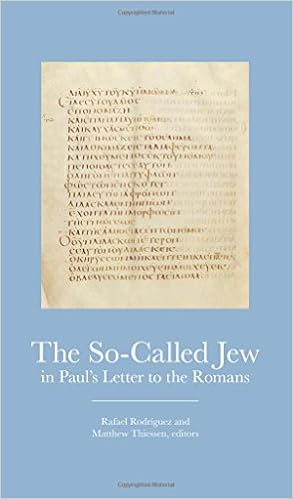
In the (e)mail: Rodríguez and Thiessen, “The So-called Jew”

Cover image forIn addition to Boccaccini and Segovia’s Paul the Jew, inbox recently saw the arrival from Fortress Press of a review copy of Rafael Rodríguez and Matthew Thiessen’s edited volume The So-Called Jew in Paul’s Letter to the Romans(2016). According to the book’s blurb:

Decades ago, Werner G. KĂŒmmel described the historical problem of Romans as its “double character”: concerned with issues of Torah and the destiny of Israel, the letter is explicitly addressed not to Jews but to Gentiles. At stake in the numerous answers given to that question is nothing less than the purpose of Paul’s most important letter. In The So-Called Jew in Paul’s Letter to the Romans, nine Pauline scholars focus their attention on the rhetoric of diatribe and characterization in the opening chapters of the letter, asking what Paul means by the “so-called Jew” in Romans 2 and where else in the letter’s argumentation that figure appears or is implied. Each component of Paul’s argument is closely examined with particular attention to the theological problems that arise in each.

...

March 16, 2017 Â· 2 min Â· J. David Stark

In the (e)mail: Boccaccini and Segovia, “Paul the Jew”

Boccaccini and Segovia, “Paul the Jew” cover In my email recently, I found Fortress Press had kindly provided a review copy of Gabriele Boccaccini and Carlos Segovia’s edited volume Paul the Jew: Rereading the Apostle as a Figure of Second Temple Judaism(2016). According to the book’s blurb:

The decades-long effort to understand the apostle Paul within his Jewish context is now firmly established in scholarship on early Judaism, as well as on Paul. The latest fruit of sustained analysis appears in the essays gathered here, from leading international scholars who take account of the latest investigations into the scope and variety present in Second Temple Judaism. Contributors address broad historical and theological questions—Paul’s thought and practice in relationship with early Jewish apocalypticism, messianism, attitudes toward life under the Roman Empire, appeal to Scripture, the Law, inclusion of Gentiles, the nature of salvation, and the rise of Gentile-Christian supersessionism—as well as questions about interpretation itself, including the extent and direction of a “paradigm shift” in Pauline studies and the evaluation of the Pauline legacy. Paul the Jew goes as far as any effort has gone to restore the apostle to his own historical, cultural, and theological context, and with persuasive results.

...

March 15, 2017 Â· 1 min Â· J. David Stark

Textual criticism in Logos

Software certainly can’t replace expertise when filtering through text-critical data. But it can provide some useful assistance in pulling that data together.

For an overview of some of the text-critical tools available in Logos Bible Software ( affiliate disclosure), check out the overview in this video for how to use the textual criticism section in the exegetical guide.

https://www.youtube.com/embed/LA7QH4wCn0s

March 14, 2017 Â· 1 min Â· J. David Stark

Gadamer on the FĂŒhrerprinzip

In a note in his Truth and Method, H.-G. Gadamer comments,

The notorious statement, “The party (or the Leader) is always right” is not wrong because it claims that a certain leadership is superior, but because it serves to shield the leadership, by a dictatorial decree, from any criticism that might be true. ( 389n22)

That is, at least from Gadamer’s viewpoint, the slogan he quotes is not so much a statement of fact, but a statement of what must necessarily be articulated as a statement of fact, despite any possible indications to the contrary.

...

March 13, 2017 Â· 1 min Â· J. David Stark

Trial versions of Biblical Studies software

Software that supports biblical and theological scholarship can be pricey, but Mark Hoffman has helpfully collected links to trial versions.

March 10, 2017 Â· 1 min Â· J. David Stark
« Prev 18/49 Next 20/49 Â»
© J. David Stark · 2026 · Affiliate Disclosures · Comment Policy · Operating License · Privacy Policy