TNT Updates
Two latest posts on the Tyndale New Testament blog contain some interesting further comments about the edition and its preparation.
Two latest posts on the Tyndale New Testament blog contain some interesting further comments about the edition and its preparation.
Geoffrey Smith has made available offprints of new transcriptions for 5258 (132), containing fragments of Eph 3:21–4:2, and 5259 (133), containing fragments of 1 Tim 3:13–4:8. Dated to the third century, 5259 (133) is the earliest published witness to 1 Timothy.
...Software certainly can’t replace expertise when filtering through text-critical data. But it can provide some useful assistance in pulling that data together.
For an overview of some of the text-critical tools available in Logos Bible Software ( affiliate disclosure), check out the overview in this video for how to use the textual criticism section in the exegetical guide.
...The newest volume of TC has been released, containing eight book reviews and the following articles:
HT: New Articles and Reviews in the TC Journal — Evangelical Textual Criticism
...
Peter Gurry reflects on the “logical impossibility” criterion that feeds into the Editio Critica Maior’s account of “variants”:
...The Editio Critica Maior defines a “variant” as a reading that is both “grammatically correct and logically possible.” If it doesn’t meet these two criteria it is marked with an f for Fehler (= error). Neither criteria is completely objective, but then most of the errors so recorded in the ECM are pretty obvious gibberish. Occasionally, however, one finds cause…
Via the ETC blog and Peter Gurry, Elijah Hixson has an informative overview of Codex Rossanensis’s presence in recent news.
...The following is a guest post from Elijah Hixson. Elijah is currently writing his doctoral thesis on Codex Rossanensis and two other purple codices at the University of Edinburgh under the supervision of Paul Foster. When I saw last week that Rossenansis had recently be restored I asked Elijah if he would give us a…
The Center for the Study and Preservation of the Majority Text has a website dedicated to its edition of the Greek New Testament. The website also provides a copy of that edition as a free PDF.

The Byzantine Greek New Testament (BGNT)The Byzantine Greek New Testament (BGNT), is a new scholarly edition of the Greek New Testament. The BGNT base text is compiled from a consensus of readings from the Byzantine Kr or family 35 textform. It will serve as the comparison base text for both our online and future printed edition…
...
From Dan Wallace:
...New manuscripts digitized by the Center for the Study of New Testament Manuscripts (CSNTM) have just been added to our searchable collection. These include 10 new manuscripts from the National Library of Greece in Athens, the site of our ongoing digitization project for 2015–16.
From ETC:
Today, the Center for the Study of New Testament Manuscripts (CSNTM) launched their new and vastly improved website at CSNTM.org.
For details about the reboot see ETC’s post and the CSNTM website.
...Chris Stevens has the latest article in the Journal of Greco-Roman Christianity and Judaism, “John 9.38-39a: A Scribal Interjection for Literary Reinforcement.”
The latest reviews from the Review of Biblical Literature include:
The latest reviews from the Review of Biblical Literature include:
Rob Bradshaw has made available George Milligan’s essay, “The Greek Papyri: With Special Reference to Their Value for New Testament Study,” Journal of the Transactions of the Victoria Institute 44 (1912): 62–78.
On the web:
On the web:
Nestle-Aland, Novum Testamentum Graece, 28th ed.
The 28th edition of the Nestle-Aland Greek New Testament, including the critical apparatus, is now available on Logos Bible Software’s prepublication program. For Peter Williams’ review of the edition earlier this week, see here.
Codex Bezae with text Luke 23:47–24:1 (Photo credit: Wikipedia)
Logos Bible Software is now taking $0.00 pre-orders for their upcoming edition of Codex Bezae. Among the manuscript’s noteworthy characteristics,
...It is the oldest-known manuscript containing the story of the adulterous woman found in John 7–8, as well as a longer ending of the Gospel of Mark. There are also several apparent additions, including a story found nowhere else of Jesus addressing a man found working on the Sabbath.
On the web:
Christian Askeland highlights four PhD studentships available at the University of Aberdeen set to engage the topic of “Authority and Texts: Concepts and Use,” considering questions like:
...What constitutes authority and provides authenticity to texts and what is the role of textual criticism? How should authoritative texts (including religious, legal, and other texts), be used and interpreted, and how is this issue determined? Is investigation of the contextual meaning of texts at their time of composition necessary to understanding and respecting their authority, or do different criteria exist which influence readings of texts?
Dan Wallace digests the SBL meeting discussion of the recently announced Romans fragment in the Green collection.
Codex Sinaiticus Facsimile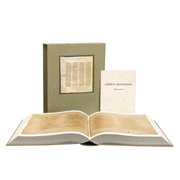
It’s still on the pricey side, but CBD currently has the Hendrickson facsimile of Codex Sinaiticus on sale for $499, $300 off the normal retail price. According to CBD’s product page,
...Hendrickson Publishers, in conjunction with the British Library, is now releasing a limited number of full color facsimiles of the entire Codex Sinaiticus. This edition includes both the Old and New Testaments, represented by “life size” pages (13.5" x 16.5").
Totaling 828 pages, the facsimile edition comes in hardback binding accompanied by a sturdy slip case that is designed to provide support the weight of the facsimiles pages (app. 25lbs) and prevent them from tearing away from the back binding, as is common with many large hardback books. Finally the Codex Sinaiticus facsimile edition comes with a 32 page booklet that provides a brief outline of the history, discovery and immense value of this rare piece of history.
Stanley Porter has the latest article in the Journal of Greco-Roman Christianity and Judaism, “Early Apocryphal Non-Gospel Literature and the New Testament Text.” Porter concludes:
...There are several observations to make regarding the text of the Greek New Testament in the apocryphal non-Gospel literature. (1) The evidence for the Greek New Testament in the apocryphal non-Gospel literature is not as great as one might expect, and this includes the apocryphal Acts, Epistles (for which there is no text early enough or in Greek for consideration) and Apocalypses. . . . (2) The Acts and apocalyptic apocryphal literature is relatively sparse in its use of the Greek New Testament, and is virtually nothing compared to that of the apocryphal Gospels. . . . (3) The evidence from the apocryphal non-Gospel literature is the same as that for the apocryphal Gospels—in other words, that the text of the Greek New Testament was relatively well established and fixed by the time of the second and third centuries. (197–98)
The latest reviews from the Review of Biblical Literature include:
New Testament and Cognate Studies
Second Temple Judaism
...On the web:
On the web:
Via Michael Bird:
New within the past few days in Hobby Lobby’s collection of biblical antiquities is a small fragment from Rom 9– 10 (HT: Peter Williams). For the fragment’s brief spot on CNN, see here. The fragment’s proposed date is the mid-second century. The side displayed in the CNN footage contains five lines. The image quality isn’t fantastic, but the last letters on the fragment look like they could be ΕΚΤΟΥ, which could seem to put that part of the fragment at Rom 9:12 or 21. If line 3 begins ΚΡΙ and line 4 ends ΗΣ*ΣΟΥ, could we then be looking at Rom 9:20–21 here?
...Through its Academic Bible website’s homepage, the German Bible Society is offering a free download of the brochure Textual Research on the Bible: Introductions to the Scholarly Editions of the German Bible Society. The Society envisions that the brochure will
...provide insight into this fascinating field of research. We have particularly in mind the interests of first-year students, who might benefit from a basic introduction like this. Thus we invite lecturers of exegesis and textual criticism to make use of this brochure in their classrooms. (Letter from the German Bible Society and Nida Institute)

 The Tyndale House Greek New Testament is set to be released with Crossway on 15 November 2017, just in time for SBL. The text is already available for pre-order on