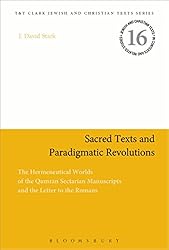
Sacred Texts and Paradigmatic Revolutions in Paperback, Part 2
A while ago, I mentioned Sacred Texts and Paradigmatic Revolutions would be coming to paperback. That format is now available at about a fourth or less of the MSRP for the hardback.
The first recourse for the Anatolian Jews under [social, political, and religious] pressure was not an appeal to ‘legalism’, but to ‘selective works of the law’, as is implied by the phrase ἔργα νόμου. The only appearance of this phrase from that time outside of Paul is found in 4QMMT. The use of ‘works of the law’ there confirms both that Paul is in (indirect) dialogue with those familiar with Essene terminology and that selectivity is in view. Although he speaks to a different audience about a different problem regarding the law in Romans, when Paul uses the phrase ἔργα νόμου in Romans 3, the immediate context is quite similar to what he addresses in Galatians. It is, in both cases, a matter of the righteousness of God, as expressed in the faithfulness of Christ (πίστις Χριστοῦ). This faithfulness of Christ suffices for both Jew and Gentile (pagan), who are equally condemned—in Galatians they are condemned for trying to supplement that faithfulness with a perverted version of the law, and in Romans they are condemned for perverting the law by their very efforts to fulfill it through a selective participation in it ( 96).
Klaus B. Haacker, “Der Geist und das Reich im Lukanischen Werk: Konkurrenz oder Konvergenz zwischen Pneumatologie und Eschatologie?”
Anthony Le Donne, “The Improper Temple Offering of Ananias and Sapphira”
Richard Last, “The Election of Officers in the Corinthian Christ-Group”
Joel R. White, “‘Peace and Security’ (1 Thessalonians 5.3): Is It Really a Roman Slogan?”
Thomas R. Blanton, “The Benefactor’s Account-book: The Rhetoric of Gift Reciprocation according to Seneca and Paul”
David J. Downs, “Justification, Good Works, and Creation in Clement of Rome’s Appropriation of Romans 5–6”
James A. Kelhoffer, “Reciprocity as Salvation: Christ as Salvific Patron and the Corresponding ‘Payback’ Expected of Christ’s Earthly Clients according to the Second Letter of Clement”
Benjamin R. Wilson, “Taking up and Raising, Fixing and Loosing: A Chiastic Wordplay in Acts 2.23b–24”
On the Web (January 23, 2013)
On the web:
Nijay Gupta provides the table of contents for the latest issue of the Journal for the Study of Paul and His Letters.
Robert Woods reflects on significance and dissonance in Great Books.
Abram K-J discusses the Göttingen Septuagint ( 1, 2, HT: Tommy Wasserman).
New Testament Studies 59, no. 1
New Testament Studies (Photo credit: Wikipedia)
In addition to John Barclay’s tribute to Friedrich Avemarie, the latest issue of New Testament Studies includes:
Kelly R. Iverson, “Incongruity, Humor, and Mark: Performance and the Use of Laughter in the Second Gospel (Mark 8.14–21)”
Izaak J. de Hulster, “The Two Angels in John 20.12: An Egyptian Icon of Resurrection”
Isaac W. Oliver, “Simon Peter Meets Simon the Tanner: The Ritual Insignificance of Tanning in Ancient Judaism”
Andrzej Gieniusz, “‘Debtors to the Spirit’ in Romans 8.12?: Reasons for the Silence”
L. L. Welborn, “‘That There May Be Equality’: The Contexts and Consequences of a Pauline Ideal”
Sigurd Grindheim, “Not Salvation History, but Salvation Territory: The Main Subject Matter of Galatians”
Andreas Dettwiler, “La lettre aux Colossiens: une théologie de la mémoire”
Régis Burnet, “Pour une Wirkungsgeschichtedes lieux: l’exemple d’Haceldama”
Gyula Vattamány, “Kann das Salz verderben? Philologische Erwägungen zum Salz-Gleichnis Jesu”
The folks at Zondervan sponsored this year’s Institute for Biblical Research meeting reception. In addition to the deserts there, they very kindly provided attending members with a copy of the recent (2012) Counterpoints volume on Paul, edited by Michael Bird. According to the publisher’s description:
...
Ben Dunson and I were at Westminster together for a bit before his Durham days, and it’s wonderful to see that this volume is now available. For those who want to take a look at the original thesis, Durham has it archived here.
Review of Biblical Literature Newsletter (October 31, 2012)
Markus Lau, “Geweißte Grabmäler. Motivkritische Anmerkungen zu Mt 23.27–28”
Matthias Adrian, “Der Blick durch die enge Tür: Lk 13.22–30 im architekturgeschichtlichen Kontext der städtischen domus”
Jonathan Bourgel, “Les récits synoptiques de la Passion préservent-ils une couche narrative composée à la veille de la Grande Révolte Juive?”
George H. van Kooten, “’Εκκλησία τοῦ θεοῦ: The ‘Church of God’ and the Civic Assemblies (ἐκκλησίαι) of the Greek Cities in the Roman Empire: A Response to Paul Trebilco and Richard A. Horsley”
Alexander N. Kirk, “Building with the Corinthians: Human Persons as the Building Materials of 1 Corinthians 3.12 and the ‘Work’ of 3.13–15”
Michael Bachmann, “Identität bei Paulus: Beobachtungen am Galaterbrief”
Baur's Paul(us) on Google Books
Ferdinand Christian Baur.
Google Books has available two full PDF copies ( 1, 2) of the original German of F. C. Baur’s Paulus, der Apostel Jesu Christi (1845). Also available are the first and second volumes of second edition of the English translation produced by Eduard Zeller ( Paul, the Apostle of Jesus Christ, 2 vols., 1873–1875). In addition, the book’s second, posthumously produced German edition (2 vols., 1866–1867) from which Zeller translated the English version is available in a single, combined PDF that contains both of its volumes.
...
Letting Paul Be Paul
In his Romans commentary, F. F. Bruce gives the following, sound advice for those who want to understand Paul better:
We may agree or disagree with Paul, but we must do him the justice of letting him hold and teach his own beliefs, and not distort his beliefs into conformity with what we should prefer him to have said ( 136).
...
Licona on Paul’s View of Believers’ Possible Fates
[caption id=“attachment_6870” align=“alignright” width=“80” caption=“Michael Licona”] [/caption]In his new monograph, The Resurrection of Jesus, Michael Licona summarizes as follows how he sees Paul conceiving of believers’ possible ends:
Paul sees two options before believers. Some believers will die prior to the parousia and will become disembodied until the general resurrection, while believers alive at the parousia will have their earthly bodies clothed with their new resurrection body made by God. Paul certainly prefers to avoid the former. But his faith gives him confidence that, if he dies prior to the parousia, he will be with the Lord, although in a disembodied state, which he prefers over present life in the earthly body. And being with Christ is what matters most to Paul ( 435–36).
...
Donnerstag Digest (December 2, 2010)
This week in the biblioblogosphere:
Bob Cargill notes that, on December 11, the National Geographic Channel will re-air its special on “Writing the Dead Sea Scrolls.”
Brian LePort hypertextually ponders Derridean non-extra-textuality and deconstruction, and he notes twenty-nine doctoral theses that the University of Durham has recently made available.
Michael Bird shows how to benefit most from the new SBL Greek New Testament and notes that the new Journal for the Study of Paul and His Letters now has its own blog.
Google Editions are poised to hit the e-book market later this month and allow fee-based full access to copyrighted titles. For some additional details and thoughts, see Blog Kindle and Google Books Help.
Paul in Acts and the Letters
While expressing doubts about the correctness of the “New Perspective(s) on Paul,” Stan Porter makes the following, interesting observation about the New Perspective(s) vis-à-vis the question of continuity between the portraits of Paul in Acts and the letters:
If this new perspective is correct, then it would appear that the Jewish elements that typify the account in Acts, such as Paul’s beginning much of his local preaching with a visit to the synagogue . . . , his agreeing to participate in the ritual in Jerusalem ( Acts 21:17–26 . . . ), and his defenses focusing upon his continuity with Judaism, all point toward continuity between the Paul of Acts and of the Letters. Thus, the new perspective on Paul would appear to render this criticism of [E.] Haenchen [that Luke is unaware of Paul’s answer to the question of the law and the Gentile mission] no longer valid ( 191).
Kirk Lowery ponders current developments in the peer review process for scholarly publications.
Scot McKnight prepares his readers for a change of blogging address.
Larry Hurtado uploads an essay on Martin Hengel’s impact on English-speaking, New Testament scholarship.
Charles Halton considers cartographic hermeneutics and some of their implications for readers of biblical texts.
Snodgrass on a “Hermeneutics of Identity”
Klyne Snodgrass discusses a “hermeneutics of identity.” Snodgrass repeatedly observes the New Testament’s concern with issues related to identity.
2010 ETS Call for Papers
The call for papers for the 2010 annual Evangelical Theological Society meeting is available. Proposals are due by March 31. This year’s theme will be “Justification by Faith” with plenary addresses by John Piper, N. T. Wright, and Frank Thielman, a lineup that promises to be highly engaging. Moreover, this year’s program will also include, on Friday morning, a two-hour panel discussion with the plenary speakers.
...
Jesus as Paul’s Hermeneutical Key
Regarding the place of Jesus in Paul’s hermeneutic, James Aageson suggests that
[Paul’s] hermeneutic is inherently theological and is governed by his experience on the Damascus road and its legacy. From a persecutor of the early church, Paul was transformed into a man with a mission to carry the name of Jesus to the Gentile world. The divine mystery that was revealed to Paul in Christ opens for him new ways of reading and listening to the ancient texts of the Jewish people. His belief in Christ is both an experience and a conviction that, in his eyes, allows him to comprehend the “true” meaning of the religion of his people and their sacred texts ( 155–56).
...
Online Papers and Lectures
Michael Bird comments that the papers for next week’s Louven conference, “New Perspectives on Paul and the Jews,” are available for download. Of the presenters listed in the program, only Anne-Marie Reijnen’s paper on " Kosmos and Creation in Paul’s Thought" is not currently available.
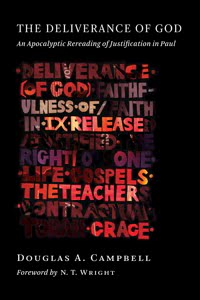
In this scholarly book Douglas Campbell pushes beyond both “Lutheran” and “New” perspectives on Paul to a noncontractual, “apocalyptic” reading of many of the apostle’s most famous-and most troublesome-texts.
Campbell holds that the intrusion of an alien, essentially modern, and theologically unhealthy theoretical construct into the interpretation of Paul has produced an individualistic and contractual construct that shares more with modern political traditions than with either orthodox theology or Paul’s first-century world. In order to counteract that influence, Campbell argues that it needs to be isolated and brought to the foreground before the interpretation of Paul’s texts begins. When that is done, readings free from this intrusive paradigm become possible and surprising new interpretations unfold.
...
2009 ETS Paper
I just received an email confirmation that my paper, “Jeremiah 9:23–24 and Rewritten Bible: A Window on Paul’s Hermeneutic,” has been accepted for this year’s national ETS meeting in New Orleans. A brief abstract follows:
The genre of rewritten Bible was reasonably common in the Second Temple period. Although rewritten Bible did not fully substitute for Israel’s scripture, this genre still provides evidence for biblical interpretations that were current in the Second Temple period. It also facilitates a greater understanding of how these interpretations could be employed in various contexts. Two Pauline texts in which the rewritten Bible tradition provides such assistance are 1 Cor 1:31 and 2 Cor 10:17, which both cite Jer 9:24. In this case, reading Jer 9:24 in concert with the rewritten Bible tradition, such as the one that the Targum of the Prophets exhibits, sheds light on Paul’s text and on the hermeneutical approach that he exhibits toward Jer 9:24 as he attempts to speak to the unique challenges of the Corinthians’ situation.