
The Unique Ways τὲ καί Clarifies Paul’s Audience in Romans
By itself, τὲ καί can’t indicate who Paul was writing to in Romans. But the phrase puts on the table important pieces to the puzzle.
By itself, τὲ καί can’t indicate who Paul was writing to in Romans. But the phrase puts on the table important pieces to the puzzle.

“Sacred Texts and Paradigmatic Revolutions” illustrates how modern readers can work to recover Second Temple interpretive contexts.
In a special podcast, Chris Jones and I discuss the challenging issues of Romans’s audience and the letter’s perspective on predestination.
Katja Kujanpää discusses Paul’s quotation in Rom 11:35 and argues that it comes not from Job 41:3 but from Isa 40:14.
Larry Hurtado reviews Archibald Hunter’s “Paul and His Predecessors.” The full text of the revised 1961 edition was available on Internet Archive.
Daily Gleanings about Word & World’s issue on Romans and especially Arland Hultgren’s essay on “Paul, Romans, and the Christians at Rome.”
Daily Gleanings from Matthew Thomas about the second-century reception of Paul’s comments on “works of the law.”
Daily Gleanings about David Downs and Benjamin Lappenga’s “Faithfulness of the Risen Christ,” which links “pistis Christou” and Jesus’s resurrection.
Daily Gleanings about reviews of recent publications on Paul in the Review of Biblical Literature.
Daily Gleanings from RBL about Channing Crisler’s “Reading Romans as Lament” and David Capes’s “Divine Christ.”
Daily Gleanings from the Review of Biblical Literature on gift exchange in Paul’s letters and rewritten and received Bible.
Daily Gleanings from Joseph Dongell, Ben Witherington, and Craig Keener on the New Perspective on Paul.
Daily Gleanings about Paul, the Law, and PDF versions of the “SBL Handbook of Style.”
Daily Gleanings from Freedom about the new Pause extension for Chrome and from Michael Kruger about contemporary cultural influences on the New Perspective.
Daily Gleanings on “Paul, a New Covenant Jew” and from J. T. Ellison on productivity as a writer.
Google Books has full-text PDFs available for both volumes of Frédéric Godet’s “Première épitre aux Corinthiens.”
At the Logos Academic Blog, Tavis Bohlinger has part 4 in his interview series with Matthew Bates about Bates’s recently released Salvation by Allegiance Alone: Rethinking Faith, Works, and the Gospel of Jesus the King (Baker, 2017). Bates comments, in part,
...Craig Keener has an interesting post on the interaction between Isaac and Ishmael in Gen 21:10. The post mainly outlines the major options for what the text might be suggesting and promises two followups that will discuss “Isaac’s line being Abraham’s heir [as well as] the propriety of Abraham sending Hagar and Ishmael away.”
 The newest issue of the Journal of Biblical Literature contains Beverly Gaventa’s essay, “Reading Romans 13 with Simone Weil: Toward a More Generous Hermeneutic.” According to the abstract,
...Simone Weil’s interpretation of the Iliad as a “poem of force” has resonances with Rom 1–8, reinforcing the question of how Rom 13:1–7 belongs in the larger argument of Romans. Seeking a generous reading of 13:1–7 along the lines of the generosity Weil extends to the Iliad, I first take Pharaoh as an example of Paul’s understanding of the relationship between God and human rulers and then propose that Paul’s treatment of human rulers coheres with his refusal in this letter to reify lines between “insider” and “outsider.” I conclude with a reflection on the need for generosity in scholarly research and pedagogy.


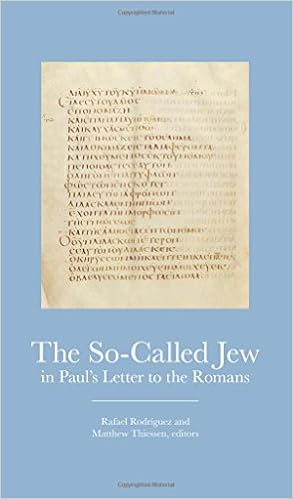 In addition to Boccaccini and Segovia’s Paul the Jew, inbox recently saw the arrival from Fortress Press of a review copy of Rafael Rodríguez and Matthew Thiessen’s edited volume The So-Called Jew in Paul’s Letter to the Romans(2016). According to the book’s blurb:


...Matthew Bates argues that faith or believing is not mere assent, not easy believism, but covenantal loyalty to the God who saves his people through the Lord Jesus Christ. Bates forces us to rethink the meaning of faith, the gospel, and works with a view to demonstrating their significance for true Christian discipleship. This will be a controversial book, but perhaps it is the controversy we need!
 March’s free and reduced-price companion volumes from Faithlife include:
Logos: Paula Gooder, This Risen Existence: The Spirit of Easter, and for $1.99, Dennis Ngien, Fruit for the Soul: Luther on the Lament Psalms Verbum: Bonaventure, The Life of Saint Francis, and for $0.99, Bonaventure, Mystical Opuscula
...Nijay Gupta introduces 1–2 Thessalonians via video, with some comments about what new readers can anticipate in his NCCS volume on the letters.
The Review of Biblical Literature contains Jason Myers’s helpful and appreciative review of Teresa Morgan’s Roman Faith and Christian Faith: Pistis and Fides in the Early Roman Empire and Early Churches (OUP, 2015).
Larry Hurtado has kindly made available the pre-publication version of his essay “YHWH’s Return to Zion: A New Catalyst for Earliest High Christology?” in the recent God and the Faithfulness of Paul: A Critical Examination of the Pauline Theology of N. T. Wright, edited by Christoph Heilig, Thomas Hewitt, and Michael Bird (WUNT 2/413; Mohr Siebeck, 2016).
...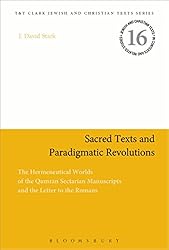 A while ago, I mentioned Sacred Texts and Paradigmatic Revolutions would be coming to paperback. That format is now available at about a fourth or less of the MSRP for the hardback.
For May, Logos Bible Software’s free volume is N. T. Wright’s The Lord and His Prayer(SPCK, 1996). The paired discount volume is Wright’s Paul: Fresh Perspectives (SPCK, 2005).
... The kind folks at Bloomsbury (the parent company of the T&T Clark imprint) have recently mentioned that a paperback release is forthcoming for my Sacred Texts and Paradigmatic Revolutions: The Hermeneutical Worlds of the Qumran Sectarian Manuscripts and the Letter to the Romans. Slated for this June, the paperback, at a $29.95 list price, will be a fiscally welcome complement to the current hardback ($120.00) and PDF ($27.99) formats. The paperback is already available for pre-order on Amazon, currently at just under the list price.