The Expositor’s Greek Testament
The Expositor’s Greek Testament is now dated, but it preserves some keen exegetical insights that more recent commentators have continued to find helpful.
The Expositor’s Greek Testament is now dated, but it preserves some keen exegetical insights that more recent commentators have continued to find helpful.
In his Tyndale series Romans commentary, F. F. Bruce offers the following colorful, if also sad, illustration as he discusses Rom 6:
...A notable historical instance [of a tendency to read Paul as advocating antinomianism] may be seen in the Russian monk Rasputin, the evil genius of the Romanov family in its last years of power. Rasputin taught and exemplified the doctrine of salvation through repeated experiences of sin and repentance; he held that, as those who sin most require most forgiveness, a sinner who continues to sin with abandon enjoys, each time he repents, more of God’s forgiving grace than any ordinary sinner.((Bruce, Romans ( affiliate disclosure), 134.))
Chris Tilling has a very fine two-part lecture on Karl Barth’s commentary on Romans.
John Calvin’s commentaries have been brought into varying English versions. The version published in Edinburgh by Calvin Translation Society, 1844–1856, is the version that has been reprinted by Baker Academic and Logos Bible Software ( affiliate disclosure).
Many of these volumes are openly available online. Below is a list with links to those that I’ve located thus far. Volumes not yet found are:
...

Available in Fortress’s Ad fontes series is Biblical Interpretation in the Early Church, edited by Michael Graves.
 To celebrate the 25th anniversary of Logos Bible Software, Logos is giving users $25 of credit toward orders at Logos.com before 1 March. Originally, the offer had been limited to credit toward a select number of resources but has since been expanded to “any order on logos.com.”
[caption id="" align=“alignright” width=“175”]  Justin Martyr presents a book to the emperor, paper etching, print made by Jacques Callot, published by Israël Henriet, 1632–1635 [ PD-1923][/caption]To date, one of this site’s more popular posts has been this one about W. Trollope’s Greek edition of Justin Martyr’s Dialog with Trypho.
On MSN:
...The earliest known draft of the King James Bible, regarded as the most widely read work in English, has been unearthed among ancient papers lodged in a Cambridge college.
American scholar Jeffrey Miller announced his year-old discovery in the Times Literary Supplement this week, saying it would help fill in gaps in understanding how the bible, published in 1611, came to be.
. . .
Treasures recently found:
The latest issue of the Journal of Faith and the Academy is kindly carrying my article “Figuring Things Out: Lyrical Resourcement for Figural Readings of Biblical Literature in the Contemporary Academy.” The “lyrical” element in the essay is an attempt to think through some of how Nicholas of Lyra might provide a helpful rubric for understanding and pursuing responsibly figural readings of biblical literature within a contemporary, confessional academic context.
...Google Books has two volumes of Christoph Friedrich Ammon’s Biblische Theologie (Erlangen: J. J. Palm, 1801) available in various full-text formats ( vol. 1, vol. 2).
Daniel Driver
In yesterday’s mail arrived Daniel Driver’s Brevard Childs, Biblical Theologian: For the Church’s One Bible (Baker). The volume is a corrected, North American edition of Driver’s previous volume under the same title from Mohr Siebeck (2010; ix), which was itself a “thorough revision and updating” of Driver’s PhD thesis ( Brevard Childs: The Logic of Scripture’s Textual Authority in the Mystery of Christ, St. Andrews, 2008; xi). This North American edition was just released in August, and Baker’s description of it is as follows:
...The Journal of Theological Studies 63, no. 2 includes several articles of note.
Ferdinand Christian Baur.
Google Books has available two full PDF copies ( 1, 2) of the original German of F. C. Baur’s Paulus, der Apostel Jesu Christi (1845). Also available are the first and second volumes of second edition of the English translation produced by Eduard Zeller ( Paul, the Apostle of Jesus Christ, 2 vols., 1873–1875). In addition, the book’s second, posthumously produced German edition (2 vols., 1866–1867) from which Zeller translated the English version is available in a single, combined PDF that contains both of its volumes.
...Brian LePort notes the availability, as an Amazonian “Deal of the Day,” of a free Kindle edition of Steven Lawson’s Expository Genius of John Calvin (Reformed Trust, 2007).
...This week in the biblioblogosphere:
This week in the blogosphere:
In the second and third centuries, the church worked under several different hermeneutical constraints, including: canonical development, community boundary definition (vis-à-vis Judaism, Paganism, and heretical, “Christian” sects), and hermeneutical method. Although this period of biblical interpretation has long been closed, being aware of the natures of these respective constraints can help us understand the early church’s hermeneutical environment and gain better access to some of their thoughts about scripture.
Regarding canonical development, within the patristic period the text of the Jewish canon was essentially closed, but what has become known as the New Testament was not yet a distinct collection. In this period, the church sometimes used certain documents as scripture, although these documents like Shepherd of Hermas or 1 Clement were not eventually canonized, and the church sometimes refrained from using as scripture other documents like Hebrews and Revelation, which were eventually canonized. Additionally, the early church seems to have viewed the Old Testament as having a higher status than the Gospels [including the Diatessaron ( ANF 9:43–130)] and Paul’s epistles, although a somewhat more egalitarian view was also feasible (cf. 2 Pet 3:15–16). For instance, when the Epistle of Barnabas cites the New Testament, the references seem to be mainly incidental to the main line of thought (e.g., Epistle of Barnabas 5:9; 4:14; 13:7), whereas the Old Testament seems to be used as though it held more weight for Barnabas’s author. In the earliest part of the patristic period, it was also possible for Papias to say that he preferred the “living voice” (of oral testimony) to what was written. By contrast, in Justin Martyr’s Dialogue with Trypho (ca. AD 165; ANF 2:194–270), Justin explicitly cites the New Testament as scripture (e.g., §43, 100). Justin’s use of the New Testament as scripture typified a growing trend out of which the Muratorian Canon list (ca. AD 200; see Westcott 557–64) came and which culminated in Athanasius’s Easter letter of AD 367 ( NPNF2 4:551–52). In this letter, Athanasius demarcated what he saw to be the boundaries of the New Testament canon, which have remained until the present day.
...The following poem, “Epi-strauss-ium,” by Arthur Hugh Clough (1819–1861) playfully draws attention to D. F. Strauss’s then recently published Das Leben Jesu, kritisch bearbeitet ( Life of Jesus Critically Examined; NAEL 2:1452 n. 1).
...Matthew and Mark and Luke and holy John Evanished all and gone! Yea, he that erst, his dusky curtains quitting, Through Eastern pictured panes his level beams transmitting, With gorgeous portraits blent, On them his glories intercepted spent, Southwestering now, through windows plainly glassed, On the inside face his radiance keen hath cast, And in the luster lost, invisible, and gone, Are, say you, Matthew, Mark, and Luke and holy John? Lost, is it? lost, to be recovered never? However, The place of worship the meantime with light Is, if less richly, more sincerely bright, And in blue skies the Orb is manifest to sight.
In his Four Gospels, Burnett Streeter articulates his view of the sources of Luke and proto-Luke as follows:
...The hypothesis I propose in no way conflicts with the generally accepted view that Matthew and Luke are ultimately dependent not only on Mark but on Q—meaning by Q a single written source. Most, if not all, of the agreements of Matthew and Luke, where Mark is absent, are, I think, to be referred to Q; but I desire to interpolate a stage between Q and the editor of the Third Gospel. I conceive that what this editor had before him was, not Q in its original form—which, I hold, included hardly any narrative and no account of the Passion—but Q+L, that is, Q embodied in a larger document, a kind of “Gospel” in fact, which I will call Proto-Luke. This Proto-Luke would have been slightly longer than Mark, and about one-third of its total contents consisted of materials derived from Q (Streeter 208).
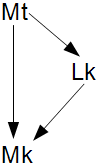
See Kümmel 139. Please see the symbol key for an explanation of the diagrams in this post series.
In this post:[caption id=“attachment_2014” align=“alignleft” width=“80” caption=“Werner Kümmel”]  [/caption]
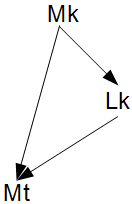
See Baird 305; Kümmel 148–49. Please see the symbol key for an explanation of the diagrams in this post series.
[caption id=“attachment_2065” align=“alignleft” width=“80” caption=“William Baird”]  [/caption] [caption id=“attachment_2014” align=“alignleft” width=“80” caption=“Werner Kümmel”] [/caption]

See Kümmel 327. Please see the symbol key for an explanation of the diagrams in this post series.
In this post:[caption id=“attachment_2014” align=“alignleft” width=“80” caption=“Werner Kümmel”] [/caption]
Early Holtzmann  Late Holtzmann
See Kümmel 151–55. Please see the symbol key for an explanation of the diagrams in this post series.
In this post:[caption id=“attachment_2014” align=“alignleft” width=“80” caption=“Werner Kümmel”] [/caption]

See Kümmel 149–51. Please see the symbol key for an explanation of the diagrams in this post series.
In this post:[caption id=“attachment_2014” align=“alignleft” width=“80” caption=“Werner Kümmel”] [/caption]

See Kümmel 146–48. Please see the symbol key for an explanation of the diagrams in this post series.
In this post:[caption id=“attachment_2014” align=“alignleft” width=“80” caption=“Werner Kümmel”] [/caption]

Herder thought that Mark most exactly reproduced Urev Or. Matthew reproduced it with expansions, and Luke, aware of these expansions, “wished to create ‘an actual historical account’ after a wholly Hellenistic pattern.” Herder also hypothesized that “[s]ome forty years later John . . . wrote an ’echo of the earlier Gospels at a higher pitch’ which undertook to set forth Jesus as the Savior of the world. . . .”
...
Eichhorn does not appear to have named Q as such, but this part of his hypothesis fits what has come to be called Q.
See Kümmel 77–79. Please see the symbol key for an explanation of the diagrams in this post series.
In this post:[caption id=“attachment_2014” align=“alignleft” width=“80” caption=“Werner Kümmel”] [/caption]

See Kümmel 76. Please see the symbol key for an explanation of the diagrams in this post series.
In this post:[caption id=“attachment_2014” align=“alignleft” width=“80” caption=“Werner Kümmel”] [/caption]