
How to Use Zotero to Properly Cite Grammars in SBL Style
You might think citing a grammar according to the “SBL Handbook of Style” would be straightforward. It is, but there are several special cases to account for.
You might think citing a grammar according to the “SBL Handbook of Style” would be straightforward. It is, but there are several special cases to account for.
Daily Gleanings about Edwin Abbott’s “Johannine Grammar.”
Daily Gleanings about “The Article in Post-classical Greek.”
Daily Gleanings about Nijay Gupta’s critical introduction to 1–2 Thessalonians and KoineGreek.com’s videos of Mark’s gospel in Greek.
Daily Gleanings about open access references for Greek personal names and subsequent transmission of classic Greek literature.
Daily Gleanings about Mike Aubrey’s discussion of new books in Greek linguistics and Mark Ward’s review of Dirk Jonkind’s “Introduction to the GNT.”
Daily Gleanings about the final EAGLE conference proceedings and Cairo Geniza texts, transcriptions. Both are freely available online.
Daily Gleanings about criteria for determining authenticity and Brill’s “Dictionary of Ancient Greek.”
University College London has posted on YouTube their 1971 documentary Greek Papyri: The Rediscovery of the Ancient World.
HT: Tommy Wasserman
Sean Hadley, one of our current PhD students in Humanities, positively reviews Robbie Castleman, Darian Lockett, and Stephen Presley’s edited volume Explorations in Interdisciplinary Reading: Theological, Exegetical, and Reception Historical Perspectives (Pickwick, 2017). Along the way, Sean provides some kind comments about my contribution in the volume.
...Mike Aubrey points to a full set of video recordings of lectures from the recent SEBTS conference on linguistics and NT Greek. I’ve included this playlist below as well. The “hamburger” button in the upper left-hand corner will expand the playlist contents with a list of speakers and their topics.
Larry Hurtado reviews Michael Dormandy’s recent TC essay, “How the Books Became the Bible: The Evidence for Canon Formation From Work-Combination in Manuscripts.”
...Gleanings about Greek, linguistics, and saint cults in late antiquity and the early middle ages.
Google Books as a combined full-text PDF of K. W. Krüger’s Griechische sprachlehre für Schulen (1861). The two tomes make for a combined PDF of just over 1100 pages.
Logos Bible Software offers syntax graphs for “the LXX Deuterocanon/Apocrypha.”
The post has been up for some time, but Charles Sullivan’s site has a list of links to where full texts of several several older Greek lexica can be found online.
HT: Rick Brannan, SCS.
 Under the heading of “keeping your Greek and Hebrew skills sharp,” Mark Ward has some helpful advice about creating a serial biblical text in Logos Bible Software. For instance, if you create a series between BHS and NA28 and you have BHS open, you can type a New Testament passage in the go box and run straight there. Logos will treat the two resources as combined.
During 2016, the “Journal of Greco-Roman Christianity and Judaism” published several noteworthy articles.
[caption id="" align=“alignright” width=“175”]  Justin Martyr presents a book to the emperor, paper etching, print made by Jacques Callot, published by Israël Henriet, 1632–1635 [ PD-1923][/caption]To date, one of this site’s more popular posts has been this one about W. Trollope’s Greek edition of Justin Martyr’s Dialog with Trypho.
Some time ago, Larry Hurtado posted some thoughts about how Jesus is characterized as ἐκ δεξιῶν or ἐν δεξιᾷ. Recently, he’s followed up with “another possible factor” for how the language coalesces and a “bonus” post on the importance of being data-driven in developing hypotheses about such phenomena.
...On 30 June–1 July, Tyndale House is set to host a workshop on Greek prepositions that focuses on cognitive linguistics, lexicography, and theology. Registration opens 1 March.
For further discussion and background, see Septuaginta &c.
Yes, search, but also read, note, and remember.
Advice from Murray Harris:
...As for the study habit that has proved most helpful in my academic career, it is this. There is no better way to become proficient in Greek, to gain a “feel” for the language, and to become enriched by the theology of the New Testament than the regular memorization of the Greek text. Paste a photocopy of verses or sections of the text on to cards and carefully reflect on it as you go about your daily exercise.
Rob Bradshaw has made available George Milligan’s essay, “The Greek Papyri: With Special Reference to Their Value for New Testament Study,” Journal of the Transactions of the Victoria Institute 44 (1912): 62–78.
As their free book of the month, Logos Bible Software is giving away volume 5 of the Expositor’s Greek Testament, edited by W. Robertson Nicoll. Volume 5 includes:
For more information about the text and to download this volume, please see here.
...According to the Perseus Digital Library at Tufts University:
...The Perseus Digital Library is pleased to announce the 1.0 Release of the Perseus Catalog.
The Perseus Catalog is an attempt to provide systematic catalog access to at least one online edition of every major Greek and Latin author (both surviving and fragmentary) from antiquity to 600 CE. Still a work in progress, the catalog currently includes 3,679 individual works (2,522 Greek and 1,247 Latin), with over 11,000 links to online versions of these works (6,419 in Google Books, 5,098 to the Internet Archive, 593 to the Hathi Trust). The Perseus interface now includes links to the Perseus Catalog from the main navigation bar, and also from within the majority of texts in the Greco-Roman collection.
Image via Wikipedia
The latest issue of the Journal of the Evangelical Theological Society arrived in yesterday’s mail and includes the following:
Paul Danove has the latest article in Biblical and Ancient Greek Linguistics, “Features of the Conceptualization of Transference in the New Testament”:
...This article develops five features that describe the conceptualizations of the event of transference grammaticalized by New Testament verbs, and uses these features to formulate a model of the possible New Testament usages of transference. The discussion resolves all New Testament occurrences of verbs that designate transference into one of eighteen usages with distinct feature descriptions, and considers the usages of transference predicted by the feature model but not realized in the New Testament.
Robert Funk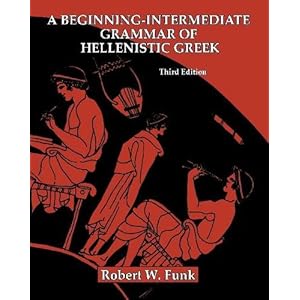
A single-volume edition Robert Funk’s Beginning-Intermediate Grammar of Hellenistic Greek is due out in April and is now available for pre-order from Polebridge. According to the publisher’s description,
...Originally published in three volumes in 1973, Robert Funk’s classic Beginning-Intermediate Grammar of Hellenistic Greek utilizes the insights of modern linguistics in its presentation of the basic features of ancient Greek grammar. Now redesigned and reformatted for ease of use, this single-volume third edition makes Funk’s ground-breaking work available once more.
On the web:
Bridget Almas notes the availability of a new syntax search utility that presently covers about 400,000 words of Perseus’s Greek and Latin texts (HT: Charles Jones).
J. P. Migne’s two massive compilations of Patristic literature have now made their way onto Logos Bible Software’s community pricing platform ( Greek, Latin). Also appearing there now is some of René Graffin, Francois Nau, and Max de Saxe’s compilation of other Patristic texts not included in Migne’s anthologies.
...