
In Luke 24:1, “the women who had come with him from Galilee” go to Jesus’ tomb “carrying spices that they had prepared” (cf. Matt 28:1–8; Mark 16:1–8; Luke 8:2–3; 23:49, 55; 24:10; John 20:1–13).1 Instead of finding Jesus, however, the women come upon an empty tomb and two shining figures (Luke 24:2–5a). The shining figures ask the women, “Why do you seek the living one among the dead?” (Luke 24:5b).
The Women’s Aim
From the women’s perspective, of course, they were not seeking among the dead someone who was alive. They were looking for a dead person. When they had been to the tomb previously, they did not have with them the typical burial spices (Luke 23:55–56). Now, they have returned to the tomb, “carrying spices that they had prepared” (Luke 24:1). Among those who were dead, the women were looking for someone whom they understood also to be dead.
The figures’ point, then, is not that the women were confused about where to find living people or where to find dead people. Instead, the figures break the news that the particular person the women were seeking had a different status than they had supposed. The person the women were searching for was alive rather than dead. And indeed, those looking for him should have known to look for him in this way—as alive and not dead (Luke 24:6–7).[^wright]
The Men’s Reaction
Among Jesus’s principal male followers, Peter at least goes to see the tomb for himself and comes away “marveling at what had happened” (Luke 24:12). But in Luke’s account, the other apostles generally fare worse. On hearing the women’s report, they think it nonsense (Luke 24:10–11).2
The Travelers to Emmaus
Cleopas and his fellow traveler also know the women’s report, but they also have no firm convictions about how true it is (Luke 24:13, 18–24).3 The travelers meet Jesus on their way but fail to recognize him. Their mysterious tag-along tells Cleopas and his original companion they should have known better about Jesus (Luke 24:25–26).4 They should’ve known to have expected Jesus’s resurrection, but they didn’t.
Normal experience, of course, was quite to the contrary of any such hope. Dead people stay dead. So, in one respect, it’s entirely understandable that the two original travelers couldn’t understand their recent experiences into any other mold besides that of unrealized hopes for Israel’s redemption (Luke 24:20–24).5
After joining the original travelers, the unrecognized Jesus spends the rest of the trip teaching the other two. Their own experience of Jesus was, self-confessedly, far from “normal” (Luke 24:19). Yet seemingly at no time during the rest of their journey do Cleopas and his companion realize that, of course, Jesus must have risen from the dead (Luke 24:13–15, 25–28). The resurrection’s inevitability stares them in the face but remains hidden. They cannot see it just like they cannot identify the risen one himself who travels with them.
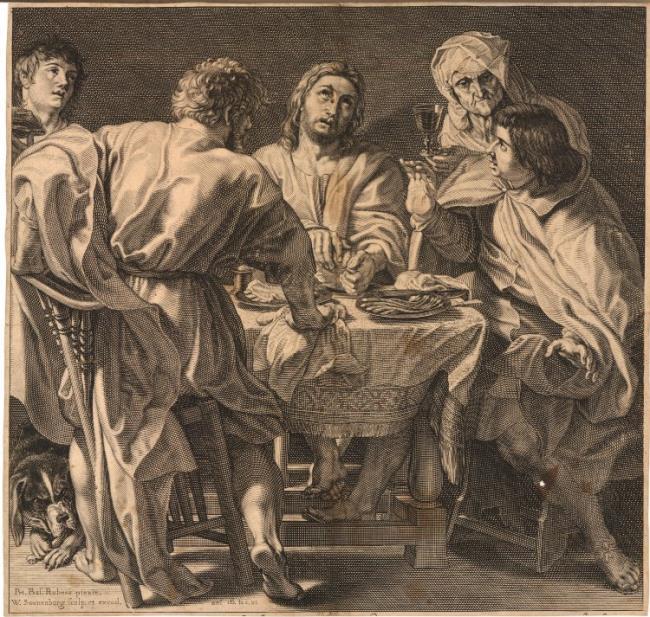 When confronted with the fact that they ought to have known better, the women at the tomb—who encountered only two other figures—had at least “remembered [Jesus’s] words” (Luke 24:8; cf. Luke 24:6).
But even after having Jesus add new words to those he had already spoken, Cleopas and his companion come only to “burning hearts” (Luke 24:35).
Their journey, so to speak, in understanding goes no farther until “he was made known to them in the breaking of the bread” (see Luke 24:28–34).6
When confronted with the fact that they ought to have known better, the women at the tomb—who encountered only two other figures—had at least “remembered [Jesus’s] words” (Luke 24:8; cf. Luke 24:6).
But even after having Jesus add new words to those he had already spoken, Cleopas and his companion come only to “burning hearts” (Luke 24:35).
Their journey, so to speak, in understanding goes no farther until “he was made known to them in the breaking of the bread” (see Luke 24:28–34).6
Persistent Incredulity
The travelers immediately return to Jerusalem report their experience (Luke 24:34). Despite this additional report and that of Simon, however, the disciples are still generally unprepared to encounter the risen Jesus. When he presents himself to them, they think they must be seeing a ghost (Luke 24:36–37). And it is, again, in connection with food that the group of astonished followers comes to accept the truth that stands before them (Luke 24:38–43).
The “Natural” Conclusion
Judging from “normal” experience, there was nothing “natural” about Jesus’ resurrection. “Normally,”
- dead people stay dead.
- unless the grave is disturbed, a dead body will be in the same place a few days as the place where it was laid to rest.
- burial spices can be brought back for the body at a later time if needed.
On the other hand, juding from the creator God’s faithfulness to his promises, nothing is more supremely “natural” than that the crucified messiah should be alive three days after he had died (Luke 24:5–7; 25–27; 44–49; cf. Rom 4:17).7 In the end—not least, in the climax of all things—neither the grave nor death is a very sturdy container for such a person.
Gently place a bullet into a plain paper bag, and the bag will hold the bullet well enough. Shoot the bullet into the bag with a gun, and the bag hasn’t got a chance.
So it was with this Jesus, in whom the fullness of the creator’s mighty power and purposes for his people were at work (cf. Luke 24:19, 21; Acts 2:24; Heb 7:15–16). So too will it be at the end, when death and the grave also prove unable to hold as the rest of the Jesus body follows its head into new and uncontainable life (1 Cor 15:12–28).
Discuss on Mastodon.
-
Header image provided by Wikimedia Commons. Translations are mine from the NA28 (affiliate disclosure). ↩︎
-
Tertullian, Marc., 4.43 (ANF 3:422; affiliate disclosure). ↩︎
-
Wright, The Resurrection of the Son of God, 657. ↩︎
-
Wright, The Resurrection of the Son of God, 650–51, 657. ↩︎
-
Augustine, Enarrat. Ps., 64.15 (NPNF 1/8:266; affiliate disclosure); Augustine, Tract. ep. Jo., 2.1 (NPNF 1/7:469–70); Wright, The Resurrection of the Son of God, 651. ↩︎
-
Image provided by
 . ↩︎
. ↩︎ -
Augustine, Enarrat. Ps., 64.15 (NPNF 1/8:266; affiliate disclosure); C. S. Lewis, God in the Dock: Essays on Theology and Ethics (affiliate disclosure; Grand Rapids: Eerdmans, 1970), 25–37; Tertullian, Marc., 4.43 (ANF 3:422; affiliate disclosure); Wright, The Resurrection of the Son of God, 649, 651–52. ↩︎