Daily Gleanings: Inscriptions (26 November 2019)
The Computerized Historical Linguistic Database of the Latin Inscriptions of the Imperial Age is producing a database of Latin inscriptions.
The Computerized Historical Linguistic Database of the Latin Inscriptions of the Imperial Age is producing a database of Latin inscriptions.
Daily Gleanings from the 2019 Christian Scholars’ Conference plenaries on child rearing in the Greco-Roman world and the Christology of the Greek fathers.
The Review of Biblical Literature contains Jason Myers’s helpful and appreciative review of Teresa Morgan’s Roman Faith and Christian Faith: Pistis and Fides in the Early Roman Empire and Early Churches (OUP, 2015).
From AWOL:
...The American Numismatic Society has created an Open Access digital library. One purpose is to host unpublished and/or orphaned MA and PhD theses/dissertations that have numismatic content. As a part of this library your thesis will be Open Access, full-text searchable, and http://schema.org properties will help Google relevance. If you (or someone you know) wants their research hosted for free (CC-BY license) alongside other numismatic work, email Andrew Reinhard at areinhard@numismatics.org.
The Logos blog has a couple minute and slightly humorous segment from Darrell Bock on the importance of background information for New Testament Studies.
According to the Perseus Digital Library at Tufts University:
...The Perseus Digital Library is pleased to announce the 1.0 Release of the Perseus Catalog.
The Perseus Catalog is an attempt to provide systematic catalog access to at least one online edition of every major Greek and Latin author (both surviving and fragmentary) from antiquity to 600 CE. Still a work in progress, the catalog currently includes 3,679 individual works (2,522 Greek and 1,247 Latin), with over 11,000 links to online versions of these works (6,419 in Google Books, 5,098 to the Internet Archive, 593 to the Hathi Trust). The Perseus interface now includes links to the Perseus Catalog from the main navigation bar, and also from within the majority of texts in the Greco-Roman collection.
Using Owen’s translation, LibriVox recordings have also been made available for Categories, Interpretation, Prior Analytics, and Posterior Analytics.
On the web:
On the web:
University of Oxford (Photo credit: Wikipedia)
The Oxford University Classics Faculty’s PINAX “is a digital library comprised of collections of displayed papyrus images and texts at Oxford.” Texts include papyri from Antinoopolis, Herculaneum, and Oxyrhynchus, as well as magical texts (HT: Charles Jones).
...In the latest contribution to the Journal of Greco-Roman Christianity and Judaism, Richard Carrier discusses “Thallus and the Darkness at Christ’s Death”:
...It is commonly claimed that a chronologer named Thallus, writing shortly after 52 CE, mentioned the crucifixion of Jesus and the noontime darkness surrounding it (which reportedly eclipsed the whole world for three hours), and attempted to explain it as an ordinary solar eclipse. But this is not a credible interpretation of the evidence. A stronger case can be made that we actually have a direct quotation of what Thallus said, and it does not mention Jesus. (185)
New Testament Studies
The latest issue of New Testament Studies includes:

A new collection of online Loeb Classical Library volumes is now available (HT: Charles Jones).
This new collection provides locally-hosted PDFs that can be downloaded without completing a CAPTCHA field.
The page also provides a link to a single ZIP file (3.2 GB) that contains all the individual LCL volume PDFs available on the page.
...Tim Brookins has the latest article in the Journal of Greco-Roman Christianity and Judaism, “Dispute with Stoicism in the Parable of the Rich Man and Lazarus.” According to Brookins,
...It is not my aim to continue discussion regarding the criterion for the rich man’s judgment. But I propose that there is more to be said about the meaning of the parable in light of a Greco-Roman milieu. . . . I shall take up [Ronald] Hock’s wider net and cast it once again in the direction of Hellenistic philosophy. It will be argued that, while the parable may share a Cynic viewpoint on the issue of wealth, it also conveys pronounced resistance to certain Stoic ideas on this issue. As a supporting argument it will further be suggested that the parable reflects elements of rhetorical ‘declamation’ (declamatio), which was in certain circles closely associated with Stoic philosophy. With these substantive and formal features taken together, we shall see that the parable means to interact with Stoicism, though in a way that is subversive to the Stoic ideas evoked (35–36; underlining for original italics).
The Flammarion woodcut is an enigmatic wood en…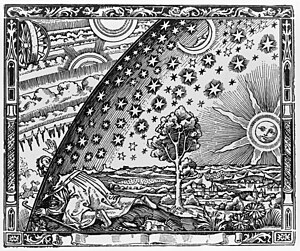
Jim Davila has picked up a discussion about ancient testimony to the earth’s spherical shape. Cicero also, by way of his Stoic character Balbus, comments to this effect, saying,
...[T]he sea, which is above the earth, tends still toward the earth’s centre, and so is itself shaped in conformity to the globe of the earth and nowhere spills or overflows. ( 171; affiliate disclosure; italics added)
As noted earlier, Logos Bible Software is working on releasing over 3000 texts from the Perseus Project for free to Logos 4 users. Included here is Perseus’s substantive collection of Greek and Latin classics and their translations. This collection also offers access to Perseus’s dictionaries and lexica and integrated searching with the rest of a user’s Logos library. For further details, see here.
...[caption id=“attachment_7680” align=“alignright” width=“80” caption=“Marcus Tullius Cicero”]  [/caption]
In his classic on The Nature of the Gods, Cicero identifies the key problem facing him as being “the question whether the gods do nothing, care for nothing, and take their ease detached from all concern with the care and government of the world: or whether on the contrary all things have been created and formed by them from the dawn of time, and will be ruled and governed by them to all eternity” ( 69–70).
...Michael Meerson has the latest article in the Journal of Greco-Roman Christianity and Judaism, “One God Supreme: A Case Study of Religious Tolerance and Survival.” In this article, Meerson “attempt[s] to combine the consideration of both [θεὸς ὕψιστος and εἷς θεός]” as these titles are found in a sundial inscription from Mount Gerizim (32). For, although
...While reading around Justin Martyr’s First Apology this morning, I came across a few interesting points.
Historical In discussing the injustice of Christians’ condemnation, Justin says,
...By the mere application of a name, nothing is decided, either good or evil, apart from the actions implied in the name; and indeed, so far at least as one may judge from the name we are accused of, we are most excellent people. But as we do not think it just to beg to be acquitted on account of the name, if we be convicted as evil-doers, so, on the other hand, if we be found to have committed no offence, either in the matter of thus naming ourselves, or of our conduct as citizens, it is your part very earnestly to guard against incurring just punishment, by unjustly punishing those who are not convicted. For from a name neither praise nor punishment could reasonably spring, unless something excellent or base in action be proved. And those among yourselves who are accused you do not punish before they are convicted; but in our case you receive the name as proof against us, and this although, so far as the name goes, you ought rather to punish our accusers. For we are accused of being Christians, and to hate what is excellent (Chrestian) is unjust (Justin, 1 Apol. 4; emphasis added).
Through his vast conquests, Alexander’s comparatively short life left several important marks on history:
In large measure, therefore, Alexander’s conquests accelerated the development or increased the strength of Hellenic influences that were already beginning to creep toward many of the areas that he subjugated.
...With Phillip II of Macedon’s (359–336 BC) son, Alexander the Great (356–323 BC), the Greeks established an empire vast enough to influence Palestine (see Ferguson 10, 13). When Thebes revolted after his father’s death, Alexander successfully re-unified the Greek city-states, albeit by conquest ( Plutarch, Alex. 11.3–6; Ferguson 12), and Alexander was made head of the campaign against Persia in his father’s stead ( Arrian, Anab. 1.1; cf. 1 Macc 1:1). In prosecuting this campaign, Alexander moved through Asia Minor ( Plutarch, Alex. 24.1), Phoenicia ( Plutarch, Alex. 24.1–25.2), Palestine ( Plutarch, Alex. 25.3–5), Egypt ( Plutarch, Alex. 26), Mesopotamia ( Plutarch, Alex. 31), Iran ( Plutarch, Alex. 37), and even as far as India ( Plutarch, Alex. 55; cf. 1 Macc 1:3–4) before dying in Babylon from a fever ( Plutarch, Alex. 75; cf. 1 Macc 1:5; see Ferguson 12). Yet, throughout these conquests, Alexander typically replaced neither the ruling class nor the religions in these conquered areas ( Ferguson 12). Rather, instead of primarily intending and explicitly acting to spread Hellenism, Alexander concentrated on appointing governors, placing garrisons, and founding cities ( Ferguson 12), things that eventually did indeed create and spread Hellenism.
...A third instance of ‘gospel’ language in the wider Greco-Roman context is the Gaius inscription (ca. 5 BC):
...On the motion of the strategi Metrodorus son of Conon, Clinius, Musaeus, and Dionysius—
Whereas Gaius Julius Caesar, the eldest of the sons of Augustus has—as has been fervently prayed for—assumed in all its splendor the pure-white toga [of manhood] in place of the purple-bordered toga [of youth], and all men rejoice to see the prayers for his sons rising together to Augustus;
And whereas our city in view of so happy an event has decided to keep the day which raised him from a boy to a man as a holy day, on which annually all shall wear wreaths and festal garb, and the annual strategi shall offer sacrifices to the gods and render prayers through the sacred heralds for his preservation; to unite in consecrating an image of him set up in his father’s temple; also on which the city received the good news and the decree was ratified, to wear wreaths and perform most sumptuous sacrifices to the gods; and to send an embassy concerning these matters to go to Rome to congratulate him and Augustus;
Therefore it was resolved by the council and the people to dispatch envoys chosen from the most distinguished men for the purpose of bringing greetings from the city, of delivering to him the copy of this decree sealed with a public seal, and of discussing with Augustus the common interests of the province of Asia and of the city. . . (translated by Lewis and Reinhold 635; insertions and italics original).
Another example of ‘gospel’ language in the Greco-Roman environment is the inscription found at Priene (ca. 9 BC) about Augustus:
...It seemed good to the Greeks of Asia, in the opinion of the high priest Apollonius of Menophilus Azanitus: “Since Providence, which has ordered all things and is deeply interested in our life, has set in most perfect order by giving us Augustus, whom she filled with virtue that he might benefit humankind, sending him as a savior [σωτήρ], both for us and for our descendants, that he might end war [= ποιῇ εἰρήνην] and arrange all things, and since he, Caesar, by his appearance [ἐπιφανεῖν] (excelled even our anticipations), surpassing all previous benefactors, and not even leaving to posterity any hope of surpassing what he has done, and since the birthday of the god Augustus was the beginning of the good tidings for the world that came by reason of him [ἦρξεν δὲ τῷ κόσμῳ τῶν δἰ αὐτὸν εὐαγγελίων ἡ γενέθλιος τοῦ θεοῦ],” which Asia resolved in Smyrna (text and translation cited from Evans 2–3).
First century Christians were not unique in their use of ‘gospel’ language. In fact, this word group (which exhibits the εὐαγγελι- stem in Greek) actually comes into several connections in ancient literature. For instance, in his Jewish Wars, Josephus records the following:
...So the men of power, perceiving that the sedition was too hard for them to subdue, and that the danger which would arise from the Romans would come upon them first of all, endeavored to save themselves, and sent ambassadors; some to Florus, the chief of whom was Simon the son of Ananias; and others to Agrippa, among whom the most eminent were Saul, and Antipas, and Costobarus, who were of the king’s kindred; and they desired of them both that they would come with an army to the city and cut off the sedition before it should be too hard to be subdued. Now this terrible message was good news [εὐαγγέλιον] to Florus; and because his design was to have a war kindled, he gave the ambassadors no answer at all ( Josephus, Jewish Wars 2.418–20).