
For twenty-first-century, Christian readers, both biblical testaments present unique challenges.1 Whether intentionally or accidentally, Christian readers often neglect the Old Testament. Or when they consider it, they often read in less than fully healthy ways.
Readings of the New Testament also face difficulties. They sometimes suffer from over-familiarity. As such, they neglect how the New Testament may more confront and admonish than comfort and affirm.
There remains much necessary work to indicate ways out of these difficulties. But one useful approach is to
- read the New Testament ever more closely and to
- ask ever more persistently how the New Testament reads the Old.2
And within the New Testament, Hebrews’s copious interaction with the Old means this book bears special attention.
Hebrews’s Hermeneutic in the Twenty-First Century
Twenty-first-century readers can’t interpret Israel’s Scriptures identically to how the author of Hebrews did. Twenty-first century worldviews are too different. And they differ not least by how Hebrews itself and its subsequent reception have shaped these worldviews.
 That said, Hebrews invites those who “read after” it (in time) also to “read after” it (in approach).3
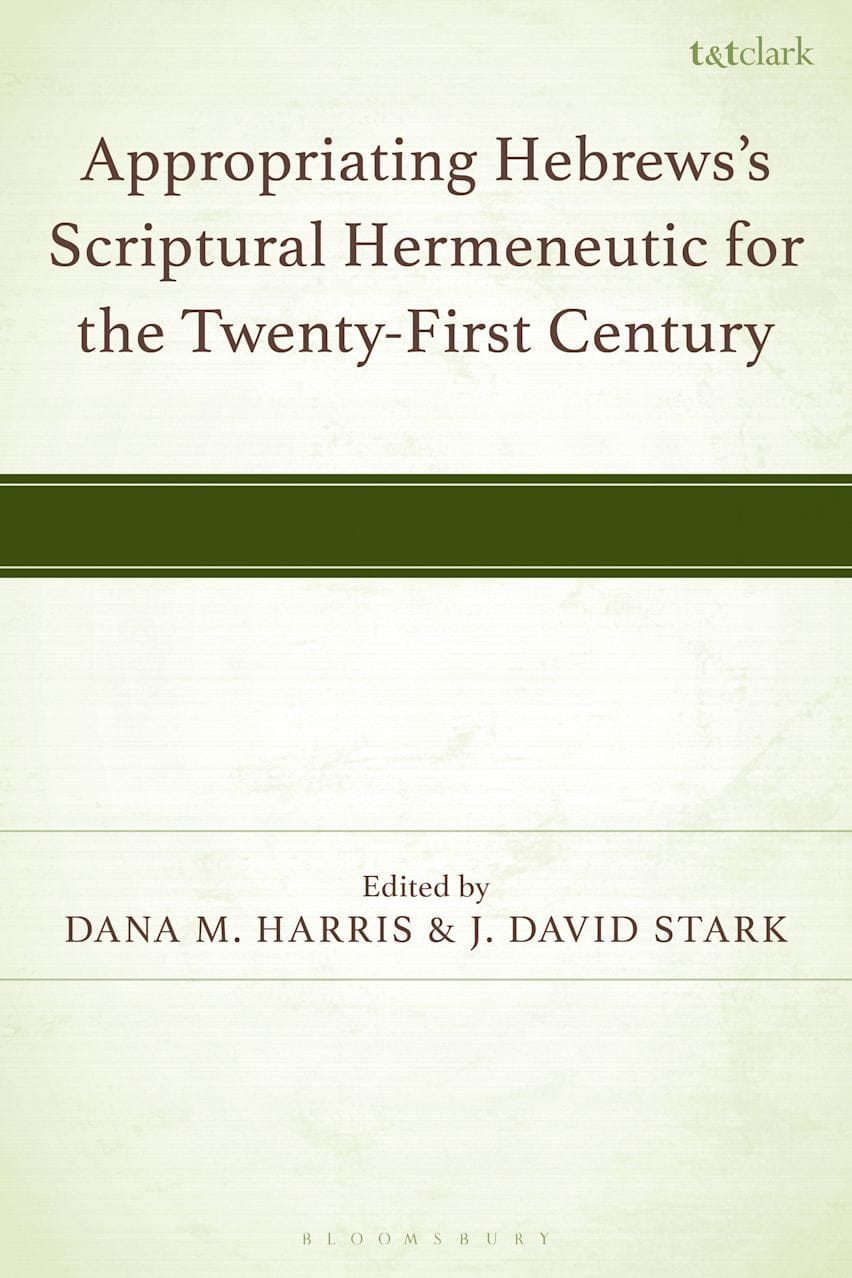
So, in cooperation with Dana Harris (Trinity Evangelical Divinity School), a fine slate of international contributors, and the production team at Bloomsbury T&T Clark, I’m delighted to see coming to press our new volume Appropriating Hebrews’s Scriptural Hermeneutic for the Twenty-First Century.
The volume should be out by the end of November 2025 and is already available for preorder (affiliate disclosure).
That said, Hebrews invites those who “read after” it (in time) also to “read after” it (in approach).3
So, in cooperation with Dana Harris (Trinity Evangelical Divinity School), a fine slate of international contributors, and the production team at Bloomsbury T&T Clark, I’m delighted to see coming to press our new volume Appropriating Hebrews’s Scriptural Hermeneutic for the Twenty-First Century.
The volume should be out by the end of November 2025 and is already available for preorder (affiliate disclosure).
For those who want to accept Hebrews’s invitation to “read after” it in approaching Israel’s Scriptures, the volume’s contributors surface four clusters in the overall mosaic of Hebrews’s hermeneutic. These clusters include how
- Hebrews explicitly, if briefly and partially, states its hermeneutic orientation to Israel’s Scriptures (esp. 1:1–2).
- Hebrews understands history through the proclamation that the author accepts and commends about Jesus.
- The proclamation that Hebrews accepts and commends about Jesus creates numerous implications that Hebrews may or may not explicitly state but that still shape how the author interprets his Scriptures.
- Hebrews’s exhortation fosters faithfulness in its audience through both encouragements and warnings drawn from Israel’s Scriptures.
Paying attention to these elements won’t help twenty-first century readers understand Israel’s Scriptures identically to how Hebrews’s author does. But these elements can help modern readers understand these Scriptures in the same way—in particular, in the way marked out by Jesus for those who would “come after” him (cf. Heb 6:19–20; 12:1–3; 13:12–15).
Initial Responses to the Volume
Already, the volume has received some very kind praise, including from Benjamin Quinn (Southeastern Baptist Theological Seminary), who says,
The recent decades of biblical and theological scholarship on the book of Hebrews have unearthed Christological treasures for God’s people that will pay great dividends for decades to come. It is a delight to see several of those great treasure-hunters among the authors of this outstanding volume in addition to new ones! Dana M. Harris and J. David Stark have curated chapters that carefully attend to important biblical, theological, and practical themes further illuminating the richness of the text. I am excited to see this volume in the T&T Clark catalogue and am honored to recommend it to all students of the great sermon of Hebrews.
And George Guthrie (Regent College) observes how the volume
offers a variegated probing of how Hebrews, as Scripture, reads Scripture, seeking to ascertain the implications for patterns of interpretation in the twenty-first century church. This group of scholars attacks the topic from such varied vantage points, often offering suggestive conclusions, that the book will prove a valuable resource for both academy and church.
Conclusion
Israel’s Scriptures demand fresh engagement in each new generation. And each new generation has its own challenges with this engagement.
But the distance between these contexts is never absolute. Instead, it is “is filled with the continuity of custom and tradition, in the light of which everything handed down presents itself to us.”4 And for Christian readers of Israel’s Scriptures, the book of Hebrews remains a seminal work through which these Scriptures hand themselves down to the present.
-
Header image provided by Tim Wildsmith. ↩︎
-
E.g., see Daniel B. Oden and J. David Stark, eds., Scripture First: Biblical Interpretation That Fosters Christian Unity (affiliate disclosure; Abilene, TX: Abilene Christian University Press, 2020). ↩︎
-
Image provided by Bloomsbury. ↩︎
-
Hans-Georg Gadamer, Truth and Method, ed. and trans. Joel Weinsheimer and Donald G. Marshall, 2nd ed., Bloomsbury Revelations (affiliate disclosure; London: Bloomsbury Academic, 2013), 308. ↩︎