
Confused or Intrigued with Second Temple Hermeneutics?
“Sacred Texts and Paradigmatic Revolutions” illustrates how modern readers can work to recover Second Temple interpretive contexts.
“Sacred Texts and Paradigmatic Revolutions” illustrates how modern readers can work to recover Second Temple interpretive contexts.
Sarianna Metso’s edition of the Community Rule addresses all surviving witnesses for the Rule and includes a critical apparatus.
The University of Cincinnati’s Department of Classics has a podcast with several noteworthy episodes, including an interview with Jodi Magness and a whole series on Qumran and Judean Desert texts.
...This Decoded Science article has an interesting treatment of some of the chemical elements of the study of the Dead Sea Scrolls, particularly the Copper Scroll. The article’s conclusion provides the reminder that
...Archaeology allows us to look into the past. However, in order for scientists to properly examine and maintain artifacts, it’s necessary to preserve them. In many cases, chemistry makes that possible.
Peter Gurry has recently shared the video recording provided via the Leverhulme Project of the Copper Scroll’s opening.
Discussion of the recent Qumran-vicinity cave finds since the previous post tracking the story here includes:
What seems to be shaping up as the key question about the status of this new find’s designation as “Cave 12” is the question “What makes a cave worthy of inclusion inside the numbering?"—actual textual finds tied to the location or simply a strong possibility that ancient texts were once located in the cave? Barring additional news about thus-far undisclosed contents from this cave, the apparently blank parchment showing text under multispectral examination, or known texts’ being re-provenanced to this cave, it seems more in keeping with the criteria applied to derive the existing 11-cave scheme not to include this new cave as a twelfth in that sequence. But, of course, the new find remains quite significant and reopens important questions about possible issues of provenance for texts currently classified as deriving from the standard 11 caves.
...James VanderKam, via University of Notre Dame](http://news.nd.edu/assets/226451/james%5Fvanderkam%5F300x350.jpg)
In a short interview published by the University of Notre Dame, James VanderKam urges caution about labeling the recent Dead Sea find as “Cave 12.” Comparisons have previously been drawn between the new find and Cave 8, which comes inside the numbering but contained no scrolls.
...Since my previous post about Qumran Cave 12, a few other noteworthy articles have cropped up, including on:
Much of what is in these articles about the new find is also in other reports. But, the Times piece confirms that
...Working under the auspices of Operation Scroll, archaeologists have discovered what is being numbered as the twelfth scroll cave in the vicinity of Khirbet Qumran.
Work in the new cave has produced no new texts, but both linen (characteristic of scroll wrappers found elsewhere) and blank parchment fragments suggest that texts probably were stored in the cave at some point. Since no [scroll-type] texts were found in this cave, as with cave 8, the new cave’s designation will likely be Q12 rather than 12Q. [Updated 15 February 2017. For explanation of this correction, please see Qumran Cave 12: Update 2.]
...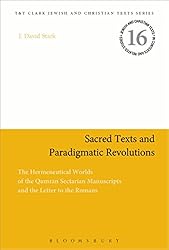 A while ago, I mentioned Sacred Texts and Paradigmatic Revolutions would be coming to paperback. That format is now available at about a fourth or less of the MSRP for the hardback.
Charles Haws notes that Revue de Qumrân now has a website. In commemoration of the website’s launch about a dozen articles have been made openly available.
The kind folks at Bloomsbury (the parent company of the T&T Clark imprint) have recently mentioned that a paperback release is forthcoming for my Sacred Texts and Paradigmatic Revolutions: The Hermeneutical Worlds of the Qumran Sectarian Manuscripts and the Letter to the Romans. Slated for this June, the paperback, at a $29.95 list price, will be a fiscally welcome complement to the current hardback ($120.00) and PDF ($27.99) formats. The paperback is already available for pre-order on Amazon, currently at just under the list price.
After having the product available for over 10 years, Logos Bible Software has released a substantive update to their Qumran Sectarian Manuscripts database (ed. Martin Abegg). Most significant among this update’s improvements are that the resource:
For more information, please see the Logos blog.
... The latest Bloomsbury Highlights notes the newly available volume 16 in the T&T Clark Jewish and Christian Texts Series. The volume is a revision of my 2011 dissertation at Southeastern Seminary and primarily explores paradigmatic, or presuppositional, aspects of the hermeneutics at play in Romans and some of the Qumran sectarian texts.
The latest reviews from the Review of Biblical Literature include:
New Testament and Cognate Studies
Second Temple Judaism
...Amazon’s selection of texts available for the Kindle platform occasionally includes some interesting oddities. For instance, those who really want to do so can apparently read the Discoveries in the Judaean Desert volumes 10 (4QMMT) and 16 (cave 4 calendrical texts) on Kindle for a mere $239.20 and $254.34 respectively, without print-equivalent page numbers. Or, used hard covers are available for just under $180. ;-)
...Last evening, I was privileged to attend the second annual Prentice Meador Lecture at Lipscomb University. There, Weston Fields, the Executive Director of the Dead Sea Scrolls Foundation, addressed what seemed very nearly to be a full house on the topic “The Dead Sea Scrolls Today.”
...This week in the biblioblogosphere:
For those who may have missed the original special or who might just want to relive it, the National Geographic Channel’s recent documentary on “Writing the Dead Sea Scrolls,” hosted by primarily by Robert Cargill, is available here.
...Robert Cargill reports that a recent test conducted by Italian scientists suggests that the Temple Scroll’s papyrus was “cured using water from the Dead Sea.” Cargill also mentions a forthcoming test that could reasonably demonstrate a connection between the scroll’s ink and the water of the Dead Sea. Even if it does so, however, Cargill qualifies, “this still leaves open the possibility that both the inks and parchment were produced at Dead Sea industrial installations and exported to other areas (for instance, Jerusalem), [but] the preponderance of evidence (animals at Qumran, inkwells at Qumran, scrolls in caves near Qumran) would seem to support the continued suggestion that at least some of the Dead Sea Scrolls were produced at Qumran.”
...[caption id=“attachment_5648” align=“alignright” width=“80” caption=“Elizabeth Mburu”]  [/caption]
Due out in a little less than one month is the revised version Elizabeth Mburu’s PhD thesis, Qumran and the Origins of Johannine Language and Symbolism. In the book, Mburu
...sets out to demonstrate that the sectarian Qumran document The Rule of the Community, provides linguistic clues which illuminate our understanding of how the author of the Fourth Gospel used truth terminology and expected it to be understood.
[The book] establishes that there are significant linguistic similarities shared by these two corpora. While these may be attributed to a development of the common tradition shared by both, as well as the influence ideology, the semantic continuity with the Rule of the Community makes it likely that the author of the Fourth Gospel was familiar with the mode of thought represented in the linguistic matrix of the Qumran literature and that he followed this in articulating his ideas in certain parts of his Gospel (Continuum).
Dead Sea Scrolls Today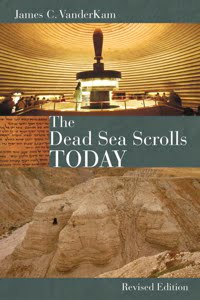
A revised edition of James VanderKam’s excellent introduction to the Dead Sea Scrolls is making its way to retailers. This new edition “retains the format, style, and aims of the first edition, and the same wider audience is envisaged” ( xii). Consequently, this edition includes five primary categories of changes ( xii–xiii):
...In an essay entitled “Paul and James on the Law in the Light of the Dead Sea Scrolls,” Martin Abegg incisively observes that
...The interpretation of the law, which had been revealed by God, is the focus of the phrase “works of the law” [at Qumran]. . . . No doubt the emphasis is on Torah in its entirety (see 1QS 8.1–2) but “obeying the law” was in accordance with the correct interpretation, that which had been revealed by God. . . . [T]he phrase does not simply mean “works of the law as God has commanded,” but rather “works of the law that God has commanded and revealed fully only to us” ( 72–73; italics original).
The University of Groningen is seeking a PhD candidate for the project: The Jewish Revolt against Rome: Religious Groups and the Shaping of Identities in First-Century Judaea:
...The Graduate School of Theology and Religious Studies of the University of Groningen is looking for a PhD candidate (0,9 fte) for the project ‘The Jewish Revolt against Rome: Religious Groups and the Shaping of Identities in First-Century Judaea’.
This PhD position is financed by a grant of the SNS/Reaal Fund. It will run parallel to the interdisciplinary NWO VENI project The Dead Sea Scrolls and the Jewish War against Rome (66–70), which investigates the impact of Rome on the self-understanding of a Jewish group at Qumran prior to the revolt. PhD candidates are expected to carry out research within the historical and archaeological framework of first-century Judaea in relation to the impact of the Roman Empire on the region and the conflict of 66–70/73. Projects may investigate e.g. Flavius Josephus’ position, specific Jewish groups, Roman reactions, specific sites, regions or interregional connections from different perspectives and on the basis of different sources (literary, archaeological and/or numismatic). The final form of the PhD project will be determined in consultation with the PhD candidate.
Brill recently released the following two new resources for Dead Sea Scroll studies:
Biblical Texts from Qumran and Other Sites (Dead Sea Scrolls Concordance, Volume 3)
[caption id=“attachment_4394” align=“alignright” width=“90” caption=“Martin Abegg Jr.”]  [/caption] According to the publisher,
...For decades a concordance of all the Dead Sea Scrolls has been a major desideratum for scholarship. The Dead Sea Scrolls Concordance covers all the Qumran material as published in the Discoveries in the Judaean Desert series, as well as the major texts from caves 1 and 11, which appeared elsewhere.
This keyword-in-context concordance, prepared by Martin G. Abegg in collaboration with other scholars, contains a new and consistent linguistic analysis of all the words found in the Dead Sea Scrolls. The total number of entries is around 134,000. Every entry includes the keyword with its context, exactly as published in the editions referred to above, with notes on some readings. All keywords have an English translation, and they are listed in alphabetical order rather than by verbal root, which makes the concordance easier to consult for the non-specialist.
John Collins rightly argues that the possibility of a positive answer to this question depends heavily on what one means by משיח (messiah).
A few weeks ago, I received confirmation that my paper, “ מורה הצדק as a Hermeneutical Functionary in the Qumran Sectarian Manuscripts,” has been accepted for presentation at the 2010 meeting of the Southeastern Commission for the Study of Religion. Here is a brief abstract:
...Although a good deal of work has been done on the hermeneutical method(s) found at Qumran, to date, insufficient attention has been given to the presuppositional matrix that allowed these methods to function at Qumran as they did. For, after all, considered in themselves, theses and interpretations appear valid not primarily because of the method by which they were derived but because of the perceived fit between a given thesis and an accepted worldview paradigm. Therefore, this paper will seek to show: (1) that מורה הצדק ( the teacher of righteousness) himself definitively determined the Qumran community’s hermeneutical matrix in certain, specific respects and (2) that these specific determinations helped the Qumran community understand their scriptures in conjunction with what they knew to be their own, special position in ’יהוהs plan for Israel.
In working through some bibliography recently for a conference paper proposal about מורה הצדק ( the teacher of righteousness), I came across the following:
...Der Lehrer [der Gerechtigkeit] ist von Gott autorisiert, die Geheimnisse der Prophetenworte zu enträtseln, denn die Worte der Propheten sind Geheimnisse (רזים [pHab] 7,5), die man ohne Auslegung des Lehrers nicht verstehen kann. Der Lehrer tritt also mit seiner Verkündigung nicht neben die Schrift, sondern er basiert auf der Schrift. Er allein hat von Gott das rechte Verständnis offenbart bekommen. Darum kann er und mit ihm seine Gemeinde nach dem Willen Gottes leben ( Jeremias 141).