Video of the opening of the Copper Scroll
Peter Gurry has recently shared the video recording provided via the Leverhulme Project of the Copper Scroll’s opening.
Peter Gurry has recently shared the video recording provided via the Leverhulme Project of the Copper Scroll’s opening.
 The SBLHS blog has a helpful discussion on the use of “and” or “but” at the start of a sentence. And they are permissible. But one should use them sparingly.
For the full and very helpful post, please see the SBLHS blog.
Nijay Gupta introduces 1–2 Thessalonians via video, with some comments about what new readers can anticipate in his NCCS volume on the letters.
In a recent First Things essay, Peter Leithart shares a transparent and good-humored five-stage taxonomy for writing a non-fiction book. Although some elements are tongue-in-cheek, the normalcy of the kinds of feelings about the process as it progresses should be encouraging to those of us with much less writing under our belts.
HT: theLAB
...In the Chronicle of Higher Education, Maren Wood suggests that institutions should be more intentional about preparing PhD students for the possibility of non-faculty or non-teaching careers. Maren’s first suggestion is especially salient and recommends, in part,
...While there are graduate students who decide that an academic career is not for them, most say their first objective is a faculty career. There is no way to know who will or won’t be successful on the academic job market, so all students should be encouraged or required to take professional courses.
There’s some fun to be had in hunting up references to and citing instances where volumes from Migne’s Patrologia latina exist in different versions.
The folks at SBL Press have kindly resolved the mystery. Most significantly, SBL Press notes,
...According to the Patrologia Latina Database … , PL’s printing history can be divided into two distinct periods. Jacques-Paul Migne initially published the 217 volumes of PL over a twelve-year period, 1844–1855. Migne reprinted volumes as needed for another decade, then sold the rights to the Paris publisher Garnier. Unfortunately, in February 1868 a fire destroyed Migne’s presses and printing plates, which meant that Garnier, which had begun reprinting some PL volumes in 1865, was the only source for future reprints—all of which were produced on plates other than Migne’s originals. These plates differed substantially in some cases and are considered in general “inferior in a number of respects to Migne’s own first editions.”
According to SBL Handbook of Style, 2nd ed., §§1, 3, 4.3.6, supports the use of “ibid.” From those descriptions, conventions look to be the same as for the Chicago Manual of Style, 16th ed., §14.29.
As an easy (and free) reference for students, SBL also provides a Student Supplement to the SBLHS. One of the courses I’ve been teaching has a comparatively heavier emphasis on getting to know the nuts-and-bolts of SBL style. And a keen-eyed student, pointed out that page 4 of the Student Supplement has consecutively numbered footnotes 78 and 79. Both notes are for the same source, but the second (note 79) does not use the “ibid.” notation.
...Peter Gurry reflects on the “logical impossibility” criterion that feeds into the Editio Critica Maior’s account of “variants”:
...The Editio Critica Maior defines a “variant” as a reading that is both “grammatically correct and logically possible.” If it doesn’t meet these two criteria it is marked with an f for Fehler (= error). Neither criteria is completely objective, but then most of the errors so recorded in the ECM are pretty obvious gibberish. Occasionally, however, one finds cause…
Larry Hurtado has kindly made available the pre-publication version of his essay “YHWH’s Return to Zion: A New Catalyst for Earliest High Christology?” in the recent God and the Faithfulness of Paul: A Critical Examination of the Pauline Theology of N. T. Wright, edited by Christoph Heilig, Thomas Hewitt, and Michael Bird (WUNT 2/413; Mohr Siebeck, 2016).
...The Center for the Study and Preservation of the Majority Text has a website dedicated to its edition of the Greek New Testament. The website also provides a copy of that edition as a free PDF.

The Byzantine Greek New Testament (BGNT)The Byzantine Greek New Testament (BGNT), is a new scholarly edition of the Greek New Testament. The BGNT base text is compiled from a consensus of readings from the Byzantine Kr or family 35 textform. It will serve as the comparison base text for both our online and future printed edition…
...
Through June 11, the Westminster Bookstore is offering a free PDF download of Iain Duguid’s Is Jesus in the Old Testament? (P&R, 2013). Duguid has been at Grove City College but has recently joined the Westminster Seminary faculty. According to its introduction, Duguid’s essay (the text is a brief 33 pages of prose) has the following major components to its argument:
...[caption id="" align=“alignright” width=“120”] William Baird, History of New Testament Research (3 vols.)[/caption]
With last year’s release of the third volume, From C. H. Dodd to Hans Dieter Betz, William Baird brought his helpful series on the recent history of New Testament Studies to a close. Cliff Kvidahl has an informative review that, despite some criticisms, rightly praises Baird’s work as “informative while remaining entertaining. [Baird] brings the reader through the life and work of each scholar without getting bogged down in too much detail.” Those interested can also find the whole 3-volume set available among Logos Bible Software’s prepublication listings.
...[caption id=“attachment_4050” align=“alignright” width=“56”]  WTS Books[/caption]
Through September 3, the Westminster Bookstore has select Ed Clowney resources available at half-off, including:
As usual, the Bookstore has also included some related, free PDF or multimedia material on these books’ product pages.
...Further thanks to Jonathan Kiel (via Brian Davidson) for passing along Miles Van Pelt’s Göttingen Septuagint sigla chart PDF.
[caption id="" align=“alignright” width=“80”] John Walton, Victor Matthews, and Mark Chavalas[/caption]
Ahead of class this fall, the folks at InterVarsity have kindly forwarded John Walton, Victor Matthews, and Mark Chavalas’s Old Testament backgrounds commentary (2000). According to the publisher’s description,
...Tommy Keene notes the revival of an automatic link builder for Firefox and the Westminster Bookstore’s blog partner program. Tommy’s earlier Firefox search bar add-on for the Westminster Bookstore is also a very helpful tool.
[caption id="" align=“alignright” width=“175”]  Louis Comfort Tiffany, “Window of St. Augustine” (Lightner Museum, St. Augustine, Florida; photo credit: Wikipedia)[/caption]
Citing Varro as “a most learned man among the [pagans], and [a man] of the weightiest authority” on paganism ( Civ. 4.1 [ NPNF1 2:64]), Augustine summarizes Varro’s account of the naming of Athens ( Civ. 18.9 [ NPNF1 2:365]):
...[caption id="" align=“alignright” width=“80”] Darrell Bock[/caption]
In the second volume to be released in Zondervan’s Biblical Theology of the New Testament series, Darrell Bock takes up Luke and Acts. On the text’s product page, the Westminster Bookstore has assembled a 5-part playlist of YouTube interviews from Zondervan about the volume.
[caption id="" align=“alignright” width=“80”]  Colin Kruse[/caption]
In recognition of the release of Colin Kruse’s Romans volume in the Pillar New Testament Commentary, the Westminster Bookstore is running several sales, including:
...A new collection of online Loeb Classical Library volumes is now available (HT: Charles Jones).
This new collection provides locally-hosted PDFs that can be downloaded without completing a CAPTCHA field.
The page also provides a link to a single ZIP file (3.2 GB) that contains all the individual LCL volume PDFs available on the page.
...It seems like I’ve seen the site before, but Gideon Burton at Brigham Young University has digested a good deal of information about classical and Renaissance rhetoric at Silva Rhetoricae: The Forest of Rhetoric. The site “is intended to help beginners, as well as experts, make sense of rhetoric, both on the small scale (definitions and examples of specific terms) and on the large scale (the purposes of rhetoric, the patterns into which it has fallen historically as it has been taught and practiced for 2000+ years).”
...Philosophical Hermeneutics
According to Hans-Georg Gadamer,
...Prejudices [i.e., prejudgments] are not necessarily unjustified and erroneous, so that they inevitably distort the truth. In fact, the historicity of our existence entails that prejudices, in the literal sense of the word [i.e., prejudgments], constitute the directedness of our whole ability to experience. Prejudices are biases of our openness to the world. They are simply conditions whereby we experience something—whereby what we encounter says something to us.((Gadamer, Philosophical Hermeneutics ( affiliate disclosure), 9.))
The Flammarion woodcut is an enigmatic wood en…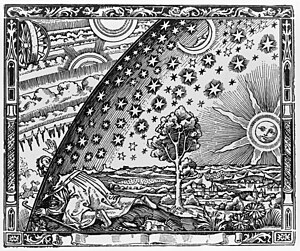
Jim Davila has picked up a discussion about ancient testimony to the earth’s spherical shape. Cicero also, by way of his Stoic character Balbus, comments to this effect, saying,
...[T]he sea, which is above the earth, tends still toward the earth’s centre, and so is itself shaped in conformity to the globe of the earth and nowhere spills or overflows. ( 171; affiliate disclosure; italics added)
Through its Academic Bible website’s homepage, the German Bible Society is offering a free download of the brochure Textual Research on the Bible: Introductions to the Scholarly Editions of the German Bible Society. The Society envisions that the brochure will
...provide insight into this fascinating field of research. We have particularly in mind the interests of first-year students, who might benefit from a basic introduction like this. Thus we invite lecturers of exegesis and textual criticism to make use of this brochure in their classrooms. (Letter from the German Bible Society and Nida Institute)
Van Til’s perspective resembles Kuhn’s. One major difference is that, where Kuhn has mutable paradigms, Van Til has a reality-constituting mind of God.
James Garland has an insightful article, “The Value of Humility in Academe (No Kidding)” at the Chronicle of Higher Education.


Joel Watts has up May’s “unsettled” biblioblog carnival, and last month, Joel Watts et al. unseated Jim West in the Alexa biblioblog ranking. Among this past months top 50 biblioblogs by Alexa rank, the top 10 student biblioblogs are:
...On Tuesday, Brian Croxall compared Zotero and EndNote. At least until a stable release of Zotero standalone arrives, the review has the two platforms standing fairly on equal terms. Recent updates to Zotero’s SBL citation style have included some additional issues, but hopefully, those problems will soon be remedied also.
...Having been away this past weekend, I have just gotten to pull March’s top student biblioblogs. March’s top 10 by Alexa rank are:
StudentOverallAuthor(s)Blog12Joel WattsUnsettled Christianity26Brian LePort, JohnDave Medina, Joshua Smith, Mark StevensNear Emmaus: Christ and Text313Amanda Mac, Rodney Thomas, Chad PressleyPolitical Jesus417Matthew CroweA Fistful of Farthings527Jeremy ThompsonFree Old Testament Audio Website Blog628Phillip LongReading Acts729Scott BaileyScotteriology831Mitchell PowellFont Words936Gavin RumneyOtagosh1038Bob Hayton, Jason Skipper, Damien Garofalo, Will Dudding, Erik DiVietro, and Phil DearmoreKJV Only Debate
...