Free ESV Audio Bible
Faith Comes by Hearing has a selection of free audio Bibles, including the English Standard Version.
Registration requires both an email and a physical address.
Faith Comes by Hearing has a selection of free audio Bibles, including the English Standard Version.
Registration requires both an email and a physical address.
In his Tyndale series Romans commentary, F. F. Bruce offers the following colorful, if also sad, illustration as he discusses Rom 6:
...A notable historical instance [of a tendency to read Paul as advocating antinomianism] may be seen in the Russian monk Rasputin, the evil genius of the Romanov family in its last years of power. Rasputin taught and exemplified the doctrine of salvation through repeated experiences of sin and repentance; he held that, as those who sin most require most forgiveness, a sinner who continues to sin with abandon enjoys, each time he repents, more of God’s forgiving grace than any ordinary sinner.((Bruce, Romans ( affiliate disclosure), 134.))
Communication is hermeneutical; it involves people sending and receiving messages. To make the communication process work, the sender(s) and receiver(s) both have to meet their own particular, communicative responsibilities. Of course, with literature like the New Testament, the people who sent the messages it contains cannot clarify or supplement anything they have already said. So, if communication is to happen, any modern readers, or receivers, must try to understand the text’s own communicative horizon, for all the problems that task entails (see this post for a discussion). On this task, consider the following, insightful comments from N. T. Wright’s New Testament and the People of God:
...St. Johns Nottingham has a helpful introduction to the life and philosophy of H.-G. Gadamer.
Michele Cushatt, Michael Hyatt, and Greg McKeown discuss “essentialism,” which is about saying “yes” to what matters most.
The Logos Academic Blog has reposted there my essay from January’s issue of Didaktikos on presence in online education. Received wisdom says that presence is harder to achieve online. Physically, this is hardly disputable … but there also seems to be quite a bit more to the question than is often brought out.
...Stephen Chan has a substantive essay on interaction between Jürgen Moltmann and Paul Ricoeur that focuses on the centrality of hope to Christian eschatology.
Holger Strutwolf has made the Editio Critica Maior for Acts freely available online.
Logos Bible Software appears to have started releasing an updated set of tutorials about syntax searching.
TopTracker provides a straight-forward, free time tracking utility that works on both Windows and OS X.
In a helpful 2003 essay, David Aune discusses “the use and abuse of the enthymeme in New Testament scholarship” (New Testament Studies 49, no. 3, 299–320).
Digital devices and media can make focus difficult. Freedom provides helpful of “training wheels” to foster better focus amid such distractions.
Texas Christian University’s open, online thesis repository contains John Burkett’s treatment of Book III of Aristotle’s Retoric. The project is a commentary-style work on that book that strives to complete the project that William Grimaldi began with Books I and II. According to the abstract,
...

In Dan Gookin’s Word 2016 for Dummies ( affiliate disclosure; Wiley, 2016), he provides a good deal of helpful guidance for beginning Word users. One particularly helpful resource that may be of interest more broadly is his nicely condensed presentation of prefix keys for producing diacritical marks (pg. 256, reproduced below).
...At theLAB, Rick Brannan has an interesting post about the most frequently cited verses in a selection of systematic theologies. Especially by comparison with the size of the two testaments, New Testament references vastly outnumber Old Testament references (90% to 10% in the top 100 most frequently cited texts). As a supplement to the analysis, it might also be interesting to see a bibliography of the exact systematic theologies involved in the accounting would be interesting, as well as whether there would be some way of calculating whether the sample size is large enough to be statistically significant (e.g., within the publication date ranges represented).
...On Academia.edu, Matthew Larsen has posted his recent Journal for the Study of the New Testament essay on “Accidental Publication, Unfinished Texts and the Traditional Goals of New Testament Textual Criticism.”
Peter Head has started a related discussion on the Evangelical Textual Criticism Blog.
...Stimulated by Craig Hill’s Servant of All: Status, Ambition, and the Way of Jesus (Eerdmans, 2016), Nijay Gupta provides some interesting excerpts and reflections. He comments, in part,
...I have learned that I cannot control what other people think of me. I need to be driven by what I think is right, keep my pride in check, have friends and colleagues who can graciously call me out if I err, and pass on generosity to those who are struggling just as others have lifted me up. I think we will be held back from doing all that we are called to do if we are overly occupied with how our work “looks” to others. I try to believe that if we commit ourselves to quality (and not just quantity), we should not be embarrassed with our work and productivity.
Mike Aubrey has provided an excerpt from an essay of his in Linguistics & Biblical Exegesis (Lexham, 2016). The excerpt strives carefully to work out a middle ground that is neither wholly on the side of theological lexica nor on that of James Barr’s critique of them.
... SBL Press continues to be quite responsive on its blog to questions submitted by users of the SBL Handbook of Style. One of the latest examples is the Press’s clarification of how to format citations from J.-P. Migne’s Patrologia Graeca. The 161-volume series is available online in the public domain from various sources, including Patristica.net and Document Catholica Omnia.


Focus is now the lifeblood of this economy.
Why? Because focus is rare and distraction abundant. As Hyatt comments,
...Geoffrey Smith has made available offprints of new transcriptions for 5258 (132), containing fragments of Eph 3:21–4:2, and 5259 (133), containing fragments of 1 Tim 3:13–4:8. Dated to the third century, 5259 (133) is the earliest published witness to 1 Timothy.
...Mark Ward helpfully describes the syntax of searching for particular highlighting styles in Logos Bible Software.
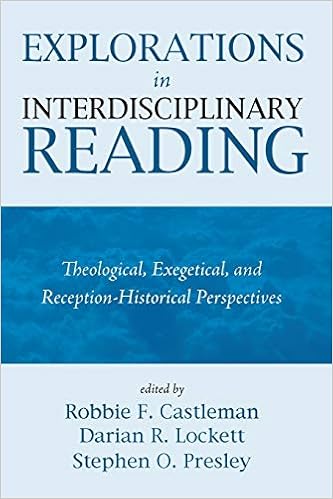 Explorations in Interdisciplinary Reading: Theological, Exegetical, and Reception-historical Perspectives, edited by Robbie Castleman, Darian Lockett, and Stephen Presley, appeared under Wipf and Stock’s Pickwick in 2017.
The volume includes essays assembled through the Institute for Biblical Research’s recently concluded study group on Biblical Theology, Hermeneutics, and Theological Disciplines.
...Free to Focus logo
As part of Michael Hyatt’s Free to Focus resource set, he’s made available three treat the significance for productivity of adequate, quality sleep:
Shawn Stevenson’s core business certainly falls in an area where probably few biblical scholars will care to follow. But some of the implications of the expertise that he has for broader productivity applications may indeed prove informative and helpful.
...This Decoded Science article has an interesting treatment of some of the chemical elements of the study of the Dead Sea Scrolls, particularly the Copper Scroll. The article’s conclusion provides the reminder that
...Archaeology allows us to look into the past. However, in order for scientists to properly examine and maintain artifacts, it’s necessary to preserve them. In many cases, chemistry makes that possible.

Michael Hyatt has a good discussion of digital notekeeping tools, a.k.a. “Evernote alternatives.” As even the nomenclature might suggest, Michael opts for Evernote.
I used Evernote for quite some time too but transitioned several months back to OneNote. I haven’t ever gotten particularly sold on Apple devices, so Apple-only alternatives were out by default.
...Software certainly can’t replace expertise when filtering through text-critical data. But it can provide some useful assistance in pulling that data together.
For an overview of some of the text-critical tools available in Logos Bible Software ( affiliate disclosure), check out the overview in this video for how to use the textual criticism section in the exegetical guide.
...Software that supports biblical and theological scholarship can be pricey, but Mark Hoffman has helpfully collected links to trial versions.


...Matthew Bates argues that faith or believing is not mere assent, not easy believism, but covenantal loyalty to the God who saves his people through the Lord Jesus Christ. Bates forces us to rethink the meaning of faith, the gospel, and works with a view to demonstrating their significance for true Christian discipleship. This will be a controversial book, but perhaps it is the controversy we need!