Judaism in Justification and Variegated Nomism

D. A. Carson, Peter O'Brien, and Mark Seifrid

D. A. Carson, Peter O’Brien, and Mark Seifrid

In contrast to Sanders’ emphasis on the essential consistency of Palestinian Judaism’s pattern of religion, the essays in Second Temple Judaism ( affiliate disclosure) emphasize the nomistic diversity, or variegation, that ancient Judaism exhibited.

Consequently, a concise summary of the whole volume that appreciates the variegated findings of each author would be difficult to produce. Therefore, below are brief, individual summaries for each of the essays. For more detailed summaries of the arguments in chapters 2–15, see Carson’s concluding essay (505–48). The bracketed numbers below refer to the chapter numbers in Second Temple Judaism; all parenthetical references also refer to this work unless otherwise noted.

...

October 19, 2018 Âˇ 11 min Âˇ J. David Stark

Discoveries in the Judaean Desert, Volume 32

Discoveries in the Judaean Desert, vol. 32 has two codices that provide photographs, transcriptions, an introduction, notes, and catalog of variants for 1QIsaa.

May 2, 2017 Âˇ 2 min Âˇ J. David Stark

In the (e)mail: Nanos and Zetterholm, “Paul within Judaism”

In addition to the Boccacci and Segovia and Rodríguez and Thiessen volumes, Fortress Press has kindly, if accidentally, passed along a review copy of Mark Nanos and Magnus Zetterholm’s edited volume Paul within Judaism: Restoring the First-century Context to the Apostle(2015). According to the book’s blurb:

In these chapters, a group of renowned international scholars seek to describe Paul and his work from “within Judaism,” rather than on the assumption, still current after thirty years of the “New Perspective,” that in practice Paul left behind aspects of Jewish living after his discovery of Jesus as Christ (Messiah). After an introduction that surveys recent study of Paul and highlights the centrality of questions about Paul’s Judaism, chapters explore the implications of reading Paul’s instructions as aimed at Christ-following non-Jews, teaching them how to live in ways consistent with Judaism while remaining non-Jews. The contributors take different methodological points of departure: historical, ideological-critical, gender-critical, and empire-critical, and examine issues of terminology and of interfaith relations. Surprising common ground among the contributors presents a coherent alternative to the “New Perspective.” The volume concludes with a critical evaluation of the Paul within Judaism perspective by Terence L. Donaldson, a well-known voice representative of the best insights of the New Perspective.

...

March 17, 2017 Âˇ 2 min Âˇ J. David Stark

In the (e)mail: Boccaccini and Segovia, “Paul the Jew”

Boccaccini and Segovia, “Paul the Jew” cover In my email recently, I found Fortress Press had kindly provided a review copy of Gabriele Boccaccini and Carlos Segovia’s edited volume Paul the Jew: Rereading the Apostle as a Figure of Second Temple Judaism(2016). According to the book’s blurb:

The decades-long effort to understand the apostle Paul within his Jewish context is now firmly established in scholarship on early Judaism, as well as on Paul. The latest fruit of sustained analysis appears in the essays gathered here, from leading international scholars who take account of the latest investigations into the scope and variety present in Second Temple Judaism. Contributors address broad historical and theological questions—Paul’s thought and practice in relationship with early Jewish apocalypticism, messianism, attitudes toward life under the Roman Empire, appeal to Scripture, the Law, inclusion of Gentiles, the nature of salvation, and the rise of Gentile-Christian supersessionism—as well as questions about interpretation itself, including the extent and direction of a “paradigm shift” in Pauline studies and the evaluation of the Pauline legacy. Paul the Jew goes as far as any effort has gone to restore the apostle to his own historical, cultural, and theological context, and with persuasive results.

...

March 15, 2017 Âˇ 1 min Âˇ J. David Stark

Journal of the Jesus Movement in its Jewish Setting

Access to the Journal of the Jesus Movement in its Jewish Setting is open and available online. JJMJS is:

a peer-reviewed academic open access journal, published electronically (immediate free online availability) in co-operation with Eisenbrauns, with support of McMaster University and Caspari Center….

The journal aims, uniquely, to advance scholarship on this crucial period in the early history of the Jewish and Christian traditions when they developed into what is today known as two world religions, mutually shaping one another as they did so. JJMJS publishes high-quality research on any topic that directly addresses or has implications for the understanding of the inter-relationship and interaction between the Jesus movement and other forms of Judaism, as well as for the processes that led to the formation of Judaism and Christianity as two related but independent religions.

...

November 2, 2016 Âˇ 1 min Âˇ J. David Stark

Thesis-style Numistmatism Wanted

From AWOL:

The American Numismatic Society has created an Open Access digital library. One purpose is to host unpublished and/or orphaned MA and PhD theses/dissertations that have numismatic content. As a part of this library your thesis will be Open Access, full-text searchable, and http://schema.org properties will help Google relevance. If you (or someone you know) wants their research hosted for free (CC-BY license) alongside other numismatic work, email Andrew Reinhard at areinhard@numismatics.org.

October 27, 2015 Âˇ 1 min Âˇ J. David Stark

Un-Bock-sing the Importance of Backgrounds

The Logos blog has a couple minute and slightly humorous segment from Darrell Bock on the importance of background information for New Testament Studies.

February 18, 2015 Âˇ 1 min Âˇ J. David Stark

Journal of the Evangelical Theological Society 55, no. 3

The Journal of the Evangelical Theological Society 55, no. 3 includes several articles of interest.

October 23, 2012 Âˇ 1 min Âˇ J. David Stark

Translation and Rewriting

[caption id=“attachment_7680” align=“alignright” width=“80” caption=“Marcus Tullius Cicero”] The Nature of the Gods[/caption]

In his translator’s comments on Cicero’s Nature of the Gods, H. C. P. McGregor makes the following observation about the task of translation:

One can . . . choose verbal accuracy at any price, translate each sentence word for word, and so produce a safe bud deadly crib. In an opposite extreme, one may throw all scholarly impedimenta overboard, let vocabulary and syntax go, seeking only to preserve in English dress the sense and argument of the original. . . . A third method goes beyond translation altogether and creates a new work in the image of the old, as Pope and Chapman did with Iliad and Odyssey. ( 64)

...

July 28, 2011 Âˇ 1 min Âˇ J. David Stark

Donnerstag Digest (August 19, 2010)

This week in the blogosphere:

  • James McGrath helpfully notes that John Byron, Associate Professor of New Testament at Ashland Theological Seminary, is now blogging at The Biblical World.
  • Sadly, Gerald Hawthorne passes away (HT: John Byron).
  • Helen Bond discusses the composition of the Sanhedrin in first-century Palestine.
  • Trevor provides a good summary of a variety of different ways to add records to Zotero.
  • Happy Dissertating suggests priming the writing pump as necessary via 750 Words. Based on what the site provides, it looks like a fully private blog could also be used in much the same way, but particularly for those who would prefer not to need to ensure for themselves that all their privacy settings are correct or who might enjoy some of the other features that 750 Words offers, the site may be worth a look.
  • Pat McCullough begins a bibliography of resources about the application of Social Identity Theory to biblical studies and invites suggestions for additions.

August 20, 2010 Âˇ 1 min Âˇ J. David Stark

Meerson, “One God Supreme”

Michael Meerson has the latest article in the Journal of Greco-Roman Christianity and Judaism, “One God Supreme: A Case Study of Religious Tolerance and Survival.” In this article, Meerson “attempt[s] to combine the consideration of both [θεὸς ὕψιστος and εἷς θεός]” as these titles are found in a sundial inscription from Mount Gerizim (32). For, although

[a] picture of a sundial with a Greek inscription was published in the 33rd (2000) issue of Qadmoniot, as an illustration to the essay of Y. Magen, ‘Mount Gerizim—A Temple City’ . . . the sundial’s inscription, neither transcribed nor translated, failed to provoke commentary. And yet the inscription is remarkable in many ways: one of only five Greek inscriptions from the Hellenistic era ever found on Mount Gerizim, it was discovered outside any architectural context. The inscription addresses θεὸς ὕψιστος, the God Most High, which would have provided the archaeologists of Gerizim with a doubly difficult quest: to identify the ‘nationality’ of the so-called god, and to find a temple in which this sundial would have stood—Samaritan, Seleucid or Roman. Inscriptions bearing the εἷς θεός invocation present a similar problem (32).

...

July 14, 2010 Âˇ 1 min Âˇ J. David Stark

Creation in Second Temple Judaism

Joel Watts has a very intriguing “showcase [of] several motifs in Second Temple Jewish thought” related to the creation narrative in Genesis 1–3. To read the three-part series, click below.

As a whole, the series “survey[s] . . . how certain authors interpreted and perhaps used the Creation account as a means to [their own] end[s].”

February 11, 2010 Âˇ 1 min Âˇ J. David Stark

מורה הצדק and Qumran Hermeneutics

In working through some bibliography recently for a conference paper proposal about מורה הצדק ( the teacher of righteousness), I came across the following:

Der Lehrer [der Gerechtigkeit] ist von Gott autorisiert, die Geheimnisse der Prophetenworte zu enträtseln, denn die Worte der Propheten sind Geheimnisse (רזים [pHab] 7,5), die man ohne Auslegung des Lehrers nicht verstehen kann. Der Lehrer tritt also mit seiner Verkündigung nicht neben die Schrift, sondern er basiert auf der Schrift. Er allein hat von Gott das rechte Verständnis offenbart bekommen. Darum kann er und mit ihm seine Gemeinde nach dem Willen Gottes leben ( Jeremias 141).

...

October 14, 2009 Âˇ 1 min Âˇ J. David Stark

Two Online Journals

As news to me, I recently found Jewish Studies, an Internet Journal and the Journal of Hebrew Scriptures openly accessible online.

September 24, 2009 Âˇ 1 min Âˇ J. David Stark

Online Papers and Lectures

Michael Bird comments that the papers for next week’s Louven conference, “New Perspectives on Paul and the Jews,” are available for download. Of the presenters listed in the program, only Anne-Marie Reijnen’s paper on ” Kosmos and Creation in Paul’s Thought” is not currently available.

Additionally, in the developing list of audio and video resources over at Evangelical Textual Criticism:

  • Tommy Wasserman mentions some audio and video material from Dan Wallace.
  • Mark Francois notes the availability of the video recordings of Stanley Porter’s 2008 Hayward Lectures.

September 10, 2009 Âˇ 1 min Âˇ J. David Stark

Little Bunny Fufu Meets the Maccabees

Sometimes, a bit of humor or oddity can be pedagogically advantageous. In this connection, I have tried to fit the chief, Maccabean figures into the chorus from “Little Bunny Fufu” (who may apparently appear, at least occasionally, as “Little Rabbit Fufu” in the UK) ( midi audio, lyrics).

There is, of course, a little fudging in this adaptation:

  • The first mention of a John Hyrcanus and an Aristobulus should naturally be taken as implying “the first” in their denominations, just as the second mention should be taken as implying “the second.” Creativity failed me, however, when trying to think of a tune where these additional epithets could be included without making nuisances of themselves.
  • Two slightly different pronunciations of Aristobulus appear (see Tomasino 330).
  • At the end of the ditty, little bunny Fufu ends up having to pick up the field mice and bop them on the head once more in order to squeeze in Antigonus Mattathias.

Still, even with these caveats, a ditty like this one could prove to be a useful tool for helping students learn a basic framework for the Maccabean period’s chief figures. Those who are interested can download or listen to the recording in mp3 format.

...

September 10, 2009 Âˇ 1 min Âˇ J. David Stark

Roland Deines on Halakah and Community Definition

In reading Roland Deines’ essay in Second Temple Judaism (“The Pharisees Between ‘Judaisms’ and ‘Common Judaism’”), I came across the following, astute paragraph:

If it is correct that it was particularly halakah that constituted Pharisees as Pharisees, it is also true that it constituted Essenes as Essenes and Sadducees as Sadducees. The same can be said regarding the other Jewish groups that existed prior to 70. This explains why the differences and even antagonism between these three basic movements (which included diverse elements within themselves) did not lead to the complete suspension of religious association within Judaism, whereas the association with early Christians broke off quite soon. All three Jewish movements oriented themselves basically around the Torah as the center of individual and national Jewish existence. In this system the Messiah was subordinated to Torah. For Christians, on the other hand, Christ became the center of individual as well as communal existence. In him, a person’s profound relationship with his own nation was expanded to an eschatological and thus at the same time universal horizon. The final breakdown came when the soteriological marginality of the Torah in relation to Christ could no longer be overlooked in the course of generational change. Even where Torah was observed with sincerity in Jewish-Christian congregations, it had still lost its absolute, eschatological dimension. It had, even in these congregations, reached its τέλος in Christ ( 499–500; italics added).

...

April 24, 2009 Âˇ 2 min Âˇ J. David Stark

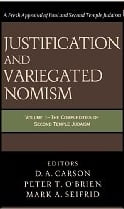
Justification and Variegated Nomism

[caption id=“attachment_1423” align=“alignleft” width=“80” caption=“D. A. Carson, Peter O’Brien, and Mark Seifrid”] D. A. Carson, Peter O’Brien, and Mark Seifrid[/caption]If first-century Judaism had a different shape than much New Testament scholarship has traditionally assumed, then an understanding of the New Testament’s—and especially Paul’s—negative critique of Judaism, as well as the positive, doctrinal affirmations predicated to some degree upon this traditional view of Judaism, may need to be revised. The direction this revision has taken based on the trajectory Sanders set in the last portion of Paul and Palestinian Judaism ( 431–556), 1 provides the impetus for the Justification and Variegated Nomism set ( Carson, O’Brien, and Seifrid 5). This set attempts to determine “whether ‘covenantal nomism’ serves us well as a label for an overarching pattern of religion” in Palestinian Judaism ( Carson, O’Brien, and Seifrid 5).

...

April 21, 2009 Âˇ 2 min Âˇ J. David Stark
9781506438146h

Judaism in Paul and Palestinian Judaism

The New Perspective on Paul has its beginnings in what N. T. Wright has called “the Sanders revolution.”

April 20, 2009 Âˇ 3 min Âˇ J. David Stark