Graves, ed., “Biblical interpretation in the early church”
Available in Fortress’s Ad fontes series is Biblical Interpretation in the Early Church, edited by Michael Graves.
In
addition to the Boccacci and
Segovia and RodrĂguez
and Thiessen volumes, Fortress Press has kindly, if
accidentally, passed along a review copy of Mark Nanos and Magnus
Zetterholm’s edited volume Paul
within Judaism: Restoring the First-century Context to the
Apostle(2015). According to the book’s blurb:
In these chapters, a group of renowned international scholars seek to describe Paul and his work from “within Judaism,” rather than on the assumption, still current after thirty years of the “New Perspective,” that in practice Paul left behind aspects of Jewish living after his discovery of Jesus as Christ (Messiah). After an introduction that surveys recent study of Paul and highlights the centrality of questions about Paul’s Judaism, chapters explore the implications of reading Paul’s instructions as aimed at Christ-following non-Jews, teaching them how to live in ways consistent with Judaism while remaining non-Jews. The contributors take different methodological points of departure: historical, ideological-critical, gender-critical, and empire-critical, and examine issues of terminology and of interfaith relations. Surprising common ground among the contributors presents a coherent alternative to the “New Perspective.” The volume concludes with a critical evaluation of the Paul within Judaism perspective by Terence L. Donaldson, a well-known voice representative of the best insights of the New Perspective.
...
In addition to Boccaccini and
Segovia’s Paul the Jew, inbox recently saw the arrival
from Fortress Press of a
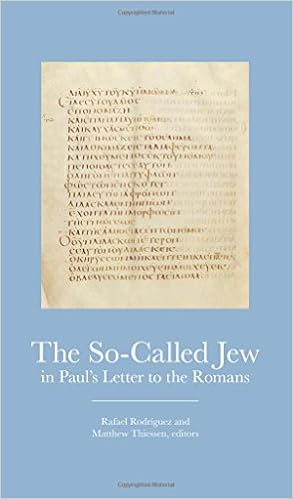
review copy of Rafael RodrĂguez and Matthew Thiessen’s edited volume The So-Called Jew in Paul’s Letter to
the Romans(2016). According to the book’s blurb:
Decades ago, Werner G. Kümmel described the historical problem of Romans as its “double character”: concerned with issues of Torah and the destiny of Israel, the letter is explicitly addressed not to Jews but to Gentiles. At stake in the numerous answers given to that question is nothing less than the purpose of Paul’s most important letter. In The So-Called Jew in Paul’s Letter to the Romans, nine Pauline scholars focus their attention on the rhetoric of diatribe and characterization in the opening chapters of the letter, asking what Paul means by the “so-called Jew” in Romans 2 and where else in the letter’s argumentation that figure appears or is implied. Each component of Paul’s argument is closely examined with particular attention to the theological problems that arise in each.
...
In
my email recently, I found Fortress Press had kindly
provided a review copy of Gabriele Boccaccini and Carlos Segovia’s
edited volume Paul the Jew:
Rereading the Apostle as a Figure of Second Temple
Judaism(2016). According to the book’s blurb:
The decades-long effort to understand the apostle Paul within his Jewish context is now firmly established in scholarship on early Judaism, as well as on Paul. The latest fruit of sustained analysis appears in the essays gathered here, from leading international scholars who take account of the latest investigations into the scope and variety present in Second Temple Judaism. Contributors address broad historical and theological questions—Paul’s thought and practice in relationship with early Jewish apocalypticism, messianism, attitudes toward life under the Roman Empire, appeal to Scripture, the Law, inclusion of Gentiles, the nature of salvation, and the rise of Gentile-Christian supersessionism—as well as questions about interpretation itself, including the extent and direction of a “paradigm shift” in Pauline studies and the evaluation of the Pauline legacy. Paul the Jew goes as far as any effort has gone to restore the apostle to his own historical, cultural, and theological context, and with persuasive results.
...