J. P. Migne’s two massive compilations of Patristic literature have now made their way onto Logos Bible Software’s community pricing platform ( Greek, Latin). Also appearing there now is some of René Graffin, Francois Nau, and Max de Saxe’s compilation of other Patristic texts not included in Migne’s anthologies.
...
Review of Biblical Literature Newsletter (December 7, 2012)
Zotero 3.0.11 and 3.0.11.1 have just been released with some additional bug fixes. For change logs, see here, and for basic introductory material to the platform, see here.
Review of Biblical Literature Newsletter (November 23, 2012)
Zotero 3.0.9 and 3.0.10 have recently been released with a number of bug fixes. For change logs, see here, and for basic introductory material to the platform, see here.
The folks at Zondervan sponsored this year’s Institute for Biblical Research meeting reception. In addition to the deserts there, they very kindly provided attending members with a copy of the recent (2012) Counterpoints volume on Paul, edited by Michael Bird. According to the publisher’s description:
...
Review of Biblical Literature Newsletter (November 15, 2012)
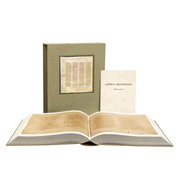
It’s still on the pricey side, but CBD currently has the Hendrickson facsimile of Codex Sinaiticus on sale for $499, $300 off the normal retail price. According to CBD’s product page,
Hendrickson Publishers, in conjunction with the British Library, is now releasing a limited number of full color facsimiles of the entire Codex Sinaiticus. This edition includes both the Old and New Testaments, represented by “life size” pages (13.5" x 16.5").
Totaling 828 pages, the facsimile edition comes in hardback binding accompanied by a sturdy slip case that is designed to provide support the weight of the facsimiles pages (app. 25lbs) and prevent them from tearing away from the back binding, as is common with many large hardback books. Finally the Codex Sinaiticus facsimile edition comes with a 32 page booklet that provides a brief outline of the history, discovery and immense value of this rare piece of history.
...
In the Mail: Driver, Brevard Childs
Daniel Driver
In yesterday’s mail arrived Daniel Driver’s Brevard Childs, Biblical Theologian: For the Church’s One Bible (Baker). The volume is a corrected, North American edition of Driver’s previous volume under the same title from Mohr Siebeck (2010; ix), which was itself a “thorough revision and updating” of Driver’s PhD thesis ( Brevard Childs: The Logic of Scripture’s Textual Authority in the Mystery of Christ, St. Andrews, 2008; xi). This North American edition was just released in August, and Baker’s description of it is as follows:
...
In the Mail: Tigay, Deuteronomy
The volume has been available for quite some time, but in yesterday’s mail arrived Jeffrey Tigay’s Deutronomy (The JPS Torah Commentary, 1996). According to the publisher,
The JPS Torah Commentary series guides readers through the words and ideas of the Torah. Each volume is the work of a scholar who stands at the pinnacle of his field.
Every page contains the complete traditional Hebrew text, with cantillation notes, the JPS translation of the Holy Scriptures, aliyot breaks, Masoretic notes, and commentary by a distinguished Hebrew Bible scholar, integrating classical and modern sources.
Each volume also contains supplementary essays that elaborate upon key words and themes, a glossary of commentators and sources, extensive bibliographic notes, and maps.
...
Ben Dunson and I were at Westminster together for a bit before his Durham days, and it’s wonderful to see that this volume is now available. For those who want to take a look at the original thesis, Durham has it archived here.
I hadn’t noticed until today, but among the volumes available at Loebolus is Aristotle’s Rhetoric (vol. 193; ed. J. H. Freese, 1926).
There are several observations to make regarding the text of the Greek New Testament in the apocryphal non-Gospel literature. (1) The evidence for the Greek New Testament in the apocryphal non-Gospel literature is not as great as one might expect, and this includes the apocryphal Acts, Epistles (for which there is no text early enough or in Greek for consideration) and Apocalypses. . . . (2) The Acts and apocalyptic apocryphal literature is relatively sparse in its use of the Greek New Testament, and is virtually nothing compared to that of the apocryphal Gospels. . . . (3) The evidence from the apocryphal non-Gospel literature is the same as that for the apocryphal Gospels—in other words, that the text of the Greek New Testament was relatively well established and fixed by the time of the second and third centuries. (197–98)
...
Review of Biblical Literature Newsletter (October 31, 2012)
One of our recent MLitt graduates through the Christian Institute for the Study of Liberal Arts, Joe Puckett, completed his thesis earlier this year, and it has now come to press with Wipf and Stock under the title, The Apologetics of Joy: A Case for the Existence of God from C. S. Lewis’s Argument from Desire. The title should soon also be available through other booksellers.
...
Runge, "Relative Saliency and Information Structure in Mark's Parable of the Sower"
Steven Runge has the latest article in Biblical and Ancient Greek Linguistics: “Relative Saliency and Information Structure in Mark’s Parable of the Sower.” According to the abstract:
This study applies the cognitive model of Chafe and Givón, and the information-structure model of Lambrecht as applied by Levinsohn and Runge to the Markan explanation of the Parable of the Sower (4:14–20). The primary objective is to identify and analyze other linguistic devices, besides demonstratives, which might clarify the apparent prominence given to the unfruitful scatterings in Mark’s account. This study provides the necessary framework for comparing Mark’s pragmatic weighting of saliency to that found in Matthew and Luke’s accounts in order to determine whether Mark’s version is consistent with or divergent from the other traditions.
...
Journal of the Evangelical Theological Society 55, no. 3
The Journal of the Evangelical Theological Society 55, no. 3 includes several articles of interest.
Open-Access JETS Archive
If I had noticed it before, it had since slipped my mind. But, the PDF archive for the Journal of the Evangelical Theological Society is largely open-access. The open-access portion of the archive contains all the Journal’s volumes except those from the past two full years, which are accessible to subscribers. The archive also contains the first four volumes of the older Bulletin of the Evangelical Theological Society.
Kristin De Troyer, “The Seventy-two and their Many Grandchildren: A Review of Septuagint Studies from 1997 Onward”
Nicholas Perrin and Christopher W. Skinner, “Recent Trends in Gospel of Thomas Research (1989–2011): Part II: Genre, Theology and Relationship to the Gospel of John”
Timo S. Paananen, “From Stalemate to Deadlock: Clement’s Letter to Theodore in Recent Scholarship”
Jonathan S. Milgram, “Then and Now: A Summary of Developments in the Field of Talmudic Literature through Contributions to the First and Second Editions of the Encyclopaedia Judaica”
Baxter, The Reformed Pastor
Richard Baxter (1615–1691; photo credit: Wikipedia)
For today’s “Pastor Appreciation Month” sale, Logos Bible Software is offering volume 14 of their series of Richard Baxter’s practical works for free. The volume includes Baxter’s classic The Reformed Pastor (1655) and his Confirmation and Restauration (1658).
The University of Pennsylvania has made available online a series of PDFs containing the New English Translation of the Septuagint (Oxford, 2009). In keeping with the NETS’s printed text, the beginning of each file also contains a good introduction to the translation that it provides (HT: Charles Jones).
...
Biblical-theological Preaching at the Westminster Bookstore