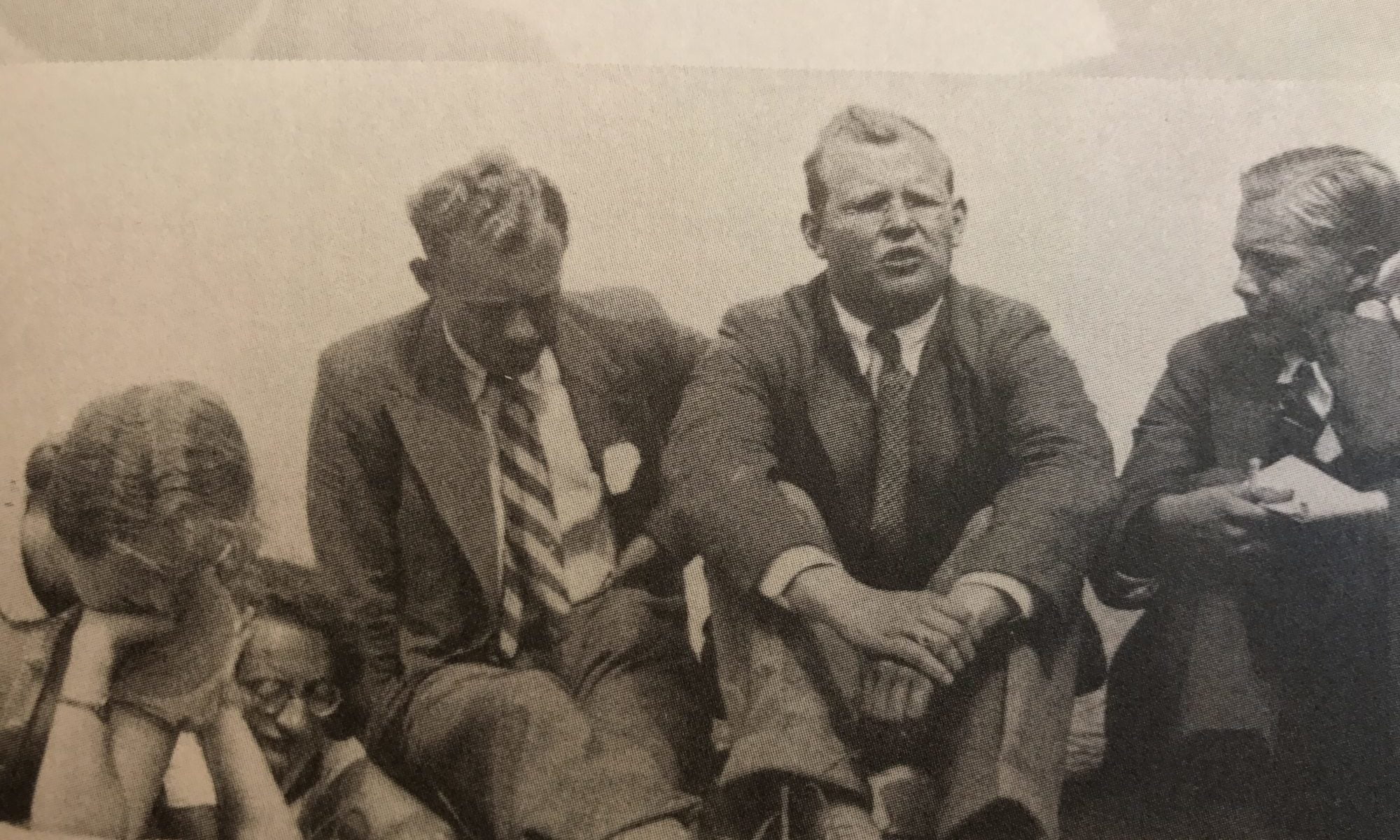
Why Authentic Doctrines Aren’t Freestanding
Doctrine needs to respond to a question that arises and demands an answer. If it’s a freestanding assertion, it loses connection with its life context.
Doctrine needs to respond to a question that arises and demands an answer. If it’s a freestanding assertion, it loses connection with its life context.
Daily Gleanings from Joe Gordon based on his book “Divine Scripture in Human Understanding.”
Daily Gleanings about Brandon Crowe’s forthcoming “Hope of Israel: The Resurrection of Christ in the Acts of the Apostles.”
Daily Gleanings about free books for August 2019 from Logos and Verbum.
Daily Gleanings about biblical theology from Eckhard Schnabel and Craig Keener’s commentary on Galatians from Larry Hurtado.
Daily Gleanings about new releases from SBL Press on the theology and intertextuality of the Hebrew Bible.
Daily Gleanings from RBL on Fiona Gregson’s, “Everything in Common?” and Jason Maston and Benjamin Reynolds’s, “Anthropology and New Testament Theology.”
Daily Gleanings on “Paul, a New Covenant Jew” and from J. T. Ellison on productivity as a writer.
Gleanings about essentialism and Charles Quarles's Matthean theology.
Due out with InterVarsity Press is John Walton’s “Old Testament Theology for Christians: From Ancient Context to Enduring Belief.”
Due out from Baker Academic in February 2018 is Ian Levy’s “Introducing Medieval Biblical Interpretation: The Senses of Scripture in Premodern Exegesis.”
Due out from Baker Academic in January 2018 is R. W. L. Moberly’s “The Bible in a Disenchanted Age: The Enduring Possibility of Christian Faith.”


Earlier this month, Rick Brannan posted an analysis of the most frequently cited in a selection of systematic theologies. Rick has since made available on his blog the bibliography of systematic theologies that fed this analysis.
Meanwhile, Christianity Today picked up the post for further discussion. According to CT,
...At theLAB, Rick Brannan has an interesting post about the most frequently cited verses in a selection of systematic theologies. Especially by comparison with the size of the two testaments, New Testament references vastly outnumber Old Testament references (90% to 10% in the top 100 most frequently cited texts). As a supplement to the analysis, it might also be interesting to see a bibliography of the exact systematic theologies involved in the accounting would be interesting, as well as whether there would be some way of calculating whether the sample size is large enough to be statistically significant (e.g., within the publication date ranges represented).
...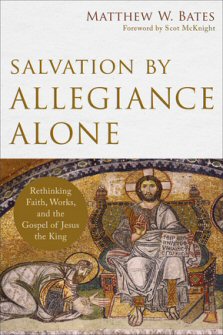 Over at the Logos Academic Blog, Tavis Bohlinger now has up the second part of his interview with Matthew Bates about his Salvation by Allegiance Alone: Rethinking Faith, Works, and the Gospel of Jesus the King (Baker, 2017). This interview portion focuses much more on Bates’s particular proposal in the volume.
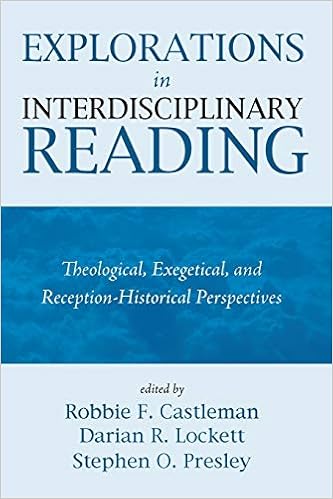 Explorations in Interdisciplinary Reading: Theological, Exegetical, and Reception-historical Perspectives, edited by Robbie Castleman, Darian Lockett, and Stephen Presley, appeared under Wipf and Stock’s Pickwick in 2017.
The volume includes essays assembled through the Institute for Biblical Research’s recently concluded study group on Biblical Theology, Hermeneutics, and Theological Disciplines.
... Annually, the St. George’s Centre for Biblical and Public Theology sponsors three seminars at SBL: Scripture and Church, Scripture and Doctrine, and Scripture and Hermeneutics (in partnership with the Institute for Biblical Research). Registration is now open for these seminars’ 2017 meetings in Boston, as well as for the accompanying dinner. The lectures and discussion are always quite stimulating.
 This month, Logos Bible Software’s free book is N. T. Wright’s Following Jesus: Biblical Reflections on Christian Discipleship (SPCK, 1994). The book falls into two parts:
...Part one outlines the essential messages of six major New Testament books—Hebrews, Colossians, Matthew, John, Mark, and Revelation. Part two examines six key New Testament themes—resurrection, rebirth, temptation, hell, heaven, and new life—and considers their significance for the lives of present-day disciples.

Today’s Advent givaway by Logos Bible Software is Geerhardus Vos’s Idea of Biblical Theology as a Science and as a Theological Discipline.
Google Books has two volumes of Christoph Friedrich Ammon’s Biblische Theologie (Erlangen: J. J. Palm, 1801) available in various full-text formats ( vol. 1, vol. 2).
[caption id=“attachment_4050” align=“alignright” width=“56”]  WTS Books[/caption]
Through September 3, the Westminster Bookstore has select Ed Clowney resources available at half-off, including:
As usual, the Bookstore has also included some related, free PDF or multimedia material on these books’ product pages.
...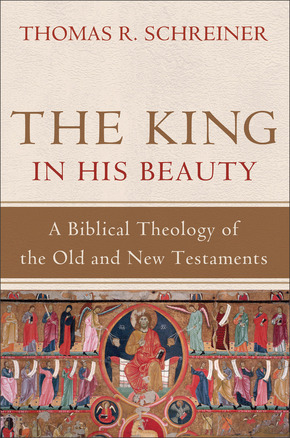
Baker and the Stone-Campbell Journal were kind enough to provide a copy of Tom Schreiner’s The King in His Beauty: A Biblical Theology of the Old and New Testaments. According to the publisher’s description, Schreiner:
...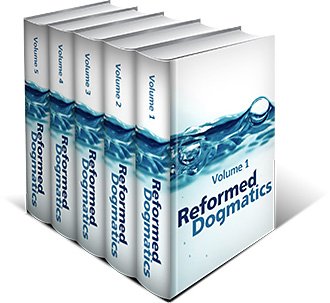 Logos Bible Software is currently preparing the first English translation of Geerhardus Vos’s Reformed Dogmatics. By way of background regarding Vos:
...[T]he “father of Reformed biblical theology,” was born 151 years ago this month. Vos, a professor of biblical theology at Princeton, lectured alongside many famous theologians, including J. Gresham Machen, B. B. Warfield, and Abraham Kuyper. So great was Vos’ academic insight that Kuyper offered him the chair of Old Testament studies at the Free University of Amsterdam when Vos was just 24.
Christopher Morgan and Robert Peterson, eds.
Crossway has recently released The Kingdom of God, co-edited by Christopher Morgan of Mid-America Baptist Theological Seminary, and Robert Peterson, of Covenant Theological Seminary. According to Crossway’s description:
...The kingdom of God is a very large biblical category indeed. Accordingly, a comprehensive understanding of the kingdom would illuminate many aspects of theology. With this in mind, Bruce Waltke, Robert Yarbrough, Gerald Bray, Clinton Arnold, Gregg Allison, Stephen Nichols, and Anthony Bradley have collaborated to articulate a full view of the kingdom of God across multiple disciplines. One of the most important books on the kingdom since G. E. Ladd, this volume offers a robust theology and is corroborated by the very series in which it stands. Fourth in the noted Theology in Community series, The Kingdom of God establishes the significance of the kingdom from the perspectives of biblical theology, systematic theology, history, pastoral application, missiology, and cultural analysis.
Daniel Driver
In yesterday’s mail arrived Daniel Driver’s Brevard Childs, Biblical Theologian: For the Church’s One Bible (Baker). The volume is a corrected, North American edition of Driver’s previous volume under the same title from Mohr Siebeck (2010; ix), which was itself a “thorough revision and updating” of Driver’s PhD thesis ( Brevard Childs: The Logic of Scripture’s Textual Authority in the Mystery of Christ, St. Andrews, 2008; xi). This North American edition was just released in August, and Baker’s description of it is as follows:
...Graeme Goldsworthy
New out earlier this year was Graeme Goldsworthy’s Christ-Centered Biblical Theology: Hermeneutical Foundations and Principles (InterVarsity). On the volume’s product page, the folks at the Westminster Bookstore have made available a PDF containing the volume’s first chapter, “Biblical Theology: Lame Duck or Eagles’ Wings?” (19–37).
... In acknowledgement of Westminster Seminary’s Preaching Conference later this month, the Westminster Bookstore is running a half (or more)-off special on Edmund Clowney’s Preaching and Biblical Theology, Graeme Goldsworthy’s Preaching the Whole Bible as Christian Scripture, as well as a number of other resources.
The latest reviews from the Review of Biblical Literature include:
Jewish Scriptures and Cognate Studies
New Testament and Cognate Studies
...On the web: