Daily Gleanings: Ptolemy IV (31 October 2019)
Daily Gleanings about the recent discovery of the tomb of Ptolemy IV Philopater.
Daily Gleanings about the recent discovery of the tomb of Ptolemy IV Philopater.
D. A. Carson, Peter O’Brien, and Mark Seifrid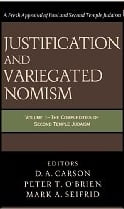
In contrast to Sanders’ emphasis on the essential consistency of Palestinian Judaism’s pattern of religion, the essays in Second Temple Judaism ( affiliate disclosure) emphasize the nomistic diversity, or variegation, that ancient Judaism exhibited.
...Due out this November is Randall Price and Wayne House’s “Zondervan Handbook of Biblical Archaeology.”
Shawn Wilhite discusses the primary literature reading schedule he’s been maintaining.
Discoveries in the Judaean Desert, vol. 32 has two codices that provide photographs, transcriptions, an introduction, notes, and catalog of variants for 1QIsaa.
Discussion of the recent Qumran-vicinity cave finds since the previous post tracking the story here includes:
What seems to be shaping up as the key question about the status of this new find’s designation as “Cave 12” is the question “What makes a cave worthy of inclusion inside the numbering?"—actual textual finds tied to the location or simply a strong possibility that ancient texts were once located in the cave? Barring additional news about thus-far undisclosed contents from this cave, the apparently blank parchment showing text under multispectral examination, or known texts’ being re-provenanced to this cave, it seems more in keeping with the criteria applied to derive the existing 11-cave scheme not to include this new cave as a twelfth in that sequence. But, of course, the new find remains quite significant and reopens important questions about possible issues of provenance for texts currently classified as deriving from the standard 11 caves.
...Jim Davila provides information about a Hezekiah seal impression find.
From AWOL:
...The American Numismatic Society has created an Open Access digital library. One purpose is to host unpublished and/or orphaned MA and PhD theses/dissertations that have numismatic content. As a part of this library your thesis will be Open Access, full-text searchable, and http://schema.org properties will help Google relevance. If you (or someone you know) wants their research hosted for free (CC-BY license) alongside other numismatic work, email Andrew Reinhard at areinhard@numismatics.org.
The Logos blog has a couple minute and slightly humorous segment from Darrell Bock on the importance of background information for New Testament Studies.

The Lexham Theological Wordbook began shipping late last year and includes my entry on “Forgiveness.”
The Lexham Bible Dictionary has recently been updated with, among other items, my entries on “Haifa” and “Jenin.”
Connections can read these contributions via my LinkedIn page under “Publications.”
...[caption id="" align=“alignright” width=“80”] John Walton, Victor Matthews, and Mark Chavalas[/caption]
Ahead of class this fall, the folks at InterVarsity have kindly forwarded John Walton, Victor Matthews, and Mark Chavalas’s Old Testament backgrounds commentary (2000). According to the publisher’s description,
...Alison Babeu has a new ebook freely available in PDF format: “Rome Wasn’t Digitized in a Day”: Building a Cyberinfrastructure for Digital Classicists (Washington, D. C.: Council on Library and Information Resources, 2011). According to the publisher,
...The author provides a summative and recent overview of the use of digital technologies in classical studies, focusing on classical Greece, Rome, and the ancient Middle and Near East, and generally on the period up to about 600 AD [ sic]. The report explores what projects exist and how they are used, examines the infrastructure that currently exists to support digital classics as a discipline, and investigates larger humanities cyberinfrastructure projects and existing tools or services that might be repurposed for the digital classics.
[caption id=“attachment_2049” align=“alignright” width=“100” caption=“D. A. Carson and Douglas Moo”] 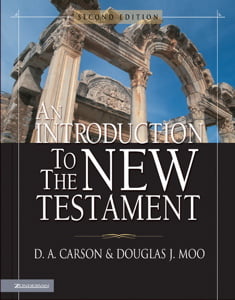 [/caption]
Thanks to the kind folks at Zondervan, I just received the second edition of D. A. Carson and Douglas Moo’s Introduction to the New Testament for use this fall. I had used the first edition (co-authored also with Leon Morris) when I took my initial New Testament Introduction course, so I will be interested (finally—this second edition has been available since 2005) to see firsthand what revisions have been made.
...[caption id=“attachment_4657” align=“alignright” width=“80” caption=“Natalio Marcos and Wilfred Watson”] 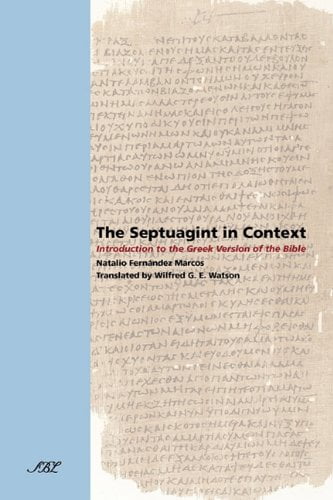 [/caption] The second edition of Natalio Marcos and Wilfred Watson’s Septuagint in Context: Introduction to the Greek Version of the Bible is now available in a somewhat more cost effective paperback from the Society of Biblical Literature. According to Brill, who has previously published the hardback edition,
Lipscomb University is set to host a symposium in honor of Everett Ferguson:
...Everett Ferguson’s Baptism in the Early Church offers an exhaustive survey of the literary and material evidence for baptismal practice in the first five centuries of Christian history. This symposium, hosted by the Christian Scholars’ Conference, brings together leading scholars to engage this magisterial work and to honor its author’s contribution to ecumenical theological scholarship ( Lipscomb).
In working through some bibliography recently for a conference paper proposal about מורה הצדק ( the teacher of righteousness), I came across the following:
...Der Lehrer [der Gerechtigkeit] ist von Gott autorisiert, die Geheimnisse der Prophetenworte zu enträtseln, denn die Worte der Propheten sind Geheimnisse (רזים [pHab] 7,5), die man ohne Auslegung des Lehrers nicht verstehen kann. Der Lehrer tritt also mit seiner Verkündigung nicht neben die Schrift, sondern er basiert auf der Schrift. Er allein hat von Gott das rechte Verständnis offenbart bekommen. Darum kann er und mit ihm seine Gemeinde nach dem Willen Gottes leben ( Jeremias 141).
As news to me, I recently found Jewish Studies, an Internet Journal and the Journal of Hebrew Scriptures openly accessible online.
The Biblical Archaeology Society catalog arrived yesterday with a list of free resources in the back, most of which are relevant for New Testament and related studies. Among these works are:
All of these works are helpfully illustrated. To access these resources, you will need to submit your name and email address, and you will receive an email with download information.
...David Lincicum has the latest article in the Journal of Greco-Roman Christianity and Judaism, “The Origin of “Alpha and Omega” (Revelation 1.8; 21.6; 22.13): A Suggestion.” Lincicum takes his point of departure from the fact that
...[Some] scholars have suggested that the title ‘Alpha and Omega’ in Revelation arose through reflection on the Greek form of the divine name, ΙΑΩ. This note takes up and extends that evidence to put forth the possibility that John ‘exegeted’ the divine name, in light of Isaiah 40–48 and emerging scribal practices of abbreviating the nomina sacra, as a reference to Jesus as the Alpha and Omega ( Lincicum 128).
Through his vast conquests, Alexander’s comparatively short life left several important marks on history:
In large measure, therefore, Alexander’s conquests accelerated the development or increased the strength of Hellenic influences that were already beginning to creep toward many of the areas that he subjugated.
...With Phillip II of Macedon’s (359–336 BC) son, Alexander the Great (356–323 BC), the Greeks established an empire vast enough to influence Palestine (see Ferguson 10, 13). When Thebes revolted after his father’s death, Alexander successfully re-unified the Greek city-states, albeit by conquest ( Plutarch, Alex. 11.3–6; Ferguson 12), and Alexander was made head of the campaign against Persia in his father’s stead ( Arrian, Anab. 1.1; cf. 1 Macc 1:1). In prosecuting this campaign, Alexander moved through Asia Minor ( Plutarch, Alex. 24.1), Phoenicia ( Plutarch, Alex. 24.1–25.2), Palestine ( Plutarch, Alex. 25.3–5), Egypt ( Plutarch, Alex. 26), Mesopotamia ( Plutarch, Alex. 31), Iran ( Plutarch, Alex. 37), and even as far as India ( Plutarch, Alex. 55; cf. 1 Macc 1:3–4) before dying in Babylon from a fever ( Plutarch, Alex. 75; cf. 1 Macc 1:5; see Ferguson 12). Yet, throughout these conquests, Alexander typically replaced neither the ruling class nor the religions in these conquered areas ( Ferguson 12). Rather, instead of primarily intending and explicitly acting to spread Hellenism, Alexander concentrated on appointing governors, placing garrisons, and founding cities ( Ferguson 12), things that eventually did indeed create and spread Hellenism.
...Over the coming weeks, I plan to write a series of posts that outline some background issues that seem particularly relevant for New Testament interpretation. Of the numerous points of historical background that could be included here, four dimensions of the period leading up to the turn of the era will initially receive attention. These background dynamics will include: (1) the Greek conquest and its continuing effects, (2) the Maccabean revolt and the Hasmonean period, (3) the Roman conquest, and (4) sectarian developments within Judaism. As the series grows, if other areas suggest themselves as being particularly salient, thoughts about additional topics will certainly be welcome.
...In reading Roland Deines’ essay in Second Temple Judaism (“The Pharisees Between ‘Judaisms’ and ‘Common Judaism’”), I came across the following, astute paragraph:
...If it is correct that it was particularly halakah that constituted Pharisees as Pharisees, it is also true that it constituted Essenes as Essenes and Sadducees as Sadducees. The same can be said regarding the other Jewish groups that existed prior to 70. This explains why the differences and even antagonism between these three basic movements (which included diverse elements within themselves) did not lead to the complete suspension of religious association within Judaism, whereas the association with early Christians broke off quite soon. All three Jewish movements oriented themselves basically around the Torah as the center of individual and national Jewish existence. In this system the Messiah was subordinated to Torah. For Christians, on the other hand, Christ became the center of individual as well as communal existence. In him, a person’s profound relationship with his own nation was expanded to an eschatological and thus at the same time universal horizon. The final breakdown came when the soteriological marginality of the Torah in relation to Christ could no longer be overlooked in the course of generational change. Even where Torah was observed with sincerity in Jewish-Christian congregations, it had still lost its absolute, eschatological dimension. It had, even in these congregations, reached its τέλος in Christ ( 499–500; italics added).
[caption id=“attachment_1423” align=“alignleft” width=“80” caption=“D. A. Carson, Peter O’Brien, and Mark Seifrid”] [/caption]If first-century Judaism had a different shape than much New Testament scholarship has traditionally assumed, then an understanding of the New Testament’s—and especially Paul’s—negative critique of Judaism, as well as the positive, doctrinal affirmations predicated to some degree upon this traditional view of Judaism, may need to be revised. The direction this revision has taken based on the trajectory Sanders set in the last portion of Paul and Palestinian Judaism ( 431–556), 1 provides the impetus for the Justification and Variegated Nomism set ( Carson, O’Brien, and Seifrid 5). This set attempts to determine “whether ‘covenantal nomism’ serves us well as a label for an overarching pattern of religion” in Palestinian Judaism ( Carson, O’Brien, and Seifrid 5).

The New Perspective on Paul has its beginnings in what N. T. Wright has called “the Sanders revolution.”
Despite the imperial connection that might have been expected to promote the Latin tongue, “[e]ven after Rome became the world power in the first century BCE, Greek continued to penetrate distant lands. (This was due largely to Rome’s policy of assimilation of cultures already in place, rather than destruction and replacement.) Consequently, [when Pompey conquered Palestine in 63 BC ( Ferguson 411) and] even when Rome was in absolute control [under Augustus in 31 BC-AD 14 (cf. Ferguson 26–30)], Latin was not the lingua franca. Greek continued to be a universal language until at least the end of the first century” ( Wallace 18). Moreover, when one considers the strong Jewish presence in Palestine, it becomes clear that Hebrew and Aramaic would constitute important languages in the Palestinian milieu (cf. Poirier 55).
...The linguistic situation in Palestine during the first century AD was, to say the least, quite complex because it involved interaction among four different languages—namely, Aramaic, Hebrew, Greek, and Latin. The presence of other languages is also apparent, and although few individuals were probably fluent in three or more of these languages, many were probably bilingual ( Poirier 56). In seeking to understand this multi-faceted situation, our strategy will be to handle the less common languages first and proceed to the more common ones. Although language distribution “varied almost personally” ( Poirier 56, quoting Barr 112), of primary concern will be the question: Which language(s) held vernacular or nearly vernacular status?
...A third instance of ‘gospel’ language in the wider Greco-Roman context is the Gaius inscription (ca. 5 BC):
...On the motion of the strategi Metrodorus son of Conon, Clinius, Musaeus, and Dionysius—
Whereas Gaius Julius Caesar, the eldest of the sons of Augustus has—as has been fervently prayed for—assumed in all its splendor the pure-white toga [of manhood] in place of the purple-bordered toga [of youth], and all men rejoice to see the prayers for his sons rising together to Augustus;
And whereas our city in view of so happy an event has decided to keep the day which raised him from a boy to a man as a holy day, on which annually all shall wear wreaths and festal garb, and the annual strategi shall offer sacrifices to the gods and render prayers through the sacred heralds for his preservation; to unite in consecrating an image of him set up in his father’s temple; also on which the city received the good news and the decree was ratified, to wear wreaths and perform most sumptuous sacrifices to the gods; and to send an embassy concerning these matters to go to Rome to congratulate him and Augustus;
Therefore it was resolved by the council and the people to dispatch envoys chosen from the most distinguished men for the purpose of bringing greetings from the city, of delivering to him the copy of this decree sealed with a public seal, and of discussing with Augustus the common interests of the province of Asia and of the city. . . (translated by Lewis and Reinhold 635; insertions and italics original).
Another example of ‘gospel’ language in the Greco-Roman environment is the inscription found at Priene (ca. 9 BC) about Augustus:
...It seemed good to the Greeks of Asia, in the opinion of the high priest Apollonius of Menophilus Azanitus: “Since Providence, which has ordered all things and is deeply interested in our life, has set in most perfect order by giving us Augustus, whom she filled with virtue that he might benefit humankind, sending him as a savior [σωτήρ], both for us and for our descendants, that he might end war [= ποιῇ εἰρήνην] and arrange all things, and since he, Caesar, by his appearance [ἐπιφανεῖν] (excelled even our anticipations), surpassing all previous benefactors, and not even leaving to posterity any hope of surpassing what he has done, and since the birthday of the god Augustus was the beginning of the good tidings for the world that came by reason of him [ἦρξεν δὲ τῷ κόσμῳ τῶν δἰ αὐτὸν εὐαγγελίων ἡ γενέθλιος τοῦ θεοῦ],” which Asia resolved in Smyrna (text and translation cited from Evans 2–3).
First century Christians were not unique in their use of ‘gospel’ language. In fact, this word group (which exhibits the εὐαγγελι- stem in Greek) actually comes into several connections in ancient literature. For instance, in his Jewish Wars, Josephus records the following:
...So the men of power, perceiving that the sedition was too hard for them to subdue, and that the danger which would arise from the Romans would come upon them first of all, endeavored to save themselves, and sent ambassadors; some to Florus, the chief of whom was Simon the son of Ananias; and others to Agrippa, among whom the most eminent were Saul, and Antipas, and Costobarus, who were of the king’s kindred; and they desired of them both that they would come with an army to the city and cut off the sedition before it should be too hard to be subdued. Now this terrible message was good news [εὐαγγέλιον] to Florus; and because his design was to have a war kindled, he gave the ambassadors no answer at all ( Josephus, Jewish Wars 2.418–20).