Bulletin for Biblical Research 23, no. 1

The latest issue of the Bulletin for Biblical Research arrived in yesterday’s mail and includes:

  • Joshua Philpot, “Exodus 34:29–35 and Moses’ Shining Face”
  • Edward Bridge, “The Metaphoric Use of Slave Terms in the Hebrew Bible”
  • Gregory Goswell, “Joshua and Kingship”
  • Gregory Wong, “A Farewell to Arms: Goliath’s Death as Rhetoric against Faith in Arms”
  • David DeSilva, “The Human Ideal, the Problem of Evil, and Moral Responsibility in 4 Maccabees”

April 2, 2013 · 1 min · J. David Stark

The Christ of His Christ

Gerbrand van den Eeckhout, 'Anna Presenting Her Son Samuel to the Priest Eli'

Gerbrand van den Eeckhout, ‘Anna Presenting Her Son Samuel to the Priest Eli’

In due order within The City of God’s longer discussion of Hannah’s prayer at Samuel’s dedication, 1 Augustine arrives at the clause, “[a]nd [he] shall exalt the horn of His Christ” ( 1 Sam 2:10). Here, Augustine ponders:

How shall Christ exalt the horn of His Christ? For He of whom it was said above, “The Lord hath ascended into the heavens,” [1 Sam 2:10 LXX; 4QSama col. 2, line 33] meaning the Lord Christ, Himself, as it is said here, “shall exalt the horn of His Christ.” Who, therefore, is the Christ of His Christ? Does it mean that He shall exalt the horn of each one of His believing people, as [Hannah] says in the beginning of this hymn, “Mine horn is exalted in my God?” [1 Sam 2:1 LXX, Vg.] For we can rightly call all those christs who are anointed with His chrism, forasmuch as the whole body with its head is one Christ. 2

...

June 23, 2012 · 2 min · J. David Stark

Thousands and Ten Thousands

[caption id=“” align=“alignright” width=“250” caption=“15th-c. Illumination (Photo credit: Wikipedia)”] David quittant son troupeau. David et Saül. Da…[/caption]
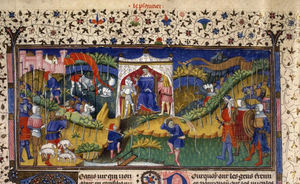
First Samuel 18:6 describes David’s return after killing Goliath ( 1 Sam 17:41–58). Precisely how this event sits chronologically in relationship to the surrounding narrative is difficult to establish. 1 One good way of reading the narrative, however, involves treating 1 Sam 18:1–5 as an extended parenthesis, which includes some foreshadowing, and understanding 1 Sam 18:6 to be bringing the reader back to the main plot line that had temporarily paused with 1 Sam 17:58. 2 In this context, it begins to be said הכה שׁאול֙ באלפו ודוד ברבבתיו ‎( 1 Sam 18:7; Saul has slain by his thousands and David by his ten thousands; see also 1 Sam 21:11; 29:5). 3 Yet, thus far, David has specifically been reported to have killed only one person (Goliath) and some animals ( 1 Sam 17:34–37)—not רבבת (ten thousands). 4 Rather, the women’s song quantitatively represents the qualitative value of David’s victory over Goliath as it relates to Saul’s previous exploits. 5 On hearing this song, then, Saul becomes enraged and starts looking and acting to do David harm ( 1 Sam 18:8–9).

...

April 22, 2012 · 5 min · J. David Stark