Biblioblog Top 50 (September 2009)
Per the Biblioblog Top 50, New Testament Interpretation actually rose 74 spaces in August to 104. Thanks very much to everyone for their interest last month.
The second issue of Ecclesia Reformanda is almost finished. This issue includes:
"‘And Their Children After Them’: A Response to Reformed Baptist Readings of Jeremiahâs New Covenant Promises," by Neil G. T. Jeffers
Journal’s Abstract: The promise of the New Covenant in Jeremiah 31:31-34 is a key text in the infant baptism debate. For Baptists, it describes the discontinuity between Old and New Covenants, highlighting in particular the individual, unbreakable, more subjective nature of the new. While paedobaptists often respond defensively, Jeremiah 32:37-41, where this promise is echoed with the important addition âfor their own good and the good of their children after themâ, suggests the Old Covenant principle of family solidarity may remain in place. This article re-examines the Baptist argument, and suggests closer exegesis shows that even Jeremiah 31 still includes children in the New Covenant.
...In his Four Gospels, Burnett Streeter articulates his view of the sources of Luke and proto-Luke as follows:
The hypothesis I propose in no way conflicts with the generally accepted view that Matthew and Luke are ultimately dependent not only on Mark but on Qâmeaning by Q a single written source. Most, if not all, of the agreements of Matthew and Luke, where Mark is absent, are, I think, to be referred to Q; but I desire to interpolate a stage between Q and the editor of the Third Gospel. I conceive that what this editor had before him was, not Q in its original formâwhich, I hold, included hardly any narrative and no account of the Passionâbut Q+L, that is, Q embodied in a larger document, a kind of “Gospel” in fact, which I will call Proto-Luke. This Proto-Luke would have been slightly longer than Mark, and about one-third of its total contents consisted of materials derived from Q (Streeter 208).
...
Three recent, Brill publications on the intersections between the New Testament and the Dead Sea Scrolls include:
[caption id=“attachment_3522” align=“alignleft” width=“80” caption=“Florentino GarcĂa MartĂnez”]
[/caption]
Publisher’s Summary: In spite of the amount of literature on the relationship between the Dead Sea Scrolls and the New Testament, no consensus among the scholars has emerged as yet on how to explain both the similarities and the differences among the two corpora of religious writings. This volume contains a revised form of the contributions to an “experts meeting” held at the Catholic University of Leuven on December 2007 dedicated to explore the relationship among the two corpora and to understand both the commonalities and the differences between the two corpora from the perspective of the common ground from which both corpora have developed: the Hebrew Bible.
...In the later half of the twentieth-century, Thomas Kuhn reappropriated and significantly adapted Immanuel Kantâs qualifications of empirical science (Kuhn, Essential Tension 336â37; Kuhn, Since Structure 103â104, 264). First published in 1962, Kuhnâs Structure of Scientific Revolutions replaced Kantâs transcendental truths of reason with theoretical âparadigmsâ (cf. Kuhn, Since Structure 264). This understanding puts Kuhn in an interesting position from which to shed light on the hermeneutical dimensions of biblical studies. Naturally, there have been some recent qualifications and objections to this application that deserve attention.
...Earlier this week, my wife, Carrie, started blogging at Stark Savings with some of the mass of the great deals that she finds and assorted other money-saving tips. The shopping results in her post from Tuesday about her most recent trip to Harris Teeter are pretty typical.
Somehow, I doubt that Stark Savings will come up in the list of biblioblogs and related blogs any time soon, but it could work: getting better deals > spending less money > having more money > buying more books about biblical studies. Or, maybe not ;-). In any case, particularly any biblical studies students or their family members who read this blog may also want to check out Stark Savings.
...Evernote is a program that manages assorted notes and images while attempting to render searchable any textâeven handwritten textâthat is in its database. While the program already provides some very useful features for biblical studies research, a beta version of a major overhaul for Evernote’s Windows client is now available. The new version mostly aims to enhance performance and to make future improvements easier.
...As news to me, I recently found Jewish Studies, an Internet Journal and the Journal of Hebrew Scriptures openly accessible online.
Mark Goodacre has updated the hermeneutics page at New Testament Gateway to include Holger Szesnat’s substantial list of online resources for biblical hermeneutics.
The Theological Writing Handout has been updated. The major change from 0.7 (beta) to 0.8 (beta) is the addition of example insets for each type of source that the handout mentions (see §32.11). The most recent version, 0.8.1 (beta), contains some minor, pagination changes in comparison with version 0.8. For fuller details on the changes made since version 0.7, please see the 0.7 to 0.8 and the 0.8 to 0.8.1 change logs.
...The latest reviews from the Review of Biblical Literature include the following:
New Testament and Cognate Studies
Hermeneutics
...Steve Runge has posted a fantastic essay on “The Bane of Dismissive Scholarship.” Among his most poignant statements are the following:
[T]he literature review and preparation for writing the paper. . . . is where I should be adding to my already profound arsenal of Knowledge, filling my cup til it runneth over. Realistically, I feel like many use this stage to fill their quiver with barbs that they will launch at other scholars. Why? Because some folks seem more interested in being right than in getting it right. . . . The specific issue that has got me in a tizzy is folks getting it mostly right, but being dismissed because of the portion that is lacking. To put it another way, instead of remodeling the missing element of the structure, they demo the whole thing so that THEY can be the builder, THEY can save the day. . . . It behooves me in writing my paper to stop and ask what my objective is: to be right or to get it right? If I am claiming something that no one else has ever claimed before, I have good reason to fear. If I am claiming something that represents the core idea the grammarians have expressed for over a century and I can build on or clarify that argument, there is a far greater chance of getting things right. It is a win-win: in getting it right, I get to be right (Runge, “Dismissive Scholarship”; italics and capitalization original).
...
The Biblical Archaeology Society catalog arrived yesterday with a list of free resources in the back, most of which are relevant for New Testament and related studies. Among these works are:
All of these works are helpfully illustrated. To access these resources, you will need to submit your name and email address, and you will receive an email with download information.
...Michael Bird comments that the papers for next week’s Louven conference, “New Perspectives on Paul and the Jews,” are available for download. Of the presenters listed in the program, only Anne-Marie Reijnen’s paper on " Kosmos and Creation in Paulâs Thought" is not currently available.
Additionally, in the developing list of audio and video resources over at Evangelical Textual Criticism:
...Sometimes, a bit of humor or oddity can be pedagogically advantageous. In this connection, I have tried to fit the chief, Maccabean figures into the chorus from “Little Bunny Fufu” (who may apparently appear, at least occasionally, as “Little Rabbit Fufu” in the UK) ( midi audio, lyrics).
...While reading around Justin Martyr’s First Apology this morning, I came across a few interesting points.
Historical In discussing the injustice of Christians’ condemnation, Justin says,
By the mere application of a name, nothing is decided, either good or evil, apart from the actions implied in the name; and indeed, so far at least as one may judge from the name we are accused of, we are most excellent people. But as we do not think it just to beg to be acquitted on account of the name, if we be convicted as evil-doers, so, on the other hand, if we be found to have committed no offence, either in the matter of thus naming ourselves, or of our conduct as citizens, it is your part very earnestly to guard against incurring just punishment, by unjustly punishing those who are not convicted. For from a name neither praise nor punishment could reasonably spring, unless something excellent or base in action be proved. And those among yourselves who are accused you do not punish before they are convicted; but in our case you receive the name as proof against us, and this although, so far as the name goes, you ought rather to punish our accusers. For we are accused of being Christians, and to hate what is excellent (Chrestian) is unjust (Justin, 1 Apol. 4; emphasis added).
...
The latest reviews from the Review of Biblical Literature include the following:
New Testament and Cognate Studies
Other Fields
...Jim West reports that the steering committee for the Society of Biblical Literature’s Biblioblog Program Unit has been formed. The committee will initially consist of April DeConick, Mark Goodacre, Stephanie Fisher, and Robert Cargill. The committee will begin working with plans for the 2010 SBL meeting in Atlanta.
...To the extent that New Testament Studies is a historical discipline, it shares the features of other historical disciplines. Among these features are its own historical-affectedness:
If we are trying to understand a historical phenomenon from the historical distance that is characteristic of our hermeneutical situation, we are always already affected by history. It determines in advance both what seems to us worth inquiring about and what will appear as an object of investigation, and we more or less forget half of what is really thereâin fact, we miss the whole truth of the phenomenonâwhen we take its immediate appearance as the whole truth ( Gadamer 300).
...
Thanks to Mark Hoffman for introducing a version of the Biblioblog-SBL Affiliate badge with a non-white background. With this color change, in an effort at collaborative improvement, I was able to get OpenOffice.org Draw to translate this background to transparent for use on blogs or places on blogs with non-white backgrounds.
...David Lincicum has the latest article in the Journal of Greco-Roman Christianity and Judaism, “The Origin of “Alpha and Omega” (Revelation 1.8; 21.6; 22.13): A Suggestion.” Lincicum takes his point of departure from the fact that
[Some] scholars have suggested that the title âAlpha and Omegaâ in Revelation arose through reflection on the Greek form of the divine name, ÎÎΩ. This note takes up and extends that evidence to put forth the possibility that John âexegetedâ the divine name, in light of Isaiah 40â48 and emerging scribal practices of abbreviating the nomina sacra, as a reference to Jesus as the Alpha and Omega ( Lincicum 128).
...
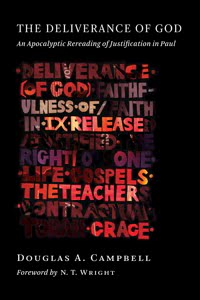
Douglas Campbell
Douglas Campbell’s new book, The Deliverance of God: An Apocalyptic Rereading of Justification in Paul, has come to publication at Eerdmans. The publisher’s description reports that:
In this scholarly book Douglas Campbell pushes beyond both “Lutheran” and “New” perspectives on Paul to a noncontractual, “apocalyptic” reading of many of the apostle’s most famous-and most troublesome-texts.
Campbell holds that the intrusion of an alien, essentially modern, and theologically unhealthy theoretical construct into the interpretation of Paul has produced an individualistic and contractual construct that shares more with modern political traditions than with either orthodox theology or Paul’s first-century world. In order to counteract that influence, Campbell argues that it needs to be isolated and brought to the foreground before the interpretation of Paul’s texts begins. When that is done, readings free from this intrusive paradigm become possible and surprising new interpretations unfold.
...
The widely used New International Version is slated for an update in 2011, its first revision in 25 years. According to the press release:
“As time passes and English changes, the NIV we have at present is becoming increasingly dated. If we want a Bible that English speakers around the world can understand, we have to listen to, and respect, the vocabulary they are using today.” . . . “The new 2011 NIV is all about maintaining and enhancing the original values of the NIV for today’s readers.” . . . “We’re looking for a translation that is above all accurate â that says what the original authors said in the way they would have said it had they been speaking in English to the global English-speaking audience today. We’re looking for a translation that offers clarity â where understanding comes naturally and readers can quickly grasp the original authors’ ideas and the cadence of their language. We’re looking for a translation that is suitable both for in-depth study and for outreach â a translation that Christians can share with their neighbors without hindrance whether they are experienced Bible readers or interested newcomers.
...
A few recent, noteworthy posts in the biblioblogs:
Michael Bird and Michael Whitenton have an article in the newest issue of New Testament Studies: “The Faithfulness of Jesus Christ in Hippolytusâs De Christo et Antichristo: Overlooked Patristic Evidence in the Î ÎčÌÏÏÎčÏ Î§ÏÎčÏÏÎżÏ Í Debate.”
...This post is somewhat belated, but I have just recently been able to listen to this year’s Carver-Barnes Lectures. On March 25, Ken Myers delivered a lecture on the “Comprehensive Character of Christian Discipleship.” Ken followed on the 26th with a lecture on the “Counter-Cultural Imperative for Christian Disciplers.”
As much as a good many discussions of the relationship(s) between Christianity and culture lack a certain degree of care and nuance, Ken has a number of highly astute insights, not least on issues related to the anthropology of the modern, Western Christian community. In addition, Ken’s irenic disposition in these lectures and in the colloquium that followed made his observations and suggestions all the more engaging.
...Through his vast conquests, Alexanderâs comparatively short life left several important marks on history:
In large measure, therefore, Alexander’s conquests accelerated the development or increased the strength of Hellenic influences that were already beginning to creep toward many of the areas that he subjugated.
...Although it certainly can be used otherwise, a progress tracking system like the one Paul Silvia suggests in his book How to Write a Lot seems to work best for writing that can be open ended: by following a regular writing schedule, projects can regularly and reliably come to completion. What happens, however, if one is working under a deadline (be it self-imposed or not) and, therefore, needs to develop a writing schedule backwards from this due date?
...With Phillip II of Macedonâs (359â336 BC) son, Alexander the Great (356â323 BC), the Greeks established an empire vast enough to influence Palestine (see Ferguson 10, 13). When Thebes revolted after his fatherâs death, Alexander successfully re-unified the Greek city-states, albeit by conquest ( Plutarch, Alex. 11.3â6; Ferguson 12), and Alexander was made head of the campaign against Persia in his fatherâs stead ( Arrian, Anab. 1.1; cf. 1 Macc 1:1). In prosecuting this campaign, Alexander moved through Asia Minor ( Plutarch, Alex. 24.1), Phoenicia ( Plutarch, Alex. 24.1â25.2), Palestine ( Plutarch, Alex. 25.3â5), Egypt ( Plutarch, Alex. 26), Mesopotamia ( Plutarch, Alex. 31), Iran ( Plutarch, Alex. 37), and even as far as India ( Plutarch, Alex. 55; cf. 1 Macc 1:3â4) before dying in Babylon from a fever ( Plutarch, Alex. 75; cf. 1 Macc 1:5; see Ferguson 12). Yet, throughout these conquests, Alexander typically replaced neither the ruling class nor the religions in these conquered areas ( Ferguson 12). Rather, instead of primarily intending and explicitly acting to spread Hellenism, Alexander concentrated on appointing governors, placing garrisons, and founding cities ( Ferguson 12), things that eventually did indeed create and spread Hellenism.
...In mid-June, I posted a review of Paul Silvia’s book How to Write a Lot with an additional tool for tracking writing progress. Yet, for academic work, non-productive non-writing time can be at least as important as important:
Is academic writing more important than spending time with your family and friends, petting the dog, and drinking coffee? A dog unpetted is a sad dog; a cup of coffee forsaken is caffeine lost forever. Protect your real-world time just as you protect your scheduled writing time ( Silvia 132).
...
Over the coming weeks, I plan to write a series of posts that outline some background issues that seem particularly relevant for New Testament interpretation. Of the numerous points of historical background that could be included here, four dimensions of the period leading up to the turn of the era will initially receive attention. These background dynamics will include: (1) the Greek conquest and its continuing effects, (2) the Maccabean revolt and the Hasmonean period, (3) the Roman conquest, and (4) sectarian developments within Judaism. As the series grows, if other areas suggest themselves as being particularly salient, thoughts about additional topics will certainly be welcome.
...