J. David Stark
  • Start Honing Your Craft 
  • About
  • Blog
  • Resources
  • Store
  • Vita 
  • 🔍

Blog

The Power of Private Presuppositions

Presuppositions that remain unacknowledged at least to oneself can still exercise strong influence. Indeed,

[a] person who believes he is free of prejudices, relying on the objectivity of his procedures and denying that he is himself conditioned by historical circumstances, experiences the power of the prejudices that unconsciously dominate him as a vis a tergo. A person who does not admit that he is dominated by prejudices will fail to see what manifests itself by their light [because it will not be foregrounded from them] (Gadamer, Truth and Method, 2006, 354 and Gadamer, Truth and Method, 2013, 369).

...

February 3, 2010 Â· 2 min Â· J. David Stark

Edwards on Faith and Justification

Since Michael Bird’s books are still in transit, cross-checking with Piper’s Future of Justification, 24–25 n. 30 ( PDF), that Bird’s post (“Justification - Publications and Conferences”) mentions, here is the relevant Jonathan Edwards quote to accompany the other excellent remarks in Bird’s post:

The design of the parable [of the Pharisee and the publican] is to show them, that the very publicans shall be justified, rather than they; as appears by the reflection Christ makes upon it, Luke xviii. 14. “I tell you, this man went down to his house justified rather than the other;” that is, this and not the other. The fatal tendency of it might also be proved from its inconsistence with the nature of justifying faith, and with the nature of that humiliation that the Scripture often speaks of as absolutely necessary to salvation; but these scriptures are so express that it is needless to bring any further arguments.

...

February 3, 2010 Â· 3 min Â· J. David Stark

ΖΩΗ ΕΚ ÎÎ•ÎšÎĄÎ©Î (Romans 11:15)

In Rom 11:15, Paul’s reference to ζωᜎ ጐÎș ΜΔÎșÏáż¶Îœ ( life from the dead) may refer to bodily resurrection, but it may also be read as metaphorically referring to the restoration of the then hardened portion of Israel into participation in the blessings of the Abrahamic covenant that Paul regards as having come to fruition in Jesus:

...

February 2, 2010 Â· 3 min Â· J. David Stark

Donaldson, “Explicit References to New Testament Variant Readings”

Amy Donaldson’s dissertation on Explicit References to New Testament Variant Readings among Greek and Latin Church Fathers is now available in PDF format through Notre Dame’s thesis and dissertation database. According to the abstract,

In his introduction to New Testament textual criticism, Eberhard Nestle stated a desideratum, later repeated by Bruce Metzger, for a collection, arranged according to time and locality, of all passages in which the church fathers appeal to New Testament manuscript evidence. Nestle began this project with a list of references; Metzger continued the work by examining the explicit references to variants by Origen and Jerome and expanding Nestle’s list. This dissertation picks up where Metzger left off, expanding and evaluating the list. The purpose is to contribute to patristics and New Testament textual criticism in two ways: first, by providing a helpful catalogue of patristic texts that refer to variant readings; and second, by analyzing the collected data with a focus on the text-critical criteria used by the fathers.

...

February 2, 2010 Â· 2 min Â· J. David Stark

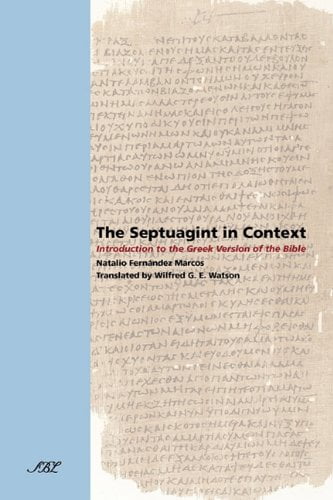
Marcos and Watson, “Septuagint in Context”

[caption id=“attachment_4657” align=“alignright” width=“80” caption=“Natalio Marcos and Wilfred Watson”] Septuagint in Context[/caption] The second edition of Natalio Marcos and Wilfred Watson’s Septuagint in Context: Introduction to the Greek Version of the Bible is now available in a somewhat more cost effective paperback from the Society of Biblical Literature. According to Brill, who has previously published the hardback edition,

This translation of the second—revised and expanded—Spanish edition deals fully with the origins of the Septuagint. It discusses its linguistic and cultural frame, its relation to the Hebrew text and to the Qumran documents, the transmission of the Septuagint and its reception by Jews and Christians. It includes the early revisions, Aquila, Symmachus and Theodotion, the Christian recensions and particularly Origen’s Hexapla, Biblical commentaries and catenae, as well as other issues such as the relation of the Septuagint to Hellenism, to the New Testament and to Early Christian Literature. It is a comprehensive introduction to the Septuagint, the first translation and interpretation of the Hebrew Bible, and to other Greek versions of the Bible.

...

February 2, 2010 Â· 1 min Â· J. David Stark

Biblical Studies Carnival XLX

Biblical Studies Carnival XLX is available at Abnormal Interests in two sections: one based on submitted posts and the other based on Duane Smith’s own blog reading and interests.

HT: James McGrath

February 1, 2010 Â· 1 min Â· J. David Stark

Tradition and Method

Despite the preeminence sometimes assigned to method in hermeneutics,

[i]n seeking to understand tradition[,] historical consciousness must not rely on the critical method with which it approaches its sources, as if this preserved it from mixing in its own judgments and prejudices. It must, in fact, think within its own historicity. To be situated within a tradition does not limit the freedom of knowledge but makes it possible ( Gadamer 354).

...

February 1, 2010 Â· 1 min Â· J. David Stark

PhD Opening at Groningen

The University of Groningen is seeking a PhD candidate for the project: The Jewish Revolt against Rome: Religious Groups and the Shaping of Identities in First-Century Judaea:

The Graduate School of Theology and Religious Studies of the University of Groningen is looking for a PhD candidate (0,9 fte) for the project ‘The Jewish Revolt against Rome: Religious Groups and the Shaping of Identities in First-Century Judaea’.

This PhD position is financed by a grant of the SNS/Reaal Fund. It will run parallel to the interdisciplinary NWO VENI project The Dead Sea Scrolls and the Jewish War against Rome (66–70), which investigates the impact of Rome on the self-understanding of a Jewish group at Qumran prior to the revolt. PhD candidates are expected to carry out research within the historical and archaeological framework of first-century Judaea in relation to the impact of the Roman Empire on the region and the conflict of 66–70/73. Projects may investigate e.g. Flavius Josephus’ position, specific Jewish groups, Roman reactions, specific sites, regions or interregional connections from different perspectives and on the basis of different sources (literary, archaeological and/or numismatic). The final form of the PhD project will be determined in consultation with the PhD candidate.

...

February 1, 2010 Â· 1 min Â· J. David Stark

Biblioblog Rankings (January, 2010)

Jeremy Thompson has the automated, monthly Alexa chart available for a short(er) list of 237 biblioblogs for which Alexa reported rating data. This month, New Testament Interpretation saw a bump up to slot 156, and not surprisingly, Joel Watts tops the chart.

January 31, 2010 Â· 1 min Â· J. David Stark

2010 ETS Call for Papers

The call for papers for the 2010 annual Evangelical Theological Society meeting is available. Proposals are due by March 31. This year’s theme will be “Justification by Faith” with plenary addresses by John Piper, N. T. Wright, and Frank Thielman, a lineup that promises to be highly engaging. Moreover, this year’s program will also include, on Friday morning, a two-hour panel discussion with the plenary speakers.

January 29, 2010 Â· 1 min Â· J. David Stark

Ferguson Symposium at Lipscomb University

Lipscomb University is set to host a symposium in honor of Everett Ferguson:

Everett Ferguson’s Baptism in the Early Church offers an exhaustive survey of the literary and material evidence for baptismal practice in the first five centuries of Christian history. This symposium, hosted by the Christian Scholars’ Conference, brings together leading scholars to engage this magisterial work and to honor its author’s contribution to ecumenical theological scholarship ( Lipscomb).

I have yet to read Ferguson’s Baptism, though it does look like a fascinating work, but I have particularly appreciated and enjoyed his Backgrounds of Early Christianity and his topical compilations of various early Christian sources in Early Christians Speak ( vol. 1, vol. 2). Those interested in the symposium who can or will be around Nashville on June 4 may want to peruse further the symposium schedule and registration information.

...

January 27, 2010 Â· 1 min Â· J. David Stark

Zotero 2.0 Release Candidates

Yesterday, Zotero 2.0 moved from beta into its first and second release candidate versions. If you have yet to try Zotero, you may download it or view the video introduction from their homepage. At this point, Society of Biblical Literature Handbook of Style support is still under development, but even so, Zotero does provide a fairly good approximation that can be tweaked here and there with reasonable ease.

Also, with the recent release of Google Chrome 4 and its “full” extension support, my curiosity was renewed about whether a Google Chrome port of Zotero might be feasible so that Zotero could take advantage of Chrome’s improved JavaScript engine. Yet, Chrome’s extension system apparently does not provide the necessary support for some key, Zotero features. So, Zotero will remain tied to Firefox for the foreseeable future and will continue seeing the benefits of future JavaScript engine improvements as have also already been made for Firefox 3.5 and 3.6.

...

January 27, 2010 Â· 1 min Â· J. David Stark

RBL Newsletter (January 22, 2010)

The latest reviews from the Review of Biblical Literature include the following:

New Testament and Cognate Fields

  • Roger S. Bagnall, Early Christian Books in Egypt, reviewed by Larry Hurtado
  • Adam H. Becker and Annette Yoshiko Reed, eds., The Ways That Never Parted: Jews and Christians in Late Antiquity and the Early Middle Ages, reviewed by Chad Spigel
  • James H. Charlesworth, The Earliest Christian Hymnbook: The Odes of Solomon, reviewed by Michael Lattke
  • Robert Goldenberg, The Origins of Judaism: From Canaan to the Rise of Islam, reviewed by Lester L. Grabbe
  • Michael J. Gorman, Inhabiting the Cruciform God: Kenosis, Justification, and Theosis in Paul’s Narrative Soteriology, reviewed by Sigurd Grindheim
  • Larry R. Helyer, The Witness of Jesus, Paul and John: An Exploration in Biblical Theology, reviewed by Petrus Grabe
  • James Allen Hewett, New Testament Greek: A Beginning and Intermediate Grammar, reviewed by Laurence Vance
  • Konrad Huber and Boris Repschinski, eds., Im Geist und in der Wahrheit: Studien zum Johannesevangelium und zur Offenbarung des Johannes sowie andere BeitrĂ€ge. Festschrift fĂŒr Martin Hasitschka SJ zum 65. Geburtstag, reviewed by Michael Labahn
  • Adam Kamesar, ed., The Cambridge Companion to Philo, reviewed by Torrey Seland
  • Robert Kugler and Patrick Hartin, An Introduction to the Bible, reviewed by Pieter Venter
  • Hermann von Lips, Timotheus und Titus: Unterwegs fĂŒr Paulus, reviewed by Korinna Zamfir
  • Eduard Lohse, Das Urchristentum: Ein RĂŒckblick auf die AnfĂ€nge, reviewed by Markus Oehler
  • Stuart L. Love, Jesus and Marginal Women: The Gospel of Matthew in Social-Scientific Perspective, reviewed by Esther A. de Boer
  • Douglas J. Moo, The Letters to the Colossians and to Philemon, reviewed by Christopher Beetham
  • Osvaldo Padilla, The Speeches of Outsiders in Acts: Poetics, Theology and Historiography, reviewed by Deborah Thompson Prince
  • Chantal Reynier, Saint Paul sur les routes du monde romain: Infrastructures, logistique, itinĂ©raires, reviewed by Michel Gourgues
  • Tom Thatcher, Greater than Caesar: Christology and Empire in the Fourth Gospel, reviewed by Benjamin Reynolds
  • Fabian Udoh, ed., Redefining First-Century Jewish and Christian Identities: Essays in Honor of Ed Parish Sanders, reviewed by Joshua Schwartz
  • Tor Vegge, Paulus und das antike Schulwesen: Schule und Bildung des Paulus, reviewed by Jens Herzer
  • N. T. Wright, Justification: God’s Plan and Paul’s Vision, reviewed by V. George Shillington

Hermeneutics and Cognate Fields

...

January 23, 2010 Â· 3 min Â· J. David Stark

Want to Help SBL?

Take this survey about a new website that the Society of Biblical Literature is developing with a grant from the National Endowment for the Humanities. According to today’s email announcement from the Society, the site is generally intended to function as a medium for making biblical scholarship more widely available and encouraging interaction with the biblical literature. So, if you might be interested in using such a site, head over to Survey Monkey, and give the Society your input.

...

January 15, 2010 Â· 1 min Â· J. David Stark

Keener Interview (Part 2) Posted

Yesterday, Nijay Gupta posted the first half of his interview with Craig Keener, and the second half of the interview is now available.

January 14, 2010 Â· 1 min Â· J. David Stark

In the Biblioblogs

In the past few days, there have been several very interesting posts around the biblioblogosphere. To highlight some of those posts here:

  • Tommy Wasserman reports the new online presence of Bodmer 25 (GA 556) and, at MĂŒnster’s Virtual Manuscript Room, another 60 manuscripts as well. This morning also sees the beginning of a series in which Philip Payne is critically responding to Peter Head’s contention that the distigmai in Vaticanus “mark[] textual variation” and “belong to one unified system that was added some time in the 16th century.”
  • John Anderson has an excellent and substantive interview with Richard Hays (HT: Stephen Carlson), and Andy Rowell has compiled a complementary bibliography of Richard Hays resources (HT: Mark Goodacre).
  • Nijay Gupta has posted an interview with Gordon Fee (HT: Thomas) and the first part of an interview with Craig Keener, as well as a link to a website that is identifying free, online, public-domain Loeb Classical Library volumes.
  • Jeremy Thompson has automated the compilation of a new biblioblog Alexa ranking list (HT: Mark Goodacre). On a similar note, the Official (Unofficial) Biblioblog List has undertaken the task of maintaining an updated list of biblioblogs (HT: Joseph Kelly) and, as of this morning, the task of maintaining a current biblioblog search engine. The Official (Unofficial) Biblioblog List also makes available HTML code that will restore a biblioblog badge that has become non-functional with the password protection of the Biblioblog Top 50.

January 13, 2010 Â· 2 min Â· J. David Stark

Interpretive Methods: Historical, Literary, or Ideological?

In the introduction to To Each Its Own Meaning: An Introduction to Biblical Criticisms and Their Application, Steven McKenzie and Stephen Haynes observe that

One fundamental disagreement between “historical” and “literary” methods of biblical criticism is found in their assumptions about the relationship between texts and history. This disagreement can be expressed in simple terms by saying that historical methods such as source criticism, form criticism, tradition-historical criticism, and redaction criticism emphasize the historical, archaeological, or literary backgrounds or roots of a text, and the development of the text through time. Thus historical-critical methods are sometimes referred to as “diachronic.” On the other hand, literary methods such as structural criticism, narrative criticism, reader-response criticism, and poststructuralist criticism tend to focus on the text itself in its final form (however the final form might have been achieved), and the relationships between a variety of textual elements (both surface and deep), and the interaction between texts and readers ( McKenzie and Haynes 7; emphasis original).

...

January 12, 2010 Â· 2 min Â· J. David Stark

Jesus as Paul’s Hermeneutical Key

Regarding the place of Jesus in Paul’s hermeneutic, James Aageson suggests that

[Paul’s] hermeneutic is inherently theological and is governed by his experience on the Damascus road and its legacy. From a persecutor of the early church, Paul was transformed into a man with a mission to carry the name of Jesus to the Gentile world. The divine mystery that was revealed to Paul in Christ opens for him new ways of reading and listening to the ancient texts of the Jewish people. His belief in Christ is both an experience and a conviction that, in his eyes, allows him to comprehend the “true” meaning of the religion of his people and their sacred texts ( 155–56).

...

January 12, 2010 Â· 1 min Â· J. David Stark

Journal of the Evangelical Theological Society 52.4

The winter issue of the Journal of the Evangelical Theological Society arrived in the mail today and includes the following:

New Testament

  • Al Wolters, â€œÎ‘Î„Î˜Î•ÎÎ€Î—ÎŁ and Its Cognates in Biblical Greek” 719–29
  • Nicholas Lunn, “Jesus, the Ark, and the Day of Atonement: Intertextual Echoes in John 19:38–20:18” 731–46
  • David Huttar, “Did Paul Call Andronicus an Apostle in Romans 16:7?” 747–78
  • Joseph Hellerman, “ΜΟΡΩΗ ΘΕΟ΄ as a Signifier of Social Status in Philippians 2:6” 779–97

Jewish Scripture

...

January 12, 2010 Â· 1 min Â· J. David Stark

Jim West Is Back

With a post titled “Why?”, Jim West has reentered the biblioblogging sphere at http://zwingliusredivivus.wordpress.com/, still reflecting the new title that he gave to http://jwest.wordpress.com/ shortly before he deleted that blog. Although the first post at Zwinglius Redivivus ostensibly presents a quotation from Calvin regarding apostolic vocation, it has some amusing inter-(hyper)textual connections with Dr. Jim West (the blog) and Zwinglius Redivivus.

HT: Joel Watts. Kudos also to Loren Rosson for successfully predicting Jim West’s return.

January 9, 2010 Â· 1 min Â· J. David Stark

Normal Science and the Role of Crises

Normal scientific endeavor can suggest beneficial refinements to a given paradigm, but because the paradigm defines normal science itself, the paradigm’s essential components stand beyond normal science’s refining the influence ( Kuhn 46–47, 66, 73, 128–29). In other words, although normal science may suggest refinements of the reigning paradigm that account for the observed difficulties, these refinements, by definition, can only be ad hoc accretions rather than systemic revisions ( Kuhn 68–71, 75, 78, 86–87; cf. Hung 78–79).

...

January 8, 2010 Â· 2 min Â· J. David Stark

Two New Dead Sea Scrolls Resources from Brill

Brill recently released the following two new resources for Dead Sea Scroll studies:

Biblical Texts from Qumran and Other Sites (Dead Sea Scrolls Concordance, Volume 3) [caption id=“attachment_4394” align=“alignright” width=“90” caption=“Martin Abegg Jr.”] Biblical Texts from Qumran and Other Sites[/caption] According to the publisher,

For decades a concordance of all the Dead Sea Scrolls has been a major desideratum for scholarship. The Dead Sea Scrolls Concordance covers all the Qumran material as published in the Discoveries in the Judaean Desert series, as well as the major texts from caves 1 and 11, which appeared elsewhere.

...

January 8, 2010 Â· 2 min Â· J. David Stark

Judges as Shepherds

In an essay on “Jesus, John, and the Dead Sea Scrolls,” Craig Evans observes that

Jesus’s appointment of the twelve ( Mark 3:14; 6:7) is an extension of John [the Baptist]’s typology. The Jordan River has been crossed, and now representatives of the restored tribes have reentered the promised land, announcing the rule of God. If the nation repents, restoration will take place. It will be a time when the twelve apostles will sit on twelve thrones, judging the twelve tribes of Israel, judging not in a condemning sense but in an administrative, even shepherding sense ( Evans 60; emphasis added).

...

January 7, 2010 Â· 1 min Â· J. David Stark

The Commonality of Communication

In an introductory essay for his edited volume Modelling Early Christianity: Social-Scientific Studies of the New Testament in Its Context, Phillip Esler observes that

All human groups, however diverse, are capable of communicating with one another. Merely to entertain the possibility of one culture seeking to understand or even translate another presupposes the necessary foundations in human nature and human sociality which transcend ethnographic particularity ( Esler 6).

Consequently, despite all of the task’s attendant dangers, there is this good reason, among others, to be hermeneutically hopeful when approaching the New Testament or other ancient pieces of literature, for “[t]ime is no[t] primarily a gulf to be bridged because it separates; it is actually the supportive ground of the course of events in which the present is rooted” ( Gadamer 297).

...

January 6, 2010 Â· 1 min Â· J. David Stark

Was the Teacher of Righteousness Considered to Be a Messiah?

John Collins rightly argues that the possibility of a positive answer to this question depends heavily on what one means by ŚžŚ©Ś™Ś— (messiah).

January 6, 2010 Â· 4 min Â· J. David Stark

Epi-strauss-ium

The following poem, “Epi-strauss-ium,” by Arthur Hugh Clough (1819–1861) playfully draws attention to D. F. Strauss’s then recently published Das Leben Jesu, kritisch bearbeitet ( Life of Jesus Critically Examined; NAEL 2:1452 n. 1).

Matthew and Mark and Luke and holy John Evanished all and gone! Yea, he that erst, his dusky curtains quitting, Through Eastern pictured panes his level beams transmitting, With gorgeous portraits blent, On them his glories intercepted spent, Southwestering now, through windows plainly glassed, On the inside face his radiance keen hath cast, And in the luster lost, invisible, and gone, Are, say you, Matthew, Mark, and Luke and holy John? Lost, is it? lost, to be recovered never? However, The place of worship the meantime with light Is, if less richly, more sincerely bright, And in blue skies the Orb is manifest to sight.

...

January 4, 2010 Â· 2 min Â· J. David Stark

“Blessed Be the Ties that Bind”

Cynthia Westfall has the latest article in the Journal of Greco-Roman Christianity and Judaism, “Blessed Be the Ties that Bind: Semantic Domains and Cohesive Chains in Hebrews 1.1–2.4 and 12.5–8.” Based on her investigation, Westfall concludes,

[A]n analysis of semantic domains provides a vital lens through which we can view every text. At times, it seems that the [Louw-Nida] lexicon does not do enough, and it is easy to find what appear to be shortcomings in the failure to place some words in certain semantic domains. For instance, the truncated classification of Ï€ÏÎżÏ†Î·ÌÏ„Î·Ï‚ï€  under ‘Religious Activities’ does not remotely begin to describe the features that ‘prophet’ shares with other lexical items. In this case, the authors did not follow one of their guiding principles that a derivative (e.g.Â Ï€ÏÎżÏ†Î·ÌÏ„Î·Ï‚) should be placed as close as possible to its semantic basis (e.g.Â Ï€ÏÎżÏ†Î·Ï„Î”Ï…ÌÏ‰). However, when the theory is understood, the reader realizes that the entries and glosses are suggestive, and the referential (meaning) range of any lexical unit can only be determined by a careful and, above all, a coherent reading of the surrounding context (216).

...

January 4, 2010 Â· 1 min Â· J. David Stark

RBL Newsletter (December 31, 2009)

The latest, New Year’s Eve, reviews from the Review of Biblical Literature include the following:

New Testament and Cognate Fields

  • Christopher A. Beetham, Echoes of Scripture in the Letter of Paul to the Colossians, reviewed by Maarten J. J. Menken
  • Craig L. Blomberg and Mariam J. Kamell, James, reviewed by Wesley Wachob
  • Renate Banschbach Eggen, Gleichnis, Allegorie, Metapher: Zur Theorie und Praxis der Gleichnisauslegung, reviewed by John S. Kloppenborg
  • Gabriella Gelardini, “VerhĂ€rtet eure Herzen nicht”: Der HebrĂ€er, eine Synagogenhomilie zu Tischa be-Aw, reviewed by Carl Mosser
  • François Genuyt, L’ÉpĂźtre aux Romains: L’instauration du sujet-Lecture sĂ©miotique, reviewed by Jean-Paul Michaud
  • Christopher Gilbert, A Complete Introduction to the Bible, reviewed by Dirk G. van der Merwe
  • Judith Hartenstein, Charakterisierung im Dialog: Maria Magdalena, Petrus, Thomas und die Mutter Jesu im Johannesevangelium im Kontext anderer frĂŒhchristlicher Darstellungen, reviewed by Ismo Dunderberg
  • Adam Kamesar, ed., The Cambridge Companion to Philo, reviewed by Gregory Sterling
  • Patricia Walters, The Assumed Authorial Unity of Luke and Acts: A Reassessment of the Evidence, reviewed by Joel B. Green and Richard I. Pervo

Hermeneutics and Translation

...

January 1, 2010 Â· 2 min Â· J. David Stark

Normal Science and Rules

While normal science does not necessarily require a full set of rules to function ( Kuhn 44), normal scientific investigation can continue without rules “only so long as the relevant scientific community accepts without question the particular problem-solutions already achieved. Rules . . . therefore become important and the characteristic unconcern about them . . . vanish[es] whenever paradigms or models are felt to be insecure” ( Kuhn 47). Debates about rules frequently occur in the pre-paradigm period, but they also typically recur when reigning paradigms come under attack from suggested inadequacies and proposed changes ( Kuhn 47–48). When a paradigm reigns unchallenged, however, the scientific community that it constitutes need not attempt to rationalize the paradigm ( Kuhn 49). Moreover, any apparent difficulties with the paradigm that cannot be resolved are typically held to result from the inadequacy of the research conducted rather than the inadequacy of the paradigm that suggests the difficulties ( Kuhn 80).

...

December 31, 2009 Â· 1 min Â· J. David Stark

Independent Biblioblog Ranking Compilation (December 2009)

With the Biblioblog Top 50 moving to a semi-annual cycle, Joseph Kelly over at Ś›ŚœÖŸŚ”ŚŚ“Ś has independently compiled a chart of December’s individual Alexa rankings to finish out 2009. Jim West (a.k.a. Zwinglius Redivivus) continues to fill the top slot, and the big movers among the top 50 this month include John Hobbins ( Ancient Hebrew Poetry, up 15 spaces to number 16); Jason ( ΔÎčς ÎŽÎżÎŸÎ±Îœ, up 18 spaces to number 40); Michael Barber, Brant Pitre, and John Bergsma ( The Sacred Page, up 25 spaces to number 48); and Joel Hoffman ( God Didn’t Say That: Bible Translations and Mistranslations, up 33 spaces to number 49). New Testament Interpretation stands this month at number 213.

...

December 31, 2009 Â· 1 min Â· J. David Stark
« Prev 43/49 Next 45/49 Â»
© J. David Stark · 2026 · Affiliate Disclosures · Comment Policy · Operating License · Privacy Policy