Artificial intelligence (AI) continues to make headlines.1 Is it largely
- an amazing new invention that will help humans flourish, like so many other labor-saving technologies before it?
- an apocalyptic horseman riding out to announce the end of civilization?
- something in between or something altogether different?
And how does the Bible help us think about these prospects, what AI is currently, and the road that lies ahead?
The Bible and AI
On the one hand, the Bible doesn’t say anything about AI. The Bible’s a millenia-old text. It comes from an ancient world. That world didn’t have electricity, much less anything that could qualify as an intelligent machine.
On the other hand, the Bible has quite a lot to say about AI. And it doesn’t have any less to say because there isn’t a specific text that references “ChatGPT.” For this, there are at least two reasons.
1. The Bible addresses those who address AI.
The Bible addresses human experience in the world. It doesn’t abstract this address from history but renders it in history.
It attests the life of Israel before God and, climactically, Jesus of Nazareth. In this attestation, the Bible claims a continuing right to be heard as “the word of God for the people of God.”
This “people of God” finds continually finds itself
- in new situations and
- called to hear and heed this same word.
God’s people, therefore, never encounter any new situation apart from the address of his word.
So, this word speaks
- to our situations not least because it speaks
- to us in these situations.
Encounter with AI is no exception.
2. AI isn’t (entirely) new.
Clearly, elements of what we now think of as “AI” are quite recent. That said, there’s also the stubborn truth that there’s “nothing new under the sun” (Eccl 1:9 NIV2011).
And ancient people knew quite well about objects that
- weren’t either human or divine and
- displayed intelligence.
Such objects have ready analogues with the phenomenon of AI as we currently conceive it.
Reflections
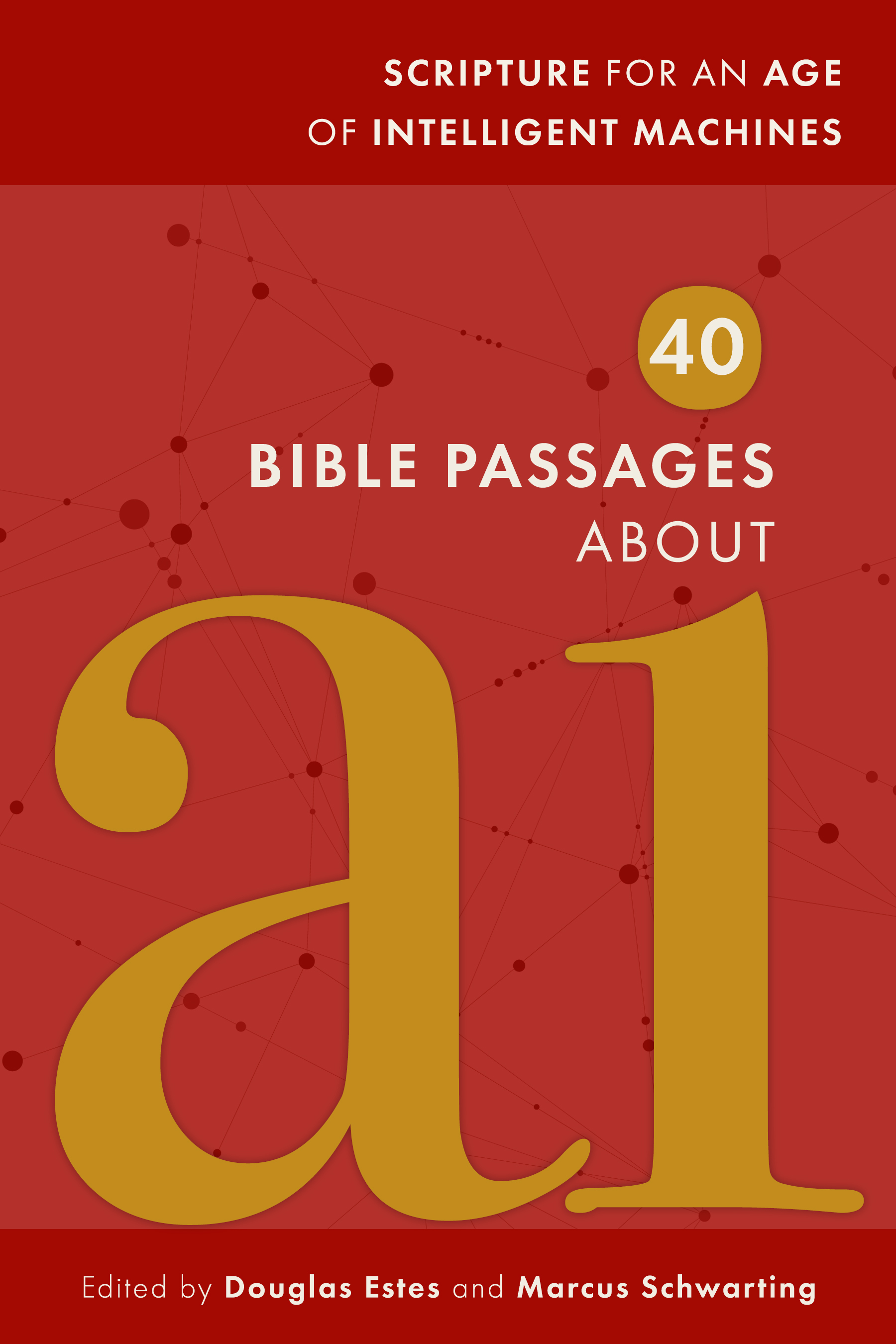 To help the church continue orienting itself regarding AI, more than twenty scholars have come together to reflect on 40 Bible Passages about AI (Friendship).
Set for release on 18 August 2026, the volume’s already available for preorder. The volume seeks to help you “move beyond fear [of] or fascination” with AI by providing
a roadmap to guide you in seeking the Bible’s wisdom about artificial intelligence and other emerging technology. Rather than relying on … familiar texts, this book curates forty passages drawn from across the breadth of the Bible, uncovering inspiration for engaging AI faithfully and ethically.… The passages are presented … in the NRSVue Bible translation[ and] paired with a concise essay that explores how and why the text matters for our present moment.2
Among these essays are two of mine.
On John 1:1–13, I discuss
- the world-forming power of language in general (including AI’s language) and
- the divine Word’s prerogative for determining truth.
The essay on 1 Cor 8:4–6 distinguishes two ways of engaging AI (as a tool, as an oracle). The tool-using mode is ultimately the one that’s compatible with humanity’s bearing of responsibility before God.
I worked through Leo’s Magnifica Humanitas too late to engage it in either essay.3 But I particularly appreciate the stress he also lays on the importance of clear-eyed, responsible action when it comes to engagement with and about AI.4
Conclusion
I’m grateful to have been able to contribute to this volume. It was really interesting to think through more carefully these two small pieces of how Scripture addresses AI.
The folks at Friendship Press are very kindly allowing me to provide a free, corrected proof of my essay on John 1. To receive it, just drop your email in the form below. I’ll also send along a discount code you can use for 15% off the volume if you order directly from Friendship. Though, for single copies including shipping, you might find Amazon slightly cheaper (affiliate disclosure).
I hope you find this volume’s essays to be fruitful “prompts” for your own (very human) further reflection on and engagement with AI and the questions it raises.
Discuss on Bluesky, LinkedIn, or Mastodon.Header image provided by Friendship Press. ↩︎
Douglas Estes and Marcus Schwarting, eds., 40 Bible Passages about AI, Scripture for an Age of Intelligent Machines (Friendship, 2026), back cover. ↩︎
Leo XIV, “Magnifica humanitas,” The Holy See (Rome, 15 May 2026). ↩︎
See also Dietrich Bonhoeffer, Ethics, ed. Clifford J. Green, trans. Reinhard Krauss, Charles C. West, and Douglas W. Stott, DBW(E) 6 (affiliate disclosure; Augsburg Fortress, 2005). ↩︎