 Douglas Estes (PhD, Religion, University of Nottingham) is Associate Professor of Religion at New College of Florida.1
He has written or edited fifteen books and more than fifty articles and essays, with a focus on biblical literature, technology and faith, and the works of J. R. R. Tolkien.
You can find more from Douglas at douglasestes.com.
Douglas Estes (PhD, Religion, University of Nottingham) is Associate Professor of Religion at New College of Florida.1
He has written or edited fifteen books and more than fifty articles and essays, with a focus on biblical literature, technology and faith, and the works of J. R. R. Tolkien.
You can find more from Douglas at douglasestes.com.
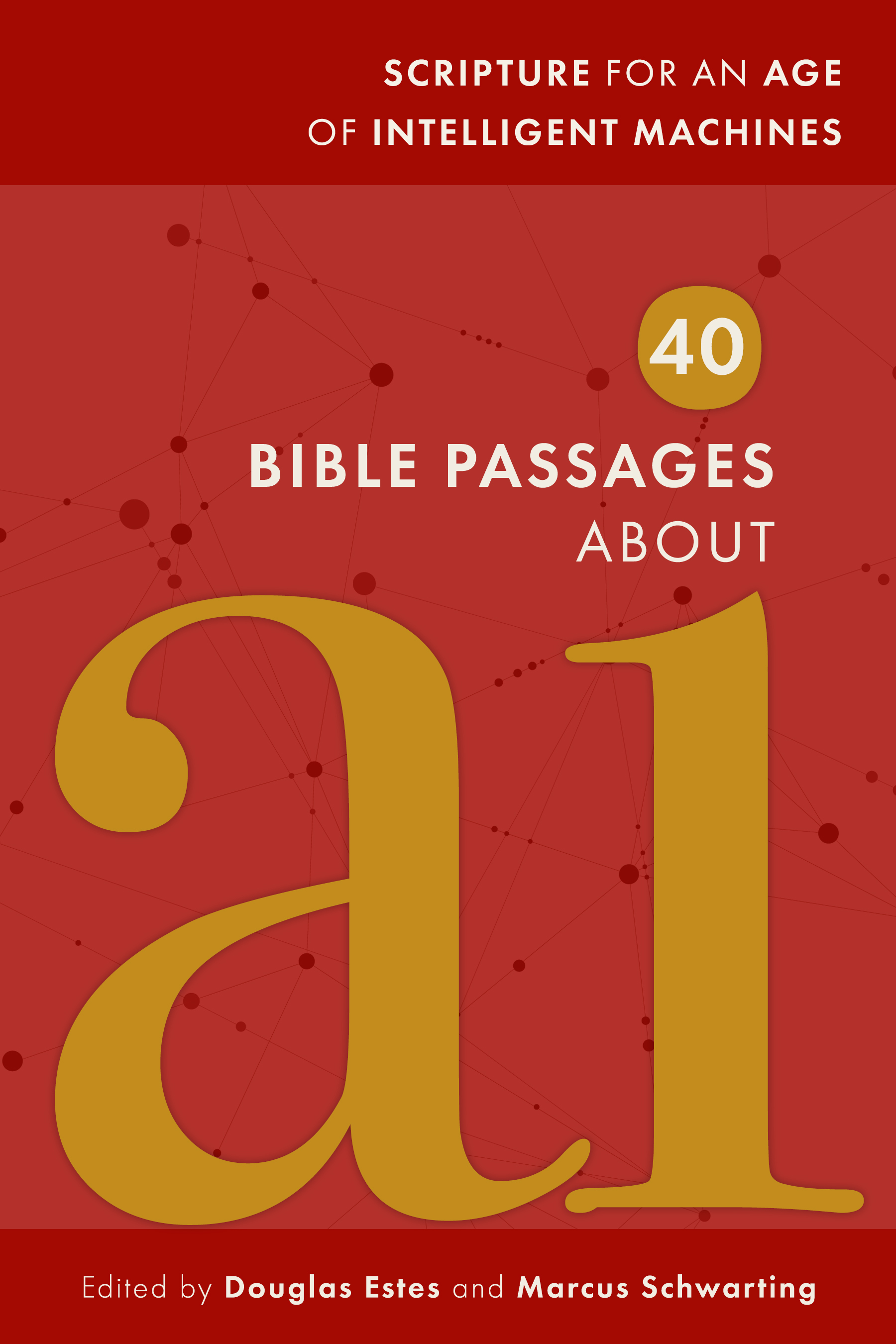
What do you hope 40 Bible Passages about AI will achieve?
What we hope this book will achieve is to encourage and to model Christians engaging the Bible more on difficult issues such as AI. To some extent, we also hope this will be a resource to start conversations in churches about AI, while at the same time, help readers have sharper answers to poor understandings about AI that exist on the internet.
How did you recruit contributors for this project?
 One of the exception virtues of this book is that Marcus and I co-edited it together.2
I have expertise in the Bible and think about AI, and Marcus has expertise in AI and thinks about the Bible.
So it was a match made in heaven for this project.
One of the exception virtues of this book is that Marcus and I co-edited it together.2
I have expertise in the Bible and think about AI, and Marcus has expertise in AI and thinks about the Bible.
So it was a match made in heaven for this project.
When it came time to recruit contributors, we reached out into our networks of colleague who are thinking about both the Bible and AI to some degree. We are excited to have attracted contributors from quite a few countries, plus both academics and practitioners.
Has this project helped your progress on any others? If so, how (e.g., by developing a new angle on an existing area of work)?
I think the main contribution this work has to my work, as well as the field itself, is that it moves the ball down the field—we must engage Scripture when we start to think about how to use and live with AI. I think what happens in many cases is that there is temptation for people start at theology and ethics for thinking about AI. I’d like to say, “Hey, wait a minute, let’s start at the best starting place, the Bible itself.”
Has this project hurt your progress on any others? If so, how (e.g., by multiplying the plates you’ve had to spin)?
Writing and editing is always hard work, and a book creator must always juggle the needs of a book with their other responsibilities. This project was important enough that Marcus and I both made time to make it happen.
How did you coordinate work on this project around or alongside other commitments?
Editing a book is a bit of an art, though mostly a science. Over the years, I have grown in my experience with these types of projects. Marcus and I were able to streamline the process early on so that it was a very reasonable effort on our part.
How did you divide up or structure your editorial work?
Marcus and I divided the work according to our specific skills and interests. Since we are discussing editorial work, communication between editors is absolutely critical. Marcus was very easy to communicate with, allowing for an excellent collaboration.
How did you handle providing feedback to the contributors?
One of the secrets to editing a book is to do your best to recruit the best contributors possible. In doing so, you save yourselves the difficulty of providing extensive feedback later.
Our starting point was to be very open about the feedback process with contributors (to set clear expectations early). We provided both general and specific feedback on both biblical interpretation and understanding of AI to out contributors. We also encouraged contributors to speak in their own voice even while making adjustments for the good of the volume.
How did you handle proofs and indexes?
In this day and age of book creation, we used a collaborative model via Google Docs. This follow a “many hands makes for light work” approach, with each contributor handling their work, allowing Marcus and me to wrap up with a global edit.
What’s been most challenging in your work on this project? Or what didn’t go as well as you’d anticipated or hoped?
The most challenging part of the work was the speed at which we hoped to release the book (a goal that our publisher, Friendship Press, was also committed to). Typically an edited volume is counted in the months, if not years, but we working in weeks, if not days.
The reason is simply that the field of AI is growing so rapidly that things become out of date quickly. Though, we hope this project will remain current for a while since it is a biblical engagement with AI.
The other challenge was simply recruiting enough contributors. People are busy, and since the title was set early (40 Bible Passages …), we were locked into a definite number.
What’s been most rewarding in your work on this project? Or what went well, either surprisingly or as you expected?
To see so much good thought on AI come from the good work of interpretation across biblical literature. When we started the project, I knew real engagement for AI with the biblical text was possible, but I wasn’t sure how probable it would be to find people already engaging AI biblically instead of theologically or ethically. To see so many contributors across so many different theological positions engaged in such a short time period is to me very, very hopeful.
In your work on this project, what tools did you use?
Candidly, none of that, except at the end. It was all what today might be considered “analog,” meaning emails, phone calls, Microsoft Word documents and similar practices.
What closing advice would you offer to emerging biblical scholars as they work on projects like this?
Don’t be discouraged by others from being imaginative. By that I mean, look at the text with new eyes or with new issues while being faithful in your biblical interpretation.
A few years ago, AI was some future thing that would never come. When you went to lectures on it, only a few people attended, and when the Bible came up, it was always 1–3 of the same verses. It was discouraging, and I limited the time I spent on it.
Now, conferences are large, and the whole world has questions. There are so many burgeoning areas that need sharp, solid biblical interpretation.
Discuss on Bluesky, LinkedIn, or Mastodon.Image provided by Douglas Estes. ↩︎