
The SBL Handbook of Style prescribes different citation conventions for different article types in
- Bible dictionaries,
- encyclopedias,
- lexica, and
- theological dictionaries.1
Zotero can handle citations for each of these types of resources. To get the proper output, you just need to
- install a current version of the SBL citation style
- distinguish between signed and unsigned articles,
- understand what SBL style requires, and
- input information into Zotero properly.
1. Install an Updated Version of Zotero’s SBL Citation Style
From Zotero’s style repository, you can install the “Society of Biblical Literature 2nd edition (full note)” style. Or just drop your email in the form below, and I’ll email you this style and a few other useful ones besides.
Like all others, output from this style depends on the quality of the records in your Zotero database. But if you put information into the database correctly, this style will do a wonderful job. Your citations and bibliographies will reflect what SBL style requires.
2. Distinguish between signed and unsigned articles.
When citing dictionaries,
- a “signed” article is attributed to a particular author, usually at the end of the article.
- an “unsigned” article is attributed to no particular author.
The SBL Handbook of Style §6.3.7 discusses citing “An Article in a Lexicon or a Theological Dictionary.” But judging from other guidance elsewhere, this section is intended to address only signed articles in lexica and theological dictionaries.
3. Understand what SBL style requires.
Some works include
- only unsigned articles (e.g., BDAG, HALOT),2
- only signed articles (e.g., TDNT), or
- some of each type (e.g., EDNT).
So, you’ll want to use the citation method appropriate for the specific entry type that you’re citing within a given lexicon or theological dictionary.
Unsigned Articles
If you’re citing an unsigned article, you’ll often have a citation with only an abbreviation and a locator. This is especially true for standard reference works. So, for example, a citation might have only
1. BDAG, s.v. “πιπράσκω.”
In your bibliography or abbreviations section, you’ll then have a single entry like the one below for this work as a whole.
Danker, Frederick W., Walter Bauer, William Arndt, and F. Wilbur Gingrich. A Greek-English Lexicon of the New Testament and Other Early Christian Literature. 3rd ed. University of Chicago Press, 2000.
Signed Articles
Nowadays, SBL style requires citing signed entries in the same way, whether they’re from
- encyclopedias,
- Bible dictionaries,
- lexica, or
- theological dictionaries.
But this hasn’t always been the case.
Encyclopedias and Bible Dictionaries (§6.3.6)
When you cite Bible encyclopedias and dictionaries, SBL style wants an initial footnote to like
1. Krister Stendahl, “Biblical Theology, Contemporary,” IDB 1:418.
Subsequent references should use only the author’s surname, a shortened article title, and drop the dictionary title abbreviation. So, for those, you’ll have a citation like
3. Stendahl, “Biblical Theology,” 1:419.
And in the bibliography, you’ll have an entry for each individual article like
Stendahl, Krister. “Biblical Theology, Contemporary.” IDB 1:418–32.
Lexica and Theological Dictionaries (§6.3.7)
According to the SBL Handbook, initial citations for lexica or theological dictionaries should look like
1. Hermann W. Beyer, “διακονέω, διακονία, κτλ,” TDNT 2:93.
Or if you’re citing only the article on one particular word in a larger group, you’ll have something like
1. Hermann W. Beyer, “διακονέω,” TDNT 2:81.
Per the SBL Handbook, however,
- subsequent citations needed to have the author’s surname and the lexicon or dictionary title but drop the article title and
- you would only include only one entry in the bibliography for a whole theological lexicon or dictionary, no matter how many articles you cited from it. This meant that
| For a Subsequent Citation of | You Would Drop | But You Would Keep | And Your Bibliography Would Have |
|---|---|---|---|
| an encyclopedia or Bible dictionary | the encyclopedia or Bible dictionary title | the article title | one entry for each article you used |
| a lexicon or theological dictionary | the article title | the lexicon or theological dictionary title | one entry for the whole lexicon or theological dictionary |
Happily, however, SBL Press has since reduced this complexity. They’ve done so by making subsequent citations and bibliography entries for signed lexicon and theological dictionary articles follow the same pattern as they do for encyclopedia and Bible dictionary articles.3 So, you’ll now have a subsequent reference like
3. Beyer, “διακονέω,” 2:83.
And in the bibliography, you’ll have an entry about the individual article(s) you cite
Beyer, Hermann W. “διακονέω, διακονία, κτλ.” TDNT 2:81–93.3
4. Input information into Zotero properly.
To get these outputs from Zotero, start by determining whether the resource you’re citing articles from has
Only Unsigned Entries
If your source has only unsigned entries, it’s probably best to have just the one Zotero record for the whole source.
If SBL style wants this source cited by abbreviation, you can specify this abbreviation by defining the annote: variable in Zotero’s Extra field.
Only Signed Entries
If your source has only signed entries, you’ll want to have one Zotero record for each entry you cite. You may or may not also need an entry for the whole work you’re citing entries from (e.g., for an abbreviation list).
Setting up a Zotero record the whole work is pretty straightforward. But setting up records for individual entries requires some special steps.
To get the proper output from Zotero,
- use the
Dictionary Entryresource type for each entry you want to cite, - fill out the resource metadata as usual, and
- include the full work title (e.g.,
Interpreter's Dictionary of the Bible) in theDictionary Titlefield.
SBL style citations and bibliographies never actually use this full title. But if you add it to Zotero, you’ll have the full title ready for use with other styles that want that instead (e.g., Chicago).
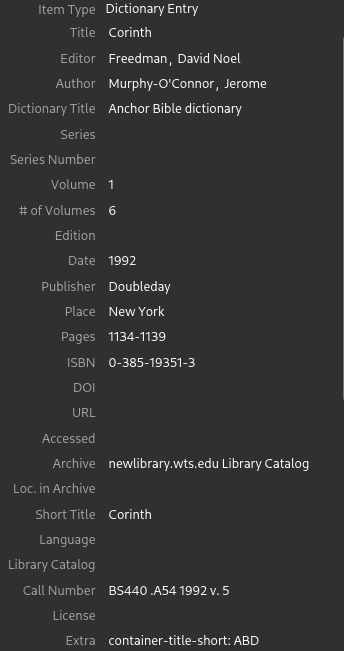 If the work’s title has an abbreviation,
- navigate to the record’s
Extrafield and - enter
container-title-short:followed by that abbreviation (e.g.,IDB).
Both Unsigned and Signed Entries
Some resources contain both unsigned and signed articles. But if you only cite signed or unsigned entries from a source, you can get away with either
Once you cite an article of the other type, however, you’ll need to add the other type of Zotero record.
Conclusion
Both Zotero and SBL style continue evolving. As they do, the process for getting certain outputs may change. But of all the bibliography managers available, Zotero provides one of the easiest out-of-the-box experiences for managing and citing research in biblical studies. And if you provide the correct information in the correct format, Zotero will continue to provide correct notes and bibliography entries, however many times you use a given source.
Discuss on Bluesky, LinkedIn, or Mastodon.Society of Biblical Literature, The SBL Handbook of Style, 2nd ed. (affiliate disclosure; SBL, 2014), §§6.3.6–6.3.7. Header image provided by Zotero via Twitter. ↩︎
See also “Citing Reference Works 2: Lexica,” SBL Handbook of Style, 30 March 2017. ↩︎