
Why Do You Seek the Living among the Dead?
Among Jesus’s followers, some fared better than others in accepting his resurrection. But it should have been something all of them were anticipating.
Among Jesus’s followers, some fared better than others in accepting his resurrection. But it should have been something all of them were anticipating.

𝘚𝘤𝘳𝘪𝘱𝘵𝘶𝘳𝘦 𝘍𝘪𝘳𝘴𝘵 argues for reading Scripture along with earliest Christian tradition as the church seeks to express its unity better.

It can be a challenge to read Scripture historically and theologically. “Explorations in Interdisciplinary Reading” helps you address this challenge.
Due out from Baker Academic in January 2018 is R. W. L. Moberly’s “The Bible in a Disenchanted Age: The Enduring Possibility of Christian Faith.”
Forthcoming this November from Baker Academic is Mary Veeneman’s “Introducing theological Method: A Survey of Contemporary Theologians and Approaches.”
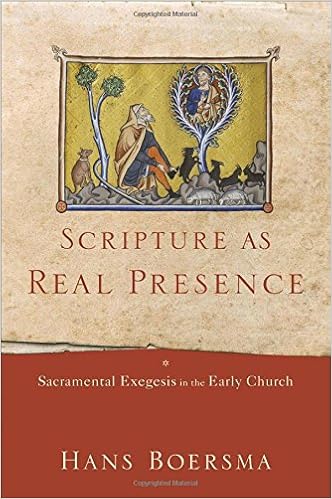 New this year from Baker is Hans Boersma’s Scripture as Real Presence: Sacramental Exegesis in the Early Church. According to the book’s blurb,
This work argues that the heart of patristic exegesis is the attempt to find the sacramental reality (real presence) of Christ in the Old Testament Scriptures. Leading theologian Hans Boersma discusses numerous sermons and commentaries of the church fathers to show how they regarded Christ as the treasure hidden in the field of the Old Testament and explains that the church today can and should retrieve the sacramental reading of the early church. Combining detailed scholarly insight with clear, compelling prose, this book makes a unique contribution to contemporary interest in theological interpretation.
...
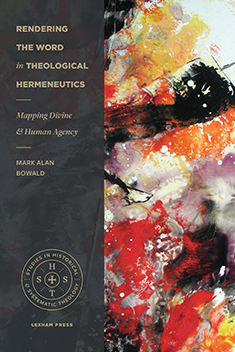 For the moment, visitors to the Logos Academic Blog site are being invited to subscribe via email. Email subscription unlocks a coupon code for a free copy of Mark Bowald’s Rendering the Word in Theological Hermeneutics: Mapping Divine and Human Agency (Lexham, 2015). According to the book’s blurb,

Today’s Advent givaway by Logos Bible Software is Geerhardus Vos’s Idea of Biblical Theology as a Science and as a Theological Discipline.
The latest issue of the Journal of Faith and the Academy is kindly carrying my article “Figuring Things Out: Lyrical Resourcement for Figural Readings of Biblical Literature in the Contemporary Academy.” The “lyrical” element in the essay is an attempt to think through some of how Nicholas of Lyra might provide a helpful rubric for understanding and pursuing responsibly figural readings of biblical literature within a contemporary, confessional academic context.
...Sadly, the Paideia Centre for Public Theology is winding down. The Scripture and Hermeneutics and Scripture and Doctrine Seminars will, however, be continuing. Much of the Centre’s other work will also be taken up under the auspices of St. George’s Anglican Church.
Through June 11, the Westminster Bookstore is offering a free PDF download of Iain Duguid’s Is Jesus in the Old Testament? (P&R, 2013). Duguid has been at Grove City College but has recently joined the Westminster Seminary faculty. According to its introduction, Duguid’s essay (the text is a brief 33 pages of prose) has the following major components to its argument:
...Kevin Vanhoozer, ed.,
For this week, Kevin Vanhoozer’s edited volume on the Theological Interpretation of the New Testament is free from Logos Bible Software when users join a Baker-related email list (HT: Tayler Beede). The volume provides a focused selection of the book-specific entries from the larger Dictionary for Theological Interpretation of the Bible.
...Jesus is both the properly trusting recipient of his Father’s care and the hen that would gather her chicks to protect them.
Pieter Lasman, ‘The Triumph of Mordechai’ (1624; Photo credit: Wikimedia Commons)
In 1 Sam 15:3, Samuel commands Saul, the son of Kish, “Go, and strike Amalek, and devote to destruction everything that is his. Do not take pity on him, but kill man and woman, child and infant, ox and lamb, camel and donkey” (לך והכיתה את־עמלק והחרמתם את־כל־אשר־לו ולא תחמל עליו והמתה מאיש עד־אשה מעלל ועד־יונק משור ועד־שה מגמל ועד־חמור). 1 Unfortunately, Saul’s subsequent engagement with the Amalekites heeded only Samuel’s order to “go and strike Amalek” (לך והכיתה את־עמלק). 2 Saul “did devote to destruction” (החרים) the Amalekite people but captured alive Agag, the king. 3 Indeed, “Saul and the people had pity on Agag and on the best of the flock and the herd and their choice offspring, on the lambs, and on everything good, and they did not accept devoting them to destruction, but every despised and weak thing they devoted to destruction” (ויחמל שאול והעם על־אגג ועל־מיטב הצאן והבקר והמשנים ועל־הכרים ועל־כל־הטוב ולא אבו החרימם וכל־המלאכה נמבזה ונמס אתה החרימו). 4 Thus, Saul becomes the object of Samuel’s ire and forfeits the continuation of his kingdom. 5
...Baker has kindly provided a substantial PDF excerpt from Christopher Seitz’s The Character of Christian Scripture: The Significance of a Two-Testament Bible (2011). Besides front matter, the excerpt includes the book’s introduction and first chapter, which account for 74 pages of text.
...To demonstrate the superiority of Jesus’ sacrifice to those previously offered under the Torah, the writer to the Hebrews quotes a version of Ps 40:6–8 (Eng; 40:7–9 HB; 39:7–9 OG; Heb 10:5–9). 1 In so doing, Hebrews fairly clearly situates its rendition of this psalm’s words as Jesus’ own (cf. Heb 10:10). 2 If one were to read the entire psalm in this direction however, 3 problems would seemingly arise (e.g., vv. 12–17 Eng). 4
...David between Wisdom and Prophecy
Ezra and Nehemiah each provide their own distinct reports of the Jews’ return from Babylonian exile. Even if the portrayal of this return as a “second exodus” is not a particular, literary concern in these books, 1 the narrative’s inclusion of elements like captivity, release, land resettlement, and covenant establishment certainly echo important features in the narrative of Israel’s exodus from Egypt. 2 Even so, Ezra and Nehemiah include in their portraits of the people’s experience of some “reviving” (מחיה) a stroke in which the people also found themselves still to be slaves ( Ezra 9:8–9; cf. Neh 9:36). 3
...In Acts 13:16–41, Paul addresses the Pisidian synagogue. In this discourse’s context, Paul asserts “we preach to you the good news concerning the promise that had come to the fathers—that this promise God has fulfilled for us their children by raising Jesus” ( Acts 13:32–33; ἡμεῖς ὑμᾶς εὐαγγελιζόμεθα τὴν πρὸς τοὺς πατέρας ἐπαγγελίαν γενομένην, ὅτι ταύτην ὁ θεὸς ἐκπεπλήρωκεν τοῖς τέκνοις [αὐτῶν] ἡμῖν ἀναστήσας Ἰησοῦν). From here, the following quotation of Ps 2:7 confirms Jesus’ resurrection by Yahweh’s hand (cf. Acts 13:37). 1 This resurrection in incorruption situates Jesus as the means by which the ancestral promise becomes actualized ( Acts 13:34–37) because it situates him as the recipient and mediator of the things vouchsafed to David ( Acts 13:34)—namely, an everlasting covenant in which the wandering return and receive forgiveness from Yahweh ( Isa 55; cf. Deut 30). 2
...In contemporary English parlance, to call someone a “man” or “woman of God” substantially means that individual is “godly” or “pious.” As such, the phrase is a descriptor of a person’s moral or religious standing in relation to some perceived measure.
In the Hebrew Bible, however, אישׁ (ה)אלהים ([the] man of God) regularly designates a “prophet.” To be sure, these prophets were often “godly” or “pious,” but even here, there were occasional exceptions to this behavior (e.g., 1 Kgs 13). Rather, when the Hebrew Bible applies this same phrase to David, it fits him into the framework of the broader tradition of the prophet as Yahweh’s representative ( Neh 12:24, 36; 2 Chron 8:14). In these particular texts, David’s status as an אישׁ אלהים (man of God) revolves around his plans for the temple’s administration. Even so, scarcely can at least the Davidic psalms be separated from vocation as a royal אישׁ אלהים (man of God). 1
...Gerbrand van den Eeckhout, ‘Anna Presenting Her Son Samuel to the Priest Eli’
In due order within The City of God’s longer discussion of Hannah’s prayer at Samuel’s dedication, 1 Augustine arrives at the clause, “[a]nd [he] shall exalt the horn of His Christ” ( 1 Sam 2:10). Here, Augustine ponders:
...All four Gospels report Peter’s adamant affirmation of fidelity Jesus, no matter what may come ( Matt 26:33–35; Mark 14:29–31; Luke 22:31–34; John 13:36–38). A key feature in the Synoptics’ presentation is Peter’s persistence about remaining with Jesus ( Matt 26:35; Mark 14:31; Luke 22:33). In so presenting his declaration, Matthew and Mark focus exclusively on Peter’s commitment to die with Jesus ( Matt 26:35; Mark 14:31). Beyond this affirmation, Luke also explicitly mentions Peter’s readiness to accept the lesser affliction of imprisonment with Jesus ( Luke 22:33).
...
First Chronicles 16 reports the ark of the covenant’s placement in the tent David had prepared for it (1 Chron 16:1). The middle of the chapter is a poetic section that celebrates Yahweh’s greatness toward Israel (1 Chron 16:8–36). The first part of this section (1 Chron 16:8–22) corresponds to Ps 105:1–15, the second (1 Chron 16:23–33) to Ps 96:1–13, and the third (1 Chron 16:34–36) to Ps 106:1, 47–48.1 The Chronicler does not explicitly describe David as this hymn’s composer, although this supposition appears reasonable.2 In any event, the hymn is offered in David’s presence and at his behest (1 Chron 16:7, 37).
...Healing of the Man Born Blind
The account of the man who had been born blind ( John 9:1– 10:21) shares some significant features with the story of the woman at the well ( John 4:4–42). In both cases, the individuals’ births place them at or outside societal margins ( John 4:9, 27; 9:2). Yet, in the end, it is such marginal individuals whom the narrative situates as most in step with Jesus’ mission and, therefore, most in step with Yahweh’s purposes for his people ( John 4:23–24, 39–42; 9:35–38), when a different situation would typically have been expected ( John 4:20, 22; 9:13–34, 40–41; 10:19–21).
...John’s narrative about Jesus’s encounter with the Samaritan woman highlights the presence of faith in unexpected places.
Jesus and Nicodemus, Crijn Hendricksz, 1616–1645.
John 1:13 describes a group of individuals “who were not born from blood nor from a fleshly will nor from a husband’s will but from God” (οἳ οὐκ ἐξ αἱμάτων οὐδὲ ἐκ θελήματος σαρκὸς οὐδὲ ἐκ θελήματος ἀνδρὸς ἀλλʼ ἐκ θεοῦ ἐγεννήθησαν). For John, being born “from blood” (ἐξ αἱμάτων), “from a fleshly will” (ἐκ θελήματος σαρκός), and “from a husband’s will” (ἐκ θελήματος ἀνδρός) would all have been perfectly reasonable ways of describing ordinary, human generation. 1 Yet, the individuals John describes as not having been born in these ways but as having been born “from God” (ἐκ θεοῦ) are still very much human beings ( John 1:9–12). John’s point, then, is not to negate the reality of the ordinary, human, physical generation of the individuals he describes but to negate the significance of this origin for determining the identity of the “children of God” ( John 1:12; τέκνα θεοῦ).
...[caption id="" align=“alignright” width=“200” caption=“Domenico Fetti, “Parable of the Good Samaritan” (c. 1610–1623; photo credit: Wikipedia)”]  [/caption]
The parable of the Good Samaritan ( Luke 10:30–35) is unique to Luke and contributes to the third Gospel’s general emphasis on socially marginalized characters and groups. 1 Introducing the parable proper is an exchange between Jesus and a νομικός (lawyer), which the lawyer begins by inquiring τί ποιήσας ζωὴν αἰώνιον κληρονομήσω; ( Luke 10:25b; what shall I do to inherit eternal life?). Both this question and the exchange that follows resemble some later rabbinic texts, not least in the lawyer’s concern to define proper Torah obedience. 2
...[caption id="" align=“alignright” width=“250” caption=“15th-c. Illumination (Photo credit: Wikipedia)”]  [/caption]
First Samuel 18:6 describes David’s return after killing Goliath ( 1 Sam 17:41–58). Precisely how this event sits chronologically in relationship to the surrounding narrative is difficult to establish. 1 One good way of reading the narrative, however, involves treating 1 Sam 18:1–5 as an extended parenthesis, which includes some foreshadowing, and understanding 1 Sam 18:6 to be bringing the reader back to the main plot line that had temporarily paused with 1 Sam 17:58. 2 In this context, it begins to be said הכה שׁאול֙ באלפו ודוד ברבבתיו ( 1 Sam 18:7; Saul has slain by his thousands and David by his ten thousands; see also 1 Sam 21:11; 29:5). 3 Yet, thus far, David has specifically been reported to have killed only one person (Goliath) and some animals ( 1 Sam 17:34–37)—not רבבת (ten thousands). 4 Rather, the women’s song quantitatively represents the qualitative value of David’s victory over Goliath as it relates to Saul’s previous exploits. 5 On hearing this song, then, Saul becomes enraged and starts looking and acting to do David harm ( 1 Sam 18:8–9).
...
Although the calling of Simon Peter appears in all three synoptic Gospels ( Matt 4:18–20; Mark 1:16–18; Luke 5:1–11; cf. John 1:35–51; 21:1–11), Luke’s narrative develops the pericope in much greater detail than Matthew’s or Mark’s. Luke 5:3 indicates that Jesus did some teaching from Simon’s boat. After concluding, Jesus instructs Simon to take the boat into the λίμνη (lake), and set out the nets for a catch ( Luke 5:4). Although incredulous, Simon acquiesces ( Luke 5:5–6a, 8–10a).((Jon L. Berquist, “Luke 5:1–11,” Int 58, no. 1 (2004): 62; Joel B. Green, The Gospel of Luke (New International Commentary on the New Testament; Grand Rapids: Eerdmans, 1997), 232.)) Then, to his surprise, not only do they catch fish, but their catch is of such quantity that it nearly nearly tears the nets and sinks both their boat and another called to help ( Luke 5:6b–7). Observing this situation, Simon προσέπεσεν τοῖς γόνασιν Ἰησοῦ λέγων· ἔξελθε ἀπʼ ἐμοῦ, ὅτι ἀνὴρ ἁμαρτωλός εἰμι, κύριε. θάμβος γὰρ περιέσχεν αὐτὸν καὶ πάντας τοὺς σὺν αὐτῷ ἐπὶ τῇ ἄγρᾳ τῶν ἰχθύων ὧν συνέλαβον ( Luke 5:8–9; fell at Jesus’ knees, saying, “Go away from me, because I am a sinful man, Lord.” For, astonishment at the catch of fish that they had enclosed had come upon him and all those who were with him).((Or, if Ἰησοῦ is a dative, προσέπεσεν τοῖς γόνασιν Ἰησοῦ may be “he fell on [his own] knees before Jesus” (I. Howard Marshall, The Gospel of Luke [New International Greek Testament Commentary; Exeter: Paternoster, 1995], 204).))
...[caption id="" align=“alignright” width=“150” caption=“Rahab Helping the Two Israelite Spies (Image via Wikipedia)”]  [/caption]
After assuming leadership over Israel ( Josh 1:10–18), Joshua commissions two men to survey Jericho and the surrounding area ( Josh 2:1a). Rather tersely, then, the menוילכו ויבאו בית־אשׁה זונה ושׁמה רחב וישׁכבו־שׁמה ( Josh 2:1b; went and entered the house of a prostitute, whose name was Rahab, and they lodged there). For onlookers, such an action might not have been unusual in itself, 1 but by some means or other, the king became aware of these Israelite’s intent to survey Jericho ahead of some forthcoming military action ( Josh 2:3).
...