Daily Gleanings: Q (21 November 2019)
Daily Gleanings about Occam’s Razor and how it does and doesn’t play into arguments about Q and the Synoptic Problem.
Daily Gleanings about Occam’s Razor and how it does and doesn’t play into arguments about Q and the Synoptic Problem.
During 2016, the “Journal of Greco-Roman Christianity and Judaism” published several noteworthy articles.
In his Four Gospels, Burnett Streeter articulates his view of the sources of Luke and proto-Luke as follows:
The hypothesis I propose in no way conflicts with the generally accepted view that Matthew and Luke are ultimately dependent not only on Mark but on Q—meaning by Q a single written source. Most, if not all, of the agreements of Matthew and Luke, where Mark is absent, are, I think, to be referred to Q; but I desire to interpolate a stage between Q and the editor of the Third Gospel. I conceive that what this editor had before him was, not Q in its original form—which, I hold, included hardly any narrative and no account of the Passion—but Q+L, that is, Q embodied in a larger document, a kind of “Gospel” in fact, which I will call Proto-Luke. This Proto-Luke would have been slightly longer than Mark, and about one-third of its total contents consisted of materials derived from Q (Streeter 208).
...
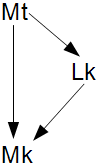
See Kümmel 139. Please see the symbol key for an explanation of the diagrams in this post series.
In this post:[caption id=“attachment_2014” align=“alignleft” width=“80” caption=“Werner Kümmel”]  [/caption]
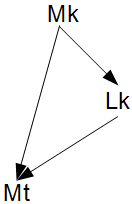
See Baird 305; Kümmel 148–49. Please see the symbol key for an explanation of the diagrams in this post series.
[caption id=“attachment_2065” align=“alignleft” width=“80” caption=“William Baird”]  [/caption] [caption id=“attachment_2014” align=“alignleft” width=“80” caption=“Werner Kümmel”] [/caption]

See Kümmel 327. Please see the symbol key for an explanation of the diagrams in this post series.
In this post:[caption id=“attachment_2014” align=“alignleft” width=“80” caption=“Werner Kümmel”] [/caption]
Early Holtzmann  Late Holtzmann
See Kümmel 151–55. Please see the symbol key for an explanation of the diagrams in this post series.
In this post:[caption id=“attachment_2014” align=“alignleft” width=“80” caption=“Werner Kümmel”] [/caption]

See Kümmel 149–51. Please see the symbol key for an explanation of the diagrams in this post series.
In this post:[caption id=“attachment_2014” align=“alignleft” width=“80” caption=“Werner Kümmel”] [/caption]

See Kümmel 146–48. Please see the symbol key for an explanation of the diagrams in this post series.
In this post:[caption id=“attachment_2014” align=“alignleft” width=“80” caption=“Werner Kümmel”] [/caption]

Herder thought that Mark most exactly reproduced Urev Or. Matthew reproduced it with expansions, and Luke, aware of these expansions, “wished to create ‘an actual historical account’ after a wholly Hellenistic pattern.” Herder also hypothesized that “[s]ome forty years later John . . . wrote an ’echo of the earlier Gospels at a higher pitch’ which undertook to set forth Jesus as the Savior of the world. . . .”
...
Eichhorn does not appear to have named Q as such, but this part of his hypothesis fits what has come to be called Q.
See Kümmel 77–79. Please see the symbol key for an explanation of the diagrams in this post series.
In this post:[caption id=“attachment_2014” align=“alignleft” width=“80” caption=“Werner Kümmel”] [/caption]

See Kümmel 76. Please see the symbol key for an explanation of the diagrams in this post series.
In this post:[caption id=“attachment_2014” align=“alignleft” width=“80” caption=“Werner Kümmel”] [/caption]

See Kümmel 75–76. Please see the symbol key for an explanation of the diagrams in this post series.
In this post:[caption id=“attachment_2014” align=“alignleft” width=“80” caption=“Werner Kümmel”] [/caption]

See Kümmel 75. Please see the symbol key for an explanation of the diagrams in this post series.
In this post:[caption id=“attachment_2014” align=“alignleft” width=“80” caption=“Werner Kümmel”] [/caption]
The following symbols, listed alphabetically, are used in the post series that summarizes solutions to the synoptic problem:
A, or UrMk – Urmarkus (a proto-Gospel of Mark)
Ar – Aramaic
frag – fragmentary
GosNaz – Gospel of the Nazarenes
Heb – Hebrew
L – a special, Lukan source
Lk – Luke
M – a special, Matthean source
Mk – Mark
...The ‘synoptic problem’ is a phenomenon that arises because the synoptic Gospels (Matthew, Mark, and Luke), while they contain so much similar material, do not always report the same material in the same way. Various solutions for the synoptic problem that have been proposed—so many that their nuances can be difficult to remember. This post series will attempt to compose a set of diagrams based on the summaries of these solutions that Kümmel, New Testament ( affiliate disclosure), provides.