
The Unique Ways τὲ καί Clarifies Paul’s Audience in Romans
By itself, τὲ καί can’t indicate who Paul was writing to in Romans. But the phrase puts on the table important pieces to the puzzle.
By itself, τὲ καί can’t indicate who Paul was writing to in Romans. But the phrase puts on the table important pieces to the puzzle.
In a special podcast, Chris Jones and I discuss the challenging issues of Romans’s audience and the letter’s perspective on predestination.
In his Tyndale series Romans commentary, F. F. Bruce offers the following colorful, if also sad, illustration as he discusses Rom 6:
A notable historical instance [of a tendency to read Paul as advocating antinomianism] may be seen in the Russian monk Rasputin, the evil genius of the Romanov family in its last years of power. Rasputin taught and exemplified the doctrine of salvation through repeated experiences of sin and repentance; he held that, as those who sin most require most forgiveness, a sinner who continues to sin with abandon enjoys, each time he repents, more of God’s forgiving grace than any ordinary sinner.((Bruce, Romans ( affiliate disclosure), 134.))
...
Chris Tilling has a very fine two-part lecture on Karl Barth’s commentary on Romans.
Daily Gleanings about Word & World’s issue on Romans and especially Arland Hultgren’s essay on “Paul, Romans, and the Christians at Rome.”
Daily Gleanings about Sarah Casson’s “Textual Signposts in the Argument of Romans: A Relevance-Theory Approach.”
Daily Gleanings from Greg Goswell about reading Romans after Acts and from Carol Newsom about rhetoric and hermeneutics in biblical and ST literature.
Daily Gleanings from RBL about Channing Crisler’s “Reading Romans as Lament” and David Capes’s “Divine Christ.”
Daily Gleanings with Craig Keener on Acts and Romans from the 2019 Stone-Campbell Journal conference.
This month, three Anchor Bible volumes are free or deeply discounted from Logos Bible software. The Anchor Bible series is itself also on sale for 50% off.
 The newest issue of the Journal of Biblical Literature contains Beverly Gaventa’s essay, “Reading Romans 13 with Simone Weil: Toward a More Generous Hermeneutic.” According to the abstract,
Simone Weil’s interpretation of the Iliad as a “poem of force” has resonances with Rom 1–8, reinforcing the question of how Rom 13:1–7 belongs in the larger argument of Romans. Seeking a generous reading of 13:1–7 along the lines of the generosity Weil extends to the Iliad, I first take Pharaoh as an example of Paul’s understanding of the relationship between God and human rulers and then propose that Paul’s treatment of human rulers coheres with his refusal in this letter to reify lines between “insider” and “outsider.” I conclude with a reflection on the need for generosity in scholarly research and pedagogy.
...
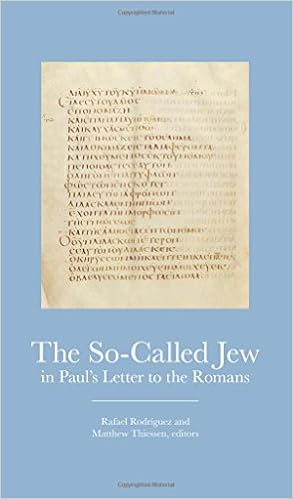 In addition to Boccaccini and Segovia’s Paul the Jew, inbox recently saw the arrival from Fortress Press of a review copy of Rafael Rodríguez and Matthew Thiessen’s edited volume The So-Called Jew in Paul’s Letter to the Romans(2016). According to the book’s blurb:


Matthew Bates argues that faith or believing is not mere assent, not easy believism, but covenantal loyalty to the God who saves his people through the Lord Jesus Christ. Bates forces us to rethink the meaning of faith, the gospel, and works with a view to demonstrating their significance for true Christian discipleship. This will be a controversial book, but perhaps it is the controversy we need!
...
SBL Press has clarified its guidance about citing J.-P. Migne’s Patrologia Latina based on the discovery that various year’s printings of certain volumes within Patrologia Latina have differences. Among these differences are variations in the column arrangements for the texts contained in Patrologia Latina. The Press’s initial recommendation was that
authors always check a PL volume title page to ensure that the printing is dated 1865 or earlier. If the publication or printing date is 1868 or later, we encourage authors to find an earlier printing of PL to cite.
...
This month, Logos Bible Software has Craig Keener’s New Covenant Commentary volume on Romans available for free. The companion deep-discount volume is Gordon Fee’s on Revelation, also from the NCC.
...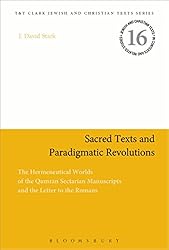 A while ago, I mentioned Sacred Texts and Paradigmatic Revolutions would be coming to paperback. That format is now available at about a fourth or less of the MSRP for the hardback.
Bulletin for Biblical Research 24, no. 4 contains five articles on various topics in Biblical Studies.
 The latest Bloomsbury Highlights notes the newly available volume 16 in the T&T Clark Jewish and Christian Texts Series. The volume is a revision of my 2011 dissertation at Southeastern Seminary and primarily explores paradigmatic, or presuppositional, aspects of the hermeneutics at play in Romans and some of the Qumran sectarian texts.
Stanley Porter and Hughson Ong have the latest article in the Journal of Greco-Roman Judaism and Christianity: “‘Standard of Faith’ or ‘Measure of Trusteeship’?: A Study in Romans 12.3—A Response.” The article’s opening paragraph explains its responsive character and general argument as follows:
John Goodrich has recently published an article regarding the interpretation of μέτρον πίστεως in Rom. 12.3 in the Catholic Biblical Quarterly. We have tried to respond to his article in that journal, but regrettably, the journal does not publish responses to articles, although we think that Goodrich’s article warrants a response. Goodrich argued ’that μέτρον πίστεως in Rom 12:3 refers to the believer’s charism, addressed shortly and explicitly thereafter in 12:6’ (p. 753). Against the typical view that takes μέτρον πίστεως as ‘standard/measure of faith’, he proposes that this charism should be seen as ‘a trusteeship’ God grants to each believer. Specifically, the genitive construction in μέτρον πίστεως, regarded as appositive, is ‘a measure, namely a trusteeship’ (pp. 769, 772). This old alternative that Goodrich seeks to revive, however, poses some significant problems that can be neither resolved nor sustained by the arguments and evidence he marshals in this article. We assess critically each of these in what follows, followed by our own interpretation of μέτρον πίστεως in Rom. 12.3. (97)
...
Barry F. Parker has the latest article in the Journal of Greco-Roman Christianity and Judaism, "‘Works of the Law’ and the Jewish Settlement in Asia Minor." According to the article’s conclusion:
The first recourse for the Anatolian Jews under [social, political, and religious] pressure was not an appeal to ‘legalism’, but to ‘selective works of the law’, as is implied by the phrase ἔργα νόμου. The only appearance of this phrase from that time outside of Paul is found in 4QMMT. The use of ‘works of the law’ there confirms both that Paul is in (indirect) dialogue with those familiar with Essene terminology and that selectivity is in view. Although he speaks to a different audience about a different problem regarding the law in Romans, when Paul uses the phrase ἔργα νόμου in Romans 3, the immediate context is quite similar to what he addresses in Galatians. It is, in both cases, a matter of the righteousness of God, as expressed in the faithfulness of Christ (πίστις Χριστοῦ). This faithfulness of Christ suffices for both Jew and Gentile (pagan), who are equally condemned—in Galatians they are condemned for trying to supplement that faithfulness with a perverted version of the law, and in Romans they are condemned for perverting the law by their very efforts to fulfill it through a selective participation in it ( 96).
...
On the web:
Dan Wallace digests the SBL meeting discussion of the recently announced Romans fragment in the Green collection.
The Journal of Theological Studies 63, no. 2 includes several articles of note.
[caption id="" align=“alignright” width=“80”]  Colin Kruse[/caption]
In recognition of the release of Colin Kruse’s Romans volume in the Pillar New Testament Commentary, the Westminster Bookstore is running several sales, including:
...[caption id="" align=“alignright” width=“250” caption=“15th-c. Illumination (Photo credit: Wikipedia)”]  [/caption]
First Samuel 18:6 describes David’s return after killing Goliath ( 1 Sam 17:41–58). Precisely how this event sits chronologically in relationship to the surrounding narrative is difficult to establish. 1 One good way of reading the narrative, however, involves treating 1 Sam 18:1–5 as an extended parenthesis, which includes some foreshadowing, and understanding 1 Sam 18:6 to be bringing the reader back to the main plot line that had temporarily paused with 1 Sam 17:58. 2 In this context, it begins to be said הכה שׁאול֙ באלפו ודוד ברבבתיו ( 1 Sam 18:7; Saul has slain by his thousands and David by his ten thousands; see also 1 Sam 21:11; 29:5). 3 Yet, thus far, David has specifically been reported to have killed only one person (Goliath) and some animals ( 1 Sam 17:34–37)—not רבבת (ten thousands). 4 Rather, the women’s song quantitatively represents the qualitative value of David’s victory over Goliath as it relates to Saul’s previous exploits. 5 On hearing this song, then, Saul becomes enraged and starts looking and acting to do David harm ( 1 Sam 18:8–9).
...In Rom 7:1–6, Paul appears to draw on Num 5:11–31 as a metaphorical way of characterizing the Christian community’s history. 1 While her husband lives, the wife’s involvement with another man would make her liable to the charge of adultery from her current husband. From this charge, the wife would also become liable to the ritual of Num 5:11–31, and the serious consequences that it would entail if she had indeed committed adultery ( Num 5:21–22, 24, 27–28).2
...Google Books has available the full text of Sanday and Headlam’s commentary on Romans in the International Critical Commentary (5th ed.; 1899).
Abraham
In Gen 17:13, God tells Abraham that his whole household was to be circumcised והיתה בריתי בבשׂרכם לברית עולם (and my covenant will be in your flesh as an everlasting covenant). Yet, Paul strongly opposes Gentiles’ submitting to circumcision in connection with their membership in the Christian community (Galatians) and asserts that ὁ ἐν τῷ κρυπτῷ Ἰουδαῖος, καὶ {ὅτι} περιτομὴ καρδίας ἐν πνεύματι οὐ γράμματι ( Rom 2:29; the Jew is one who is such inwardly, and [that] circumcision is of the heart by the Spirit, not by the letter). What then becomes of the בבשׂרכם []ברית עולם ( Gen 17:13; everlasting covenant in your [= Abraham’s household’s] flesh)? It is precisely there because of the circumcision of Abraham’s messianic seed ( Gal 3:16), ἐν ᾧ καὶ περιετμήθητε περιτομῇ ἀχειροποιήτῳ ἐν τῇ ἀπεκδύσει τοῦ σώματος τῆς σαρκός, ἐν τῇ περιτομῇ τοῦ Χριστοῦ ( Col 2:11; in whom you also were circumcised with an unhandmade circumcision in the removal of the body of the flesh, in the circumcision of the Messiah; cf. Gal 3:23–29; Bede, Genesis, 284 [ affiliate disclosure]; Chrysostom, Hom. Col. 6 [ NPNF1 13:285; affiliate disclosure]; Cyril of Alexandria, Catena on Genesis[ ACCOT 2:56; affiliate disclosure]; Theodore of Mopsuestia, Colossians [ ACCNT 9:32; affiliate disclosure]).
...In a 2003 article, Morna Hooker makes the following, insightful argument about the referent(s) of the λίθος ( stone) language in Rom 9:32–33:
Is Paul affirming here that Israel’s problem is simply that she has failed to believe in Christ? The majority of commentators accept this interpretation, but the possibility supported by some scholars that the stumbling-block is the law should not be too easily dismissed. It should be noted after all that Christ has not been mentioned since 9:1–5 and that the two subjects under discussion in Rom 9:30–31 are the law and righteousness. Moreover, what Paul has just stated is that Israel has misunderstood the function of the law. Perhaps then the stumbling-block over which Israel has fallen is the law.
...
The Evangelical Theological Society’s southeastern, regional meeting begins tomorrow and will feature some interesting-looking papers, a couple of which I have been able to preview as they have come through Southeastern’s Writing Center. Fellow blogger Alan Knox will be presenting on “A Theology of Encouragement in Hebrews,” and my own paper, “But What about Israel?: A Biblical-Theological Approach to the Question of Individual and Corporate Election in Romans 9–11” has also been included in the program. To abstract this paper briefly:
...