Daily Gleanings (8 April 2019)
Gleanings about essentialism and Charles Quarles's Matthean theology.
Gleanings about essentialism and Charles Quarles's Matthean theology.
Jesus is both the properly trusting recipient of his Father’s care and the hen that would gather her chicks to protect them.
Image via Wikipedia
The latest issue of the Journal of the Evangelical Theological Society arrived in yesterday’s mail and includes the following:
Steven Runge has the latest article in Biblical and Ancient Greek Linguistics: “Relative Saliency and Information Structure in Mark’s Parable of the Sower.” According to the abstract:
This study applies the cognitive model of Chafe and Givón, and the information-structure model of Lambrecht as applied by Levinsohn and Runge to the Markan explanation of the Parable of the Sower (4:14–20). The primary objective is to identify and analyze other linguistic devices, besides demonstratives, which might clarify the apparent prominence given to the unfruitful scatterings in Mark’s account. This study provides the necessary framework for comparing Mark’s pragmatic weighting of saliency to that found in Matthew and Luke’s accounts in order to determine whether Mark’s version is consistent with or divergent from the other traditions.
...
Image via Wikipedia
The next issue of the Biblical Theology Bulletin includes:
[caption id="" align=“alignright” width=“284” caption=“von Carolsfeld, Woodcut for “Bibel der Bildern” (Image via Wikipedia)”]  [/caption]
The story of Jesus’ raising Jairus’s daughter appears in all three synoptics ( Matt 9:18–19, 23–26; Mark 5:21–24, 35–43; Luke 8:41–42, 49–56), but only Mark and Luke report a closing admonition about the event’s further dissemination ( Mark 5:43; Luke 8:56). In Luke 8:56, Jesus instruction focuses on the fact that the witnesses, perhaps especially the parents, should not themselves engage in describing what happened. By contrast, in Mark 5:43, Jesus warns those around him ἵνα μηδεὶς γνοῖ τοῦτο (so that no one would know this*).
...[caption id="" align=“alignright” width=“225” caption=“Image via Wikipedia”]  [/caption]
In Num 12:1, Miriam and Aaron confront Moses because of his marriage to a Cushite woman, and in so doing, they attempt to claim equal prophetic status with Moses ( Num 12:2a). Apparently, on this occasion, Moses’ meekness constrains him from responding ( Num 12:3; cf. Rom 12:19; 1 Clem. 17 [ANF 9:234]; Socrates, Hist. eccl., 7.42 [NPNF2 2:176]), but יהוה hears the conversation and summons all three siblings to the tent of meeting ( Num 12:2b, 4). יהוה then summons Aaron and Miriam for a special rebuke ( Num 12:5): however high may be their claim to apparently equal prophetic status with Moses, Moses own status still surpasses that of prophet ( Num 12:6–9). The status that Aaron and Miriam claim for themselves gets them only so far—only to dreams and visions ( Num 12:6). By contrast, Moses is not limited to dreams and visions, but פה אל־פה אדבר־בו ומראה ולא בחידת ותמנת יהוה יביט ( Num 12:8a; with him, I [יהוה] speak mouth to mouth, plainly, and not in riddles, and he looks upon the form of יהוה). More than a prophet, Moses is a faithful servant in all יהוה’s house ( Num 12:7; Heb 3:5).
...[caption id="" align=“alignright” width=“193” caption=“Simon von Cyrene (Bamberger Kreuzweg; Image via Wikipedia)”]  [/caption]
Mark 15:21 describes Simon of Cyrene as having been “pressed into service” (ἀγγαρεύουσιν . . . Σίμωνα Κυρηναῖον) to carry Jesus’ cross, and Matt 27:32 uses the same language (ἄνθρωπον Κυρηναῖον ὀνόματι Σίμωνα . . . ἠγγάρευσαν). Only Matthew’s narrative, however, has Jesus previously instructing his disciples, saying, ὅστις σε ἀγγαρεύσει μίλιον ἕν, ὕπαγε μετʼ αὐτοῦ δύο ( Matt 5:41; whoever will press you into service for one mile, go with him for two; cf. Bruce, “Synoptic Gospels,” 328; Gundry, Matthew, 94; Keener, Matthew, 199). Matthew does not identify how far Simon of Cyrene carried Jesus’ cross, but the accompanying soldiers at least press him into service not to carry his own cross, as would have been anticipated, but someone else’s ( Matt 27:27–32; France, Matthew, 221–22, 1064–65; cf. Keener, Matthew, 199–200; Lightfoot, Commentary, 2:132–33; Schürer, Jewish People, 2.2.231). At this juncture, Jesus’ own disciples are not to be “found,” and in their stead is only one Cyrenean who appears only here in the synoptic tradition ( Matt 27:32; Mark 15:21; Luke 23:26). Although certainly not explicitly included among the audience for Jesus’ earlier instruction in Matt 5:41, Simon here serves, where others fail to do so, as a model of the kind of discipleship that Jesus has described. In this way, Simon has a share in Jesus’ cross, albeit still only to a limited extent (Allison, “Anticipating the Passion,” CBQ 56.4 [1994]: 704–5; cf. Luke 9:23; 14:27; 23:26; Rom 6:5; Phil 3:8–11; Augustine, Cons., 3.37 [NPNF1 6:196]; Origen, Comm. Matt., 12.24 [ANF 9:464]; [Pseudo-]Tertullian, Haer., 9.1 [ANF 3:650]*; Bonhoeffer, Discipleship, 95–104, 161; Keener, Matthew, 673).
...von Carolsfeld, Jésus est oint à Béthanie
In his Dialog with Trypho, 86, Justin Martyr suggests that οἱ βασελεῖς πάντες καὶ οἱ χριστοὶ ἀπὸ τούτου μετέσχον καὶ βασιλεῖς καλεῖσθαι καὶ χριστοί (all the kings and messiahs had, by this one [= Messiah Jesus], a share in being called both kings and messiahs [i.e., anointed ones]). Yet, Matt 26:6–13 (cf. Mark 14:3–9; Lk 7:37–39; John 12:1–8) seems to ask its readers to connect Jesus to messiahship via a rather surprising route—namely, by an un named female character (France, Matthew, 361; Keener, Matthew, 618; Thiemann, “The Unnamed Woman,” ThTo 44.2 [1987]: 183–86; cf. John 12:1–8; Barrett, John, 2nd ed., 409; Gundry, Matthew, 522; Köstenberger, Theology, 232–32; Lightfoot, Commentary, 2:341; Platt, “Ministry,” ThTo 32.1 [1977]: 30–32). Irrespective of whether this unnamed woman understands the full significance of her action, including how Jesus connects it to his upcoming burial ( Matt 26:12),
* Jesus’ response to the disciples’ objection ( Matt 26:8–13) clearly vindicates the woman’s actions also in connection with the proclamation of τὸ εὐαγγέλιον τοῦτο ἐν ὅλῳ τῷ κόσμῳ ( Matt 26:13; this gospel in the whole world; Coakley, “The Anointing at Bethany,” JBL 107.2 [1988]: 243, 249, 255; Ford, “Matthew 26:6–13,” Int 59.4 [2005]: 401; Thiemann, “The Unnamed Woman,” ThTo 44.2 [1987]: 183–86; cf. Matt 24:14; 28:18–20). Jesus thus sets the woman’s memorial in the context of her fitting, if perhaps dimly anticipatory, recognition of his soon-coming death and all of the messianic significance with which he himself viewed that sacrifice ( Matt 16:13–28; Ephraim, On Our Lord, 47 [NPNF2 13:326–27]; Keener, Matthew, 618)....[caption id="" align=“alignright” width=“200” caption=“Depiction of the Parable of the Unmerciful Servant (Image via Wikipedia)”]  [/caption]
The interchange in Matt 18:21–22 looks back to Jesus’ immediately preceding comments on handling a community member (ἀδελφός) who sins ( Matt 18:15–20; Chrysostom, Hom. Matt., 61.1 [NPNF1 10:357]; cf. Matt 18:21; 19:1). Read within this context, Peter’s question ποσάκις ἁμαρτήσει εἰς ἐμὲ ὁ ἀδελφός μου καὶ ἀφήσω αὐτῷ; ( Matt 18:21a; How many times* shall my brother sin against me and I forgive him?) addresses a very plausible ambiguity in Jesus’ preceding comments. Judging from this question, Peter presumably thinks it inappropriate for a community member endlessly to sin and repent, but as long as some repentance was involved, Jesus’ instructions could seem never to allow further action to be taken. As many times as the community member would sin and repent, this member would also be restored ( Matt 18:15b; Chrysostom, Hom. Matt., 61.1 [NPNF1 10:357]).
...English: Walk on the water Deutsch: Rettung de…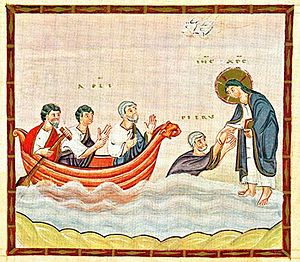
Matthew 14:22–33 narrates Jesus’ walking on water. Yet, unlike the parallel accounts in Mark 6:45–52; John 6:15–21, Matt 14:33 reports that the disciples’ conclusion, at the end of this episode, was ἀληθῶς θεοῦ υἱὸς εἶ (truly, you are the son of God). Apparently thinking along the lines similar to Heb 3:5–6, Archelaus, Disputation with Manes, 44 ( ANF 6:220; affiliate disclosure), relates this text to Jesus’ superiority to Moses. Perhaps more to the point here, however, is a chaos-versus-creation motif (Boring, “Matthew,” NIB 8, 327; affiliate disclosure) in which Jesus subjects the surrounding disorder (Graves, “Followed by the Sun,” RevExp 99, no. 1 [2002]: 92; Ladd, Theology of the New Testament, rev.ed., 163 [ affiliate disclosure]; Verseput, “The Faith of the Reader,” JSNT 46 [1992]: 14–16; cf. Augustine, Serm., 25.6 [ NPNF1 6:338; affiliate disclosure]; Jerome, Epist., 30 [ NPNF2 6:45; affiliate disclosure]). He does so, first, by walking on the sea himself and then all the more by causing Peter to do the same (Chrysostom, Hom. Matt., 50.2 [ NPNF1 10:311–12; affiliate disclosure]). In this framework, then, if Israel’s God is master of the seas (e.g., Job 9:8; Ps 89:9, 19–37; Hab 3:8, 15; cf. Gen 1:2 [LXX; LSJ, s.v. ἐπιφέρω, §§2–3PIFERW#lexicon)])—a kind of mastery not otherwise within the realm of human experience—Jesus’ walking on the sea is an eminently good reason for identifying Jesus as θεοῦ υἱός (son of God) and worshiping him as such (see Matt 14:33; Hilary of Poitiers, On the Trinity, 6.51 [ NPNF2 9:117; affiliate disclosure]; cf. Mark 6:51–52; John 6:21; Aristotle, Poetics, 5.6, 6.2 [ affiliate disclosure]).
...In an essay on “Jesus, John, and the Dead Sea Scrolls,” Craig Evans observes that
Jesus’s appointment of the twelve ( Mark 3:14; 6:7) is an extension of John [the Baptist]’s typology. The Jordan River has been crossed, and now representatives of the restored tribes have reentered the promised land, announcing the rule of God. If the nation repents, restoration will take place. It will be a time when the twelve apostles will sit on twelve thrones, judging the twelve tribes of Israel, judging not in a condemning sense but in an administrative, even shepherding sense ( Evans 60; emphasis added).
...